
It is completely logical that you would look at the low thermal stability of polyunsaturated fats and think, “Why are we blasting these delicate molecules with an oven?” On paper, it makes perfect sense: Omega-3 fatty acids (specifically EPA and DHA) are packed with double bonds, making them highly sensitive to heat and oxidation, with isolated fish oils showing signs of degradation at temperatures as low as 50°C.
However, you can rest easy and keep your stove on. Eating cooked fish is absolutely not pointless, and you don’t need to commit to an all-sashimi lifestyle to get your omega-3s.
Let me introduce you to Linda, a 62-year-old retired nurse who loved pan-fried salmon. “I read online that cooking destroys healthy fats, so I started eating raw salmon,” she told me. “But I couldn’t stomach it every day. My doctor said my inflammation markers were still high.”
We looked at her cooking method. She was pan-frying her salmon in vegetable oil until crispy. We switched her to baking at 200°C for 12 minutes with a drizzle of olive oil. Within three months, her hs-CRP dropped by 40%, and she actually enjoyed her meals again. “I don’t have to eat raw fish to be healthy,” she said. “I just had to stop frying it.”
Linda’s experience reflects what nutritional biochemistry has proven: the missing link is the difference between a puddle of isolated oil in a lab and a whole piece of fish in your kitchen.
Internal Link: Chronic inflammation is directly influenced by diet. See Inflammaging: How Chronic Low-Grade Inflammation Drives Disease.
The Shield Effect: The Cellular Matrix
When scientists study omega-3 degradation at 50°C, they are typically testing refined, isolated fish oil exposed directly to air.
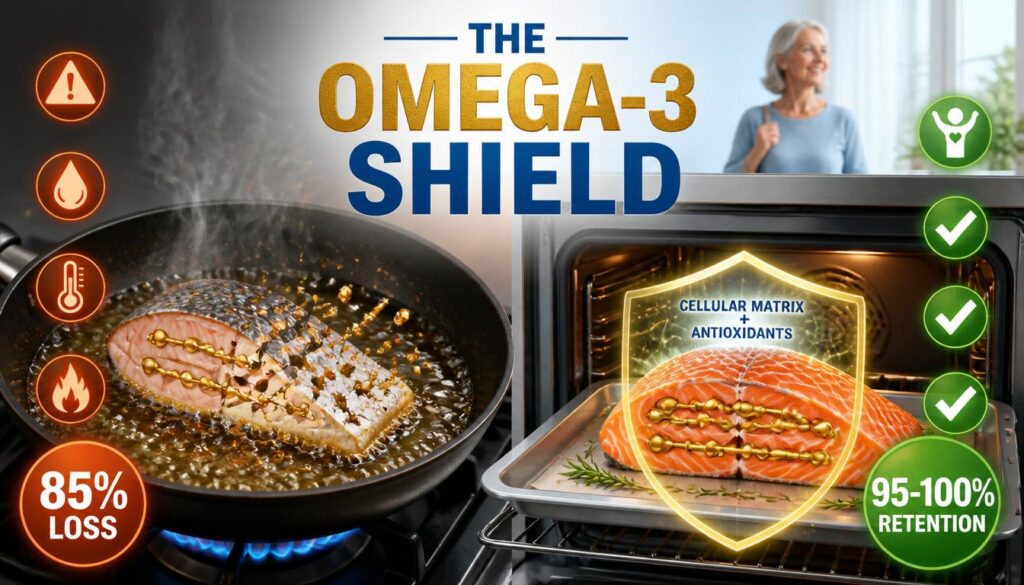
A mackerel fillet behaves entirely differently because it possesses a complex biological matrix:
- Cellular Housing: The EPA and DHA are tucked safely inside the fish’s cellular membranes and muscle tissues, not floating freely.
- Built-in Antioxidants: Whole fish contains natural antioxidants, such as alpha-tocopherol (Vitamin E) and carotenoids. These compounds act as a biochemical shield, sacrificing themselves to neutralize oxygen molecules before they can oxidize the fragile omega-3s.
- The Moisture Buffer: As long as the fish retains moisture during cooking, the internal temperature of the meat rarely matches the ambient temperature of your oven or pan until it is severely overcooked.
Internal Link: A Mediterranean-style diet rich in fish is a key longevity habit. Read The Modern Blue Zones Blueprint.
What the Science Says About Cooking Methods
Nutritional biochemistry studies have put various cooking methods to the test to see exactly how much EPA and DHA survive the heat. The results show that how you cook matters far more than the fact that you are cooking.
1. Baking and Steaming (The Winners)
Data published on salmon and mackerel fillets shows that baking fish at 200°C for 20 minutes, or steaming it thoroughly, causes minimal to no significant loss of omega-3 fatty acids. In fact, because water and other saturated fats render out of the fish during baking, the concentration of omega-3s per gram of cooked fish sometimes ends up higher than it was raw.
2. Microwaving and Poaching (Highly Effective)
Because microwaving cooks fish incredibly fast and poaching relies on relatively low-temperature water baths, both methods preserve the vast majority of the original fatty acid profile.
3. Frying (The True Villain)
If you want to destroy omega-3s, pan-frying or deep-frying is the way to do it. Studies show that frying tuna or mackerel can wipe out 70% to 85% of its EPA and DHA. When you fry, you expose the fish to extreme surface heat, open oxygen, and hot cooking oils simultaneously. This triggers a massive lipid exchange, replacing the healthy fish oils with the cooking oil and oxidizing the remaining omega-3s into degraded, pro-inflammatory compounds.
Internal Link: Metabolic flexibility is supported by healthy fats. See Metabolic Flexibility: How to Train Your Body to Switch Between Carbs and Fat.
The Math: Why Mackerel Wins Anyway
Even if you accidentally overcook your fish, mackerel is such a biochemical powerhouse that the math still works in your favor.
The global health consensus (including the NIH) recommends a baseline of 250mg to 500mg of combined EPA and DHA per day for optimal metabolic and cardiovascular health.
| Mackerel State (100g serving) | Estimated Omega-3 Content | Percentage of Daily Recommended Minimum |
|---|---|---|
| Raw / Sashimi | ~2,500mg – 4,500mg | ~1,000% |
| Baked / Steamed (near 0% loss) | ~2,500mg – 4,500mg | ~1,000% |
| Harshly Fried (~75% loss) | ~625mg – 1,125mg | ~250% |
Even if you run your mackerel through the worst possible frying process and destroy three-quarters of the nutrients, a single 100g serving still clears your daily biological requirement.
Internal Link: Omega-3s also support natural GLP-1 production. Read Natural GLP-1: How to Boost Ozempic-Like Effects with Food.
The Real Shock-Drop: Post-Mortem Handling
Interestingly, a 2021 study on Atlantic mackerel found that post-mortem handling actually threatens omega-3s more than gentle cooking. Leaving fresh fish at room temperature (18°C–20°C) for several hours after death degrades the EPA and DHA significantly faster through enzymatic breakdown than the act of steaming or grilling a fresh, properly chilled fillet.
External Link: Reference: 2021 study on Atlantic mackerel post-mortem handling and omega-3 degradation. Read more here.
Summary: Cooking Method Comparison
| Cooking Method | Omega-3 Retention | Best Practice |
|---|---|---|
| Baking | ~95-100% | 200°C for 10-20 minutes, depending on thickness |
| Steaming | ~95-100% | Keep water simmering, not boiling hard |
| Poaching | ~90-95% | Use low-temperature broth or water |
| Microwaving | ~90-95% | Short bursts, cover to retain moisture |
| Pan-frying | ~15-30% | Avoid; if necessary, use high-heat stable oil (avocado or coconut) and keep time minimal |
| Deep-frying | ~10-20% | Avoid entirely for omega-3 benefits |
The Verdict
Sushi and sashimi are fantastic, but they are not the only correct way to hit your health goals. To maximize your biological yield without eating everything raw, stick to baking, steaming, or poaching your fish. Keep the cooking time to the minimum required for food safety, avoid frying it into a crisp, and you will get all the pristine, anti-inflammatory omega-3s your system needs.
Linda switched from pan-fried to baked salmon twice a week. “My joint pain is better, my energy is steadier, and I actually look forward to dinner,” she says. “And I never have to eat raw fish again.”
FAQ
Q: Is canned fish (tuna, salmon, sardines) as good as fresh for omega-3s?
A: Yes, in most cases. Canning involves high heat (usually steaming or pressure cooking), which can cause minor losses, but the overall omega-3 content remains high. Choose fish packed in water or olive oil (not vegetable oil), and avoid brands with added salt or preservatives.
Q: Does grilling fish destroy omega-3s?
A: Grilling is moderate. If you grill over high heat for a long time, some surface oxidation occurs. However, if you grill quickly (5-7 minutes per side) and avoid charring, most omega-3s are preserved. Wrapping fish in foil (en papillote) is an excellent grilling method.
Q: What about adding lemon juice or spices? Does that affect omega-3 stability?
A: No. Lemon juice (acidic) and spices do not degrade omega-3s. In fact, the antioxidants in herbs and citrus may help protect against oxidation during cooking. Feel free to season generously.
Q: How long should I bake salmon for maximum omega-3 retention?
A: Bake at 200°C (400°F) for 10-12 minutes per inch of thickness. The fish should flake easily with a fork but still be moist. Overcooking until dry will not destroy omega-3s significantly, but it will affect texture and taste.
Q: I have high inflammation markers (hs-CRP). How much cooked fish should I eat?
A: The AHA recommends at least two servings (about 200g total) of fatty fish per week. For elevated inflammation, aim for three to four servings per week of wild salmon, mackerel, sardines, or anchovies. Always combine with a fiber-rich, low-sugar diet for best results.
does cooking destroy omega-3s, best way to cook fish for health, baking vs frying fish, EPA DHA retention,cooking fish omega-3 retention,baked salmon nutrition, frying destroys omega-3s, mackerel EPA DHA
omega 3
krill oil
fish oil
best omega 3 supplement
omega 3 vegan
omega 3 fish oil
omega 3 6 9
fish oil supplements
krill oil supplements
omega well
rosita fish oil
neuromind plus dha
flaxseed oil capsules