
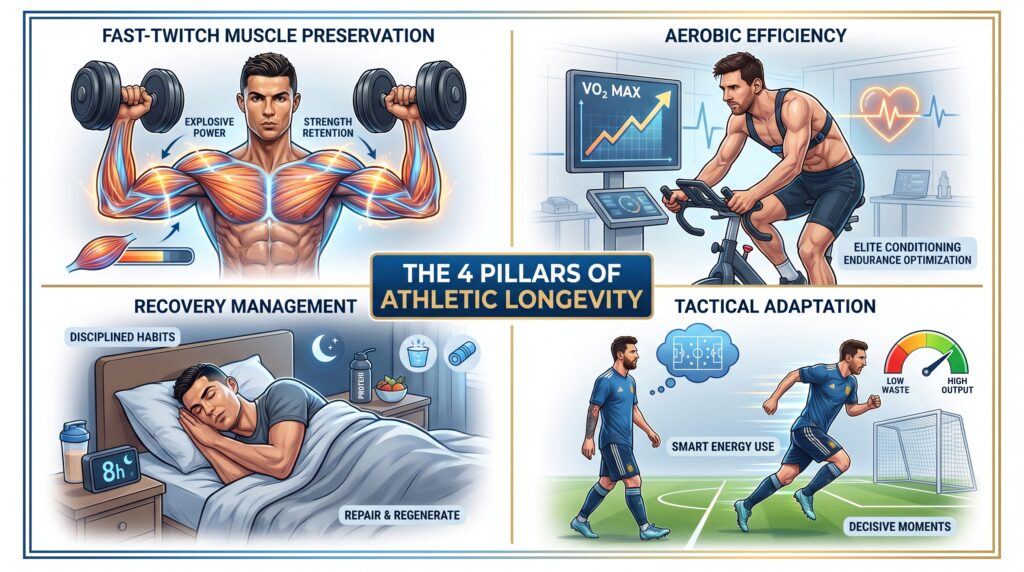
This is a fantastic breakdown of how elite athletes navigate biological aging. It perfectly illustrates the shift from relying purely on youthful genetics to utilizing advanced physiological management.
When mapping out frameworks around metabolic health or biological aging, using universally recognized figures like Lionel Messi and Cristiano Ronaldo makes the complex science of cellular decline highly accessible. Their approach proves that aging isn’t about stopping the clock—it is about actively managing the biological supply chain.
Let me introduce you to John, a 58‑year‑old former amateur soccer player. “I used to sprint up and down the field for 90 minutes,” he told me. “Now I get winded chasing my grandson.” John had lost significant fast‑twitch muscle, his VO₂ max had declined, and his knees ached after weekend pickup games.
We applied the same four principles that Messi and Ronaldo use—scaled down for a non‑athlete. John started lifting weights twice a week, added one HIIT session to his weekly walks, prioritized eight hours of sleep, and learned to “walk” during lower‑intensity moments (like resting between sets). Eight months later, he played a full 60‑minute pickup game without knee pain. “I’m not Messi,” he says, “but I feel twenty years younger.”
John’s story proves that the science of athletic longevity is not just for superstars. Here is a structured synthesis of the core principles, optimized for actionable takeaways.
External Link: A 2025 review in Sports Medicine outlines the key mechanisms of age‑related muscle decline. Read the summary here.
Elite athletes compress decline the same way everyone else can. See the six levers behind healthspan.
The 4 Pillars of the Superstar Longevity Protocol
1. Fast‑Twitch Muscle Preservation
The standard advice for aging adults is often limited to light aerobics. However, the body sheds fast‑twitch muscle fibers (responsible for explosive power and stability) first.
- The Tactic: Rigorous, heavy resistance training.
- The Biological Goal: Prevent sarcopenia (muscle loss) and maintain the neuromuscular pathways required for explosive, dynamic movement, rather than focusing purely on aesthetic muscle mass.
Internal Link: Losing muscle accelerates metabolic decline. Read Metabolic Flexibility: How to Train Your Body to Switch Between Carbs and Fat.
2. Aerobic Efficiency and Interval Training
A declining VO₂ max and maximum heart rate are inevitable after age 30.
- The Tactic: Combining steady‑state endurance with high‑intensity interval bursts.
- The Biological Goal: Forcing the cardiovascular system to remain adaptable, ensuring the heart and lungs can still efficiently deliver oxygen during peak exertion without causing overuse injuries.
Internal Link: VO₂ max is the #1 predictor of longevity. See VO₂ Max: Why Cardiorespiratory Fitness Is the Number One Predictor of Longevity.
3. Hyper‑Focused Recovery Management
The fundamental difference between a 20‑year‑old and a 40‑year‑old athlete is the refractory period. Aging tissues require significantly more time and raw materials to rebuild.
- The Tactic: Prioritizing sleep, protein synthesis, and strict rest intervals over simply accumulating more training volume.
- The Biological Goal: Avoiding chronic inflammation and ensuring the body remains in an anabolic (building) state rather than a catabolic (breaking down) state.
Internal Link: Chronic inflammation accelerates aging. Read Inflammaging: How Chronic Low‑Grade Inflammation Drives Disease.
4. Neurological and Tactical Adaptation
Perhaps the most fascinating insight is their energy economy.
- The Tactic: Strategic energy conservation on the pitch (e.g., Messi walking more, Ronaldo staying central).
- The Biological Goal: Optimizing the deployment of their remaining explosive reserves. They no longer waste cellular energy on low‑yield movements, saving their biological fuel for high‑impact sprints.
Internal Link: Autophagy helps clear damaged cells after exertion. See Autophagy Activation: How Fasting Triggers Cellular Cleanup.
Elite Protocols for Everyday Application
To translate these superstar habits into actionable strategies for a general audience, the focus shifts from winning World Cups to preserving physical independence.
| The Elite Athlete Strategy | The Everyday Longevity Translation |
|---|---|
| Training rigorously to maintain sprint speed | Lifting weights 2–3 times a week to prevent fatal falls and maintain bone density |
| Utilizing high‑tech interval training on the pitch | Mixing steady‑state cardio with a weekly HIIT session to preserve cardiovascular health |
| Employing a 24/7 medical team for muscle repair | Prioritizing 8 hours of sleep and adequate protein intake to rebuild tissue after exertion |
| Walking during a match to save energy for scoring | Modifying daily physical stress and listening to the body to prevent chronic joint wear‑and‑tear |
Internal Link: HIIT and Zone 2 training are complementary. Read Zone 2 Cardio vs. HIIT for Longevity.
The Takeaway: You Don’t Have to Be a Superstar
Messi and Ronaldo did not cheat biology. They studied it, respected it, and built systems around it. Their success proves that aging is not a passive decline—it is an active process that can be managed with the right inputs.
For the rest of us, the principles are the same, only the intensity differs. Preserve your fast‑twitch muscles, maintain your cardiovascular ceiling, prioritize recovery, and use your energy wisely. You may never win a World Cup, but you can win your marginal decade—the last ten years of your life—by staying independent, mobile, and vibrant.
John now lifts weights twice a week, does one HIIT session on a stationary bike, and has traded his weekend beer for a protein shake after games. “I’m not trying to be Ronaldo,” he says. “I’m trying to be able to play with my grandkids when I’m 80.”
FAQ: Athletic Longevity for Everyone
Q: Can a non‑athlete really train like Messi or Ronaldo?
A: Not at their intensity, but the principles apply to everyone. You can lift weights (fast‑twitch preservation), do interval training (VO₂ max), prioritize sleep (recovery), and avoid unnecessary energy waste (tactical adaptation). Scale the volume and intensity to your fitness level.
Q: How does fast‑twitch muscle loss affect falls in older adults?
A: Fast‑twitch fibers are responsible for explosive movements—catching yourself from a trip, stepping off a curb, or reacting quickly. When these fibers waste away, your reaction time slows, and a simple stumble can become a catastrophic fall. Resistance training directly prevents this.
Q: What is the ideal weekly exercise mix for longevity?
A: The evidence points to a polarized model: 80% low‑intensity (Zone 2 cardio, walking, light jogging) and 20% high‑intensity (HIIT, heavy resistance training). For most people: 3–4 Zone 2 sessions, 1–2 resistance sessions, and 1 HIIT session per week.
Q: How much sleep do I really need for muscle repair after exercise?
A: Most adults need 7–9 hours of quality sleep. During deep sleep, growth hormone is released, which directly stimulates muscle repair and protein synthesis. Chronic sleep deprivation (less than 6 hours) elevates cortisol and blocks the anabolic response to training.
Q: Can I start resistance training after age 60?
A: Absolutely. Multiple studies show that previously sedentary adults in their 60s, 70s, and even 80s can significantly increase muscle mass and strength with consistent resistance training. Start with bodyweight exercises or light bands, then progress slowly. Consult a doctor before beginning any new exercise program.
Q: What is “tactical adaptation” for someone who doesn’t play sports?
A: It means pacing yourself throughout the day. Instead of standing for hours, sit when you can. Instead of rushing through chores, take intentional breaks. Save your explosive energy (e.g., lifting something heavy, climbing stairs quickly) for when it is truly needed. This reduces cumulative joint stress and preserves your cellular energy for what matters.
science of athletic longevity
athletic longevity
Messi Ronaldo aging, fast‑twitch muscle preservation
VO₂ max training
recovery management
tactical energy conservation
Cristiano Ronaldo training routine
Lionel Messi workout
World Cup 2026
Football sports medicine
Athlete recovery techniques
How do athletes stay fit as they age
Biohacking for men over 40
Delaying biological aging
Fast-twitch muscle preservation
VO2 max training protocol
Longevity and metabolic health
Sarcopenia prevention
Advanced cellular recovery

Julian Vance is the writer and editor behind RegenStep, translating peer-reviewed longevity, metabolic, and gut-health research into practical, actionable guides. Julian is not a licensed physician; content is reviewed against cited primary sources and is for informational purposes only. Always consult a qualified healthcare provider for personal medical advice.