
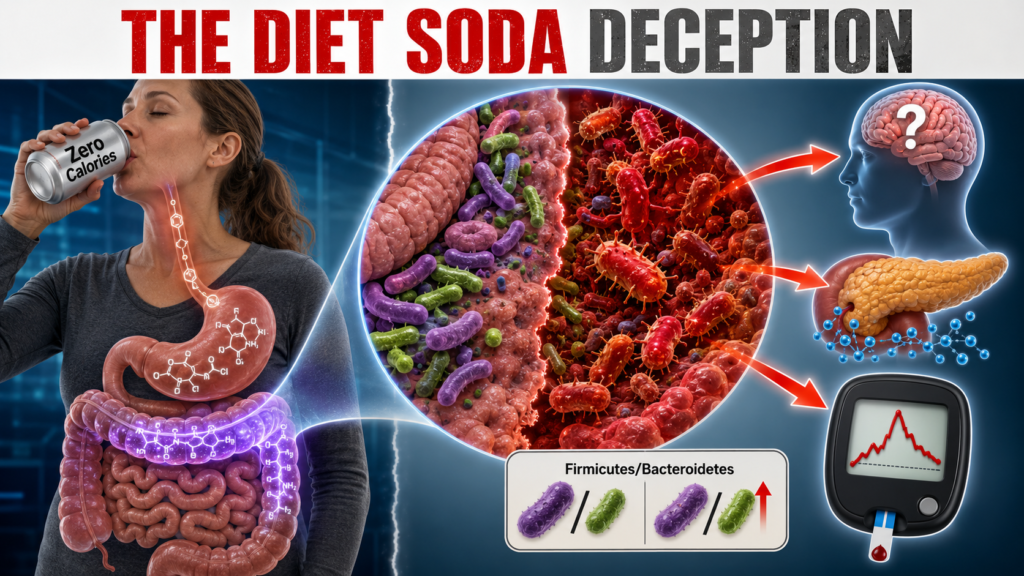
For decades, the food industry sold us the ultimate biological free lunch: zero-calorie artificial sweeteners. The premise was incredibly seductive. We could satisfy our evolutionary craving for intense sweetness without consuming the calories or triggering the massive insulin spikes associated with refined sugar.
It felt like we had successfully hacked human metabolism. But as we dive deeper into cellular biology, the reality is proving to be far more complicated—and far more concerning.
Let me introduce you to Mark, a 45-year-old accountant who drank three to four diet sodas every single day. “I switched from regular to diet twenty years ago to lose weight,” he told me. “But I never lost the weight. And for the last five years, my blood sugar has been creeping up, even though I don’t eat much sugar.”
Mark was doing what he thought was healthy. He had no idea that his “zero-calorie” habit was silently destroying his gut microbiome. When we ran his labs, his fasting glucose was elevated, his hs-CRP was high, and a stool test revealed severely depleted beneficial bacteria. We asked him to cut out all artificial sweeteners for six weeks and replace his diet soda with sparkling water with a splash of real fruit. Within a month, his sugar cravings vanished, his energy stabilized, and his blood sugar markers improved significantly. “I was paying for ‘diet’ drinks with my metabolic health,” he realized.
Mark’s story is not rare. We forgot to account for the trillions of microbes living in our digestive tract. While your human cells cannot digest or extract calories from chemicals like sucralose, saccharin, or aspartame, your gut bacteria absolutely interact with them. And the resulting biological fallout is linking these “diet” chemicals directly to the exact metabolic dysfunctions they were designed to prevent.
Here is the science behind how artificial sweeteners disrupt your internal ecosystem, and why a zero-calorie label does not mean a zero-biological impact.
External Link: A landmark study from the Weizmann Institute demonstrated that artificial sweeteners induce glucose intolerance by altering the gut microbiome. Read the summary here .
Sweeteners shift composition and diversity, the core metric in the gut-brain-skin axis.
The Illusion of the Free Pass
When you drink a regular, sugar-sweetened soda, the glucose and fructose are rapidly absorbed in your small intestine. By the time the liquid reaches your large intestine—the primary home of your microbiome—most of the sugar has already entered your bloodstream.
Artificial sweeteners operate entirely differently. Because your human enzymes lack the ability to break down the complex chemical bonds of synthetic sweeteners like sucralose (Splenda) or saccharin (Sweet’N Low), they pass through your stomach and small intestine completely undigested.
They eventually arrive directly at the colon, where they essentially carpet-bomb your microbiome.
Chemical Dysbiosis: Starving the Good, Feeding the Bad
Your microbiome is a delicate, highly competitive ecosystem. The introduction of synthetic sweeteners acts as an environmental stressor that fundamentally alters which bacteria survive and which die off.
- Bacterial Die-Off: Studies show that regular consumption of sucralose can drastically reduce the total volume of beneficial anaerobic bacteria in the gut. These are the exact microbes responsible for producing butyrate—the critical short-chain fatty acid that heals the gut barrier and cools systemic inflammation.
- Pathogenic Overgrowth: While beneficial bacteria are starved or killed off, certain opportunistic, pro-inflammatory bacteria adapt and thrive in the presence of these chemicals.
- The Firmicutes Shift: Artificial sweeteners have been shown to shift the ratio of bacterial phyla in the gut, often increasing the population of Firmicutes while decreasing Bacteroidetes. This specific imbalance is a recognized biological marker highly correlated with human obesity and metabolic syndrome.
Internal Link: A healthy gut barrier is essential for preventing leaky gut. Read Leaky Gut Syndrome 2026: Science-Backed Realities.
The Metabolic Paradox: Inducing Glucose Intolerance
The most alarming discovery regarding artificial sweeteners is their impact on blood sugar. The entire point of consuming a diet soda is to avoid the blood sugar chaos of regular sugar. Yet, clinical trials have revealed a massive paradox.
When researchers fed saccharin and sucralose to healthy human subjects who did not normally consume them, a significant percentage of the subjects developed glucose intolerance within just one week.
Biological Fact: The sweeteners themselves did not spike the subjects’ blood sugar. Instead, the chemicals altered the subjects’ microbiomes so severely that when the subjects did eat real carbohydrates, their bodies could no longer process the glucose efficiently, leading to prolonged, damaging blood sugar spikes.
When researchers took the altered gut bacteria from these subjects and transplanted them into sterile mice, the mice instantly developed the exact same glucose intolerance. The metabolic damage was completely driven by the shifted microbial ecosystem.
Internal Link: Glucose intolerance is a form of metabolic inflexibility. See Metabolic Flexibility: How to Train Your Body to Switch Between Carbs and Fat.
The Cephalic Phase Response: Confusing the Brain
Beyond the gut, artificial sweeteners create a massive signaling mismatch between your brain and your pancreas, known as the cephalic phase insulin response.
When your tongue registers an intensely sweet taste, your brain instantly sends a signal to your pancreas to release a small amount of insulin in preparation for the incoming sugar payload. But when you drink a zero-calorie diet soda, the sugar never arrives.
This creates a state of neuro-metabolic confusion. Your body has released insulin (the fat-storage hormone), which sweeps your existing blood sugar out of circulation. Because no new fuel arrived to replace it, your blood sugar drops, triggering intense, insatiable cravings for real, high-calorie carbohydrates later in the day.
Internal Link: Understanding natural GLP-1 can help manage cravings. Read Natural GLP-1: How to Boost Ozempic-Like Effects with Food .
A Smarter Approach to Sweetness (What Worked for Mark)
If you are committed to optimizing your metabolic health and preserving your gut barrier, synthetic sweeteners should be treated with the same caution as ultra-processed sugars. However, you do not have to give up sweetness entirely.
1. Reset Your Palate
Artificial sweeteners are often hundreds to thousands of times sweeter than table sugar. They hyper-stimulate your taste buds, making natural whole foods like berries or apples taste bland. By removing synthetic sweeteners for 14 to 21 days, your taste receptors will naturally recalibrate, allowing you to appreciate the subtle sweetness of real food again.
2. Transition to Natural Non-Nutritive Sweeteners
If you need a bridge to help cut out sugar or diet chemicals, look for plant-derived alternatives that have a more neutral impact on the microbiome:
- Stevia: A plant extract that does not ferment in the gut and has a long history of safe human use.
- Monk Fruit (Luo Han Guo): Gets its sweetness from antioxidant compounds called mogrosides, rather than sugars.
3. Leverage Allulose
Allulose is a “rare sugar” found naturally in trace amounts in figs and raisins. It tastes exactly like sugar but is absorbed by the small intestine and excreted in the urine without being metabolized for energy. Crucially, because it is absorbed early in digestion, it does not reach the large intestine in high amounts, thereby leaving the microbiome largely undisturbed.
Internal Link: Postbiotics are the beneficial products of a healthy microbiome. See Beyond Probiotics: Why Postbiotics Are the New Frontier.
Sweetener Quick Reference Guide
| Category | Examples | Impact on Microbiome | Metabolic Effect |
|---|---|---|---|
| Synthetic Artificial | Sucralose, Saccharin, Aspartame | High Disruption (kills beneficial bacteria) | Can drive glucose intolerance and insulin confusion |
| Sugar Alcohols | Erythritol, Xylitol | Moderate (can cause severe bloating/gas in some) | Generally low impact, but Xylitol can alter gut motility |
| Natural Non-Nutritive | Stevia, Monk Fruit | Low Disruption | Safe bridge for insulin management |
| Rare Sugars | Allulose | Minimal (absorbed before reaching the colon) | Does not spike insulin; acts similarly to a prebiotic |
True cellular health requires us to respect the complex, millions-of-years-old relationship between our bodies, our microbes, and the food we eat. Trying to outsmart this system with engineered chemicals often creates more profound metabolic damage than the sugar we were trying to avoid in the first place.
Mark switched to sparkling water with a splash of lemon and occasional stevia. Six months later, he had lost 12 pounds, his blood sugar was normal, and he no longer craved the diet sodas. “I thought I was being healthy,” he said. “Now I know what healthy actually feels like.”
FAQ
Q: Are natural sweeteners like stevia and monk fruit completely safe for the gut?
A: Research suggests they have a much lower impact on the microbiome than synthetic sweeteners. Stevia does not ferment in the gut and is generally well-tolerated. However, some people may experience mild bloating or gas from certain stevia products (especially those mixed with sugar alcohols). As with any dietary change, start with small amounts and monitor your body’s response.
Q: Does aspartame cause the same gut damage as sucralose?
A: Aspartame breaks down into its component amino acids (aspartic acid and phenylalanine) in the small intestine, so less of it reaches the colon. However, studies show that aspartame can still alter the microbiome composition and has been linked to glucose intolerance in animal models. It may be less disruptive than sucralose or saccharin, but it is not risk-free.
Q: Can I reverse the gut damage from years of artificial sweetener use?
A: Yes. The gut microbiome is highly adaptable. By eliminating artificial sweeteners and increasing your intake of prebiotic fiber (asparagus, garlic, onions, legumes) and fermented foods (kefir, kimchi, sauerkraut), you can rebuild microbial diversity. Most people see significant improvement within 4-8 weeks.
Q: Is erythritol safe? I see it in many “keto” products.
A: Erythritol is a sugar alcohol that is partially absorbed and excreted in urine. It does not spike blood sugar and is generally recognized as safe. However, recent studies have linked high blood levels of erythritol to increased cardiovascular risk (blood clotting). More research is needed. If you consume erythritol, do so in moderation and be aware that it can cause digestive distress in sensitive individuals.
Q: What about “natural” artificial sweeteners like agave nectar or coconut sugar?
A: Agave nectar and coconut sugar are not artificial; they are real sugars. Agave is very high in fructose, which can be hard on the liver. Coconut sugar has a slightly lower glycemic index than table sugar but still contains calories and will spike insulin. They are not zero-calorie alternatives and should be used sparingly, just like regular sugar.
- artificial sweeteners gut microbiome
- sucralose metabolic damage
- diet soda glucose intolerance
- saccharin dysbiosis
- cephalic phase insulin response
- stevia vs aspartame
- allulose rare sugar
- non-caloric sweeteners health risks
- how artificial sweeteners cause sugar cravings
- do zero-calorie sweeteners spike insulin
- best natural sweeteners for gut health
- can stevia cause bloating

Julian Vance is the writer and editor behind RegenStep, translating peer-reviewed longevity, metabolic, and gut-health research into practical, actionable guides. Julian is not a licensed physician; content is reviewed against cited primary sources and is for informational purposes only. Always consult a qualified healthcare provider for personal medical advice.