
For decades, the standard medical advice regarding diet and cancer prevention revolved almost entirely around what to eat: consuming more antioxidants, eating leafy greens, and avoiding processed meats. While these nutritional inputs are critical, they only represent half of the biological equation.
The frontier of longevity science has shifted its focus from what we put into our bodies to what happens when we stop eating altogether.
Let me introduce you to Susan, a 62-year-old former smoker with a strong family history of breast cancer. “I spent years obsessing over superfoods and antioxidant supplements,” she told me. “But I never thought about when I ate—or didn’t eat.”
After learning about autophagy, Susan adopted a 16:8 intermittent fasting schedule (eating between 10 AM and 6 PM) with one 36-hour fast per month. Within six months, her inflammatory markers (hs-CRP) dropped by 40%, her energy stabilized, and her doctor noted improved biomarkers associated with cellular health. “I feel like I’m not just feeding my body—I’m giving it time to clean house,” she says.
Susan’s story illustrates a profound biological truth: By strategically withholding nutrients, we can force our cells out of a constant state of growth and division and plunge them into a state of deep, aggressive repair. This cellular recycling process is called autophagy, and it is emerging as one of the most powerful, natural mechanisms the human body possesses to suppress tumor development and prevent the cellular mutations that lead to cancer.
Here is the exact cellular science of how fasting activates autophagy, and how you can leverage it as a preventative shield.
External Link: The 2016 Nobel Prize in Physiology or Medicine was awarded to Dr. Yoshinori Ohsumi for his discoveries of the mechanisms of autophagy. Read more here.
Cellular cleanup is one of the levers that keeps immune cells young. See the full guide to reversing immune aging.
The Biology of Autophagy: The Cellular Garbage Disposal
To understand autophagy (which literally translates from Greek to “self-eating”), you must visualize the interior of your cells.
Your cells are not static; they are highly active manufacturing plants continuously building proteins and organelles. Over time, this machinery gets damaged. Proteins misfold, mitochondria become dysfunctional, and metabolic waste accumulates. If a cell fills up with enough of this toxic debris, its DNA becomes unstable, creating the perfect biological environment for cancerous mutations.
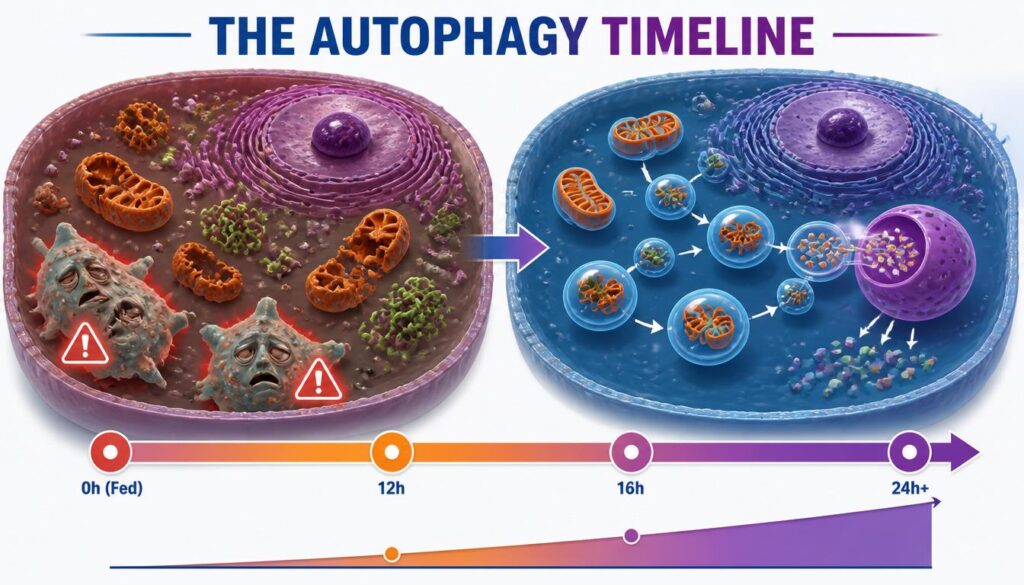
Autophagy is the body’s built-in waste management and recycling system. When activated, specialized cellular structures called autophagosomes act like microscopic garbage trucks. They roam the interior of the cell, enveloping damaged proteins, old mitochondria, and even intracellular viruses. They then deliver this debris to the lysosome—an acidic organelle that breaks the waste down into raw amino acids, which the cell reuses to build fresh, healthy structures.
Internal Link: Clearing cellular debris is also the goal of senolytics. Read Senolytics: How to Flush Zombie Cells Out of Your Body (internal link).
The Cancer Connection: Clearing the Pre-Cancerous Debris
The link between autophagy and cancer prevention lies in the concept of genomic stability. Cancer is, fundamentally, a disease of damaged DNA that leads to uncontrolled cellular replication.
When your metabolism is optimized and autophagy is running smoothly, your body aggressively hunts down and dismantles cellular threats before they can metastasize.
Eliminating Senescent Cells
As we age, some cells become severely damaged but refuse to die off (apoptosis). These “zombie” or senescent cells secrete highly inflammatory chemicals that damage the DNA of surrounding tissue, promoting tumor growth. Autophagy targets and clears out these rogue cells.
Suppressing Oxidative Stress
Damaged mitochondria leak reactive oxygen species (free radicals) , which act like microscopic shrapnel, shredding cellular DNA and causing the exact mutations that trigger cancer. By destroying and recycling these faulty mitochondria (a specific form of autophagy called mitophagy), you cut off the source of the oxidative stress.
Biological Fact: Research has shown that mice with impaired autophagy have a dramatically higher rate of spontaneous tumors, and restoring autophagy reduces tumor incidence.
Internal Link: Chronic inflammation from senescent cells drives disease. See Inflammaging: How Chronic Low-Grade Inflammation Drives Disease.
The Trigger: AMPK vs. mTOR
Your body operates on a biological seesaw governed by two primary nutrient-sensing pathways: mTOR (mammalian target of rapamycin) and AMPK (AMP-activated protein kinase).
| Pathway | Role | Activated By | Effect on Autophagy |
|---|---|---|---|
| mTOR | Growth & division (anabolic) | Protein, carbohydrates, calories | Blocks autophagy |
| AMPK | Repair & recycling (catabolic) | Fasting, low energy (ATP), exercise | Triggers autophagy |
- The Growth Switch (mTOR): When you eat—especially protein and carbohydrates—mTOR is activated. It signals your cells to build, grow, and divide. While necessary for building muscle, chronic mTOR activation (from eating 6 times a day) completely shuts down cellular cleanup. You cannot clean the factory while the assembly line is running at full speed.
- The Repair Switch (AMPK): When you fast and your cellular energy (ATP) drops, AMPK is activated. AMPK is the biological master switch that turns off mTOR and turns on autophagy.
To achieve meaningful cancer-preventative cellular cleanup, you must intentionally shut down the mTOR pathway through strategic periods of fasting.
Internal Link: Metabolic flexibility is essential for switching between fuel sources. See Metabolic Flexibility: How to Train Your Body to Switch Between Carbs and Fat.
The Protocol: Activating Autophagy Through Fasting
Autophagy is not an on/off switch; it is a dial that turns up the longer you abstain from caloric intake. If you want to leverage fasting for cellular repair, here is the biological timeline:
| Fasting Duration | Biological State | Autophagy Level |
|---|---|---|
| 12–14 hours | Glycogen stores deplete; blood sugar stabilizes | Trace – body just beginning to shift away from digestion |
| 16–18 hours | AMPK pathway activates; mTOR is suppressed | Moderate – initial stages of cellular cleanup begin |
| 24–36 hours | Deep ketosis; liver glycogen fully depleted | High – autophagosomes actively hunt and dismantle damaged components |
| 48–72+ hours | Complete metabolic shift | Peak – maximum cellular recycling; immune system reset and stem cell regeneration |
Note: Extended fasts (48+ hours) should be approached with caution and ideally under medical supervision, as they represent a significant biological stressor. Susan started with 16:8 intermittent fasting and only added a monthly 36-hour fast after consulting her doctor.
Practical Protocol for Cellular Cleanup
Based on current research and clinical experience, here is a sustainable approach to leveraging autophagy for cancer prevention:
1. Daily Time-Restricted Feeding (16:8 or 18:6)
- Eat all meals within an 8-hour window (e.g., 10 AM to 6 PM)
- Fast for 16 hours overnight, including sleep
- This provides a daily moderate autophagy trigger
2. Weekly 24-Hour Fast (Optional)
- Once per week, eat dinner, then fast until dinner the next day
- Drink water, black coffee, or unsweetened tea
- This provides a deeper weekly cleanup
3. Monthly 36–48 Hour Fast (Advanced)
- For those with metabolic flexibility and medical clearance
- Begin after dinner, fast for one full day, break fast the following morning
- This provides a profound cellular reset
4. Support Autophagy with Exercise
- Fasted Zone 2 cardio (brisk walking, jogging) further activates AMPK
- Resistance training in a fasted state may enhance mitophagy
Internal Link: Exercise enhances mitochondrial health. Read Metabolic Health Is Your Ultimate Shield Against Infections.
Important Caveats
- Not for everyone: Pregnant women, underweight individuals, those with eating disorders, diabetics on medication, and those with certain medical conditions should not fast without medical supervision.
- Quality refeeding matters: What you eat when breaking a fast is crucial. Prioritize whole foods, adequate protein, and healthy fats. Breaking a fast with processed sugar or refined carbs blunts the autophagy benefits.
- Listen to your body: Fatigue, dizziness, or severe hunger are signals to stop. Autophagy is a tool, not a punishment.
Internal Link: Natural GLP-1 production can support appetite control during fasting. See Natural GLP-1: How to Boost Ozempic-Like Effects with Food.
FAQ: Autophagy and Fasting for Cancer Prevention
Q: Can intermittent fasting alone prevent cancer?
A: No single intervention can guarantee cancer prevention. However, research consistently shows that regular fasting reduces several cancer risk factors: chronic inflammation, insulin resistance, oxidative stress, and senescent cell accumulation. Fasting is best used as part of a comprehensive lifestyle approach including a whole-food diet, exercise, and regular medical screenings.
Q: How long do I need to fast to get meaningful autophagy?
A: Meaningful autophagy begins around 16–18 hours of fasting. Peak autophagy occurs at 24–48 hours. However, even daily 16-hour fasts provide significant cellular cleanup benefits over time, especially when combined with exercise.
Q: Does coffee break autophagy?
A: Black coffee (no sugar, no cream, no artificial sweeteners) does not break autophagy and may even enhance it. Coffee contains polyphenols that activate AMPK. However, adding any calories (milk, cream, sugar, flavored syrups) will trigger mTOR and stop autophagy.
Q: Can I take supplements while fasting?
A: Most supplements (vitamins, minerals) contain small amounts of calories or binders that may technically break a fast. If you are fasting strictly for autophagy, water, black coffee, and unsweetened tea are safest. Electrolytes (sodium, potassium, magnesium) are generally fine and recommended for longer fasts.
Q: Is autophagy only triggered by fasting?
A: No. Exercise (especially fasted cardio and high-intensity interval training), caloric restriction, ketogenic diets, and certain compounds (resveratrol, spermidine, berberine) can also activate autophagy. However, complete fasting remains the most potent natural trigger.
Q: Will autophagy cause my body to break down muscle?
A: Short-term fasting (up to 24 hours) does not cause significant muscle loss. Autophagy preferentially targets damaged proteins and old organelles, not healthy muscle tissue. In fact, fasting increases growth hormone, which helps preserve lean mass. Extended fasts beyond 72 hours may begin to break down muscle, which is why longer fasts should be medically supervised.
autophagy fasting cancer prevention
senescent cells
cellular recycling
time-restricted feeding
autophagy activation
fasting for cancer prevention
cellular cleanup
AMPK mTOR
mitophagy
intermittent fasting cancer risk

Julian Vance is the writer and editor behind RegenStep, translating peer-reviewed longevity, metabolic, and gut-health research into practical, actionable guides. Julian is not a licensed physician; content is reviewed against cited primary sources and is for informational purposes only. Always consult a qualified healthcare provider for personal medical advice.