
For decades, the health and wellness industry obsessed over what we do: what to eat, what supplements to take, and what exercises to perform. But recent search trends reveal a massive shift in public awareness toward a completely different variable: when.
Searches for the “Circadian Code” are surging, driven by breakthrough geroscience and the realization that our bodies operate on a strict, 24‑hour biological clock.
Your metabolism, hormone production, and cellular repair mechanisms are not active all the time. They are turned on and off by a genetic timer. When you align your lifestyle with this timer, your health thrives. When you ignore it, your biology breaks down.
Let me introduce you to Dr. Sarah, a 55‑year‑old emergency room physician who worked rotating night shifts for twenty years. “I thought I could handle it,” she told me. “I slept when I could, ate when I was hungry, and powered through with coffee.”
But her body had other plans. She developed stubborn weight gain, prediabetes, and chronic insomnia. Her circadian code was completely broken. We shifted her focus to time‑restricted eating (compressing her meals into a 10‑hour window), morning light exposure (even on days off), and consistent sleep‑wake times. Within four months, her blood sugar normalized, she lost 12 pounds, and her sleep quality improved dramatically. “I was treating patients for years without understanding my own biology,” she says. “Timing was the missing variable.”
Here is the exact science of how the circadian code works, the symptoms of circadian disruption, and how to reset your master clock.
External Link: Dr. Satchin Panda’s landmark research on the circadian code. Read more here.
Timing is a lever in its own right. Read the complete evidence-based longevity guide.
How Does the Circadian Code Work?
To understand the circadian code, you have to look at the hierarchy of cellular clocks inside your body.
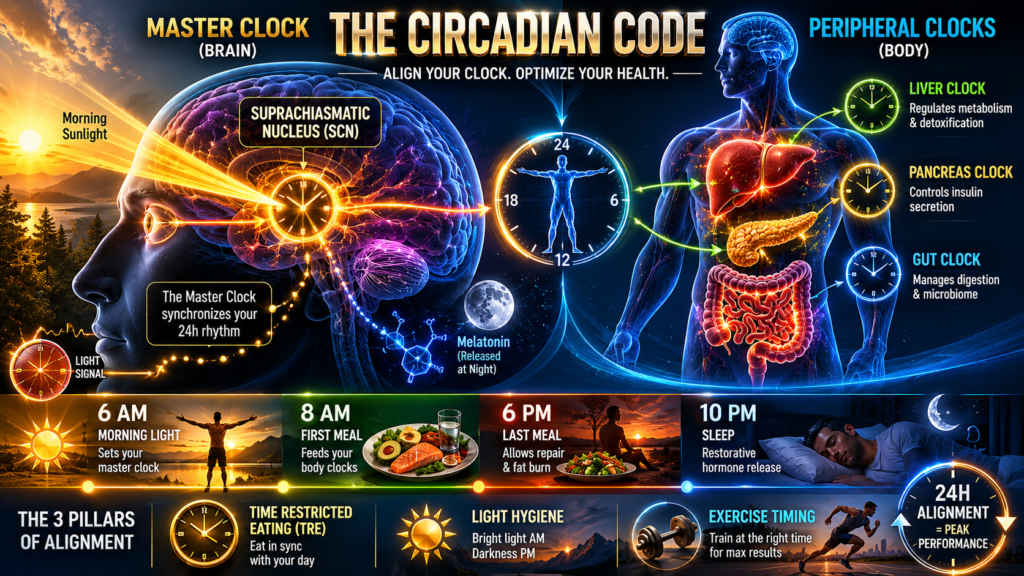
Almost every cell, organ, and tissue in your body has its own biological clock. Your liver has a clock that tells it when to process fat. Your pancreas has a clock that dictates when to release insulin. Your gut microbiome has a clock that governs digestion.
However, these peripheral organs cannot see the sun. They rely on a “Master Clock” to keep them synchronized.
The Master Clock: The SCN
Deep inside your brain, sitting just above where your optic nerves cross, is a cluster of about 20,000 neurons called the Suprachiasmatic Nucleus (SCN) . This is your master biological clock.
The SCN relies on two primary external cues (zeitgebers) to set the time for the rest of your body:
- Light (The Morning Anchor): When morning sunlight hits the melanopsin receptors in your eyes, it sends a direct electrical signal to the SCN. The SCN halts the production of melatonin (the sleep hormone) and releases a spike of cortisol, waking up your brain and central nervous system.
- Food (The Peripheral Anchor): While light sets the brain’s clock, your first bite of food sets the clocks for your liver, gut, and muscles. If you eat late at night, you send conflicting signals: your brain thinks it is time to sleep because it’s dark, but your liver thinks it is daytime because it is processing food. This creates internal metabolic chaos.
Internal Link: Metabolic chaos from circadian disruption drives inflammation. Read Inflammaging: How Chronic Low‑Grade Inflammation Drives Disease.
What Is the Circadian Code Summary?
The “Circadian Code” was popularized by Dr. Satchin Panda, a leading researcher at the Salk Institute. The summary of his clinical research is profoundly simple: Timing is just as important as the intervention itself.
The core protocol relies on three pillars:
1. Time‑Restricted Eating (TRE)
Consuming all your calories within a strict 8‑ to 12‑hour window during daylight hours. Digestion requires massive cellular energy. By fasting for at least 12 hours overnight, you allow your organs to stop digesting and shift into cellular repair and autophagy.
2. Light Hygiene
Viewing natural sunlight outside within 30‑60 minutes of waking to anchor the SCN, and strictly blocking artificial blue light from screens 2 hours before bed to allow natural melatonin production.
3. Exercise Timing
Performing high‑intensity or strength training in the late afternoon or early evening when core body temperature is highest, maximizing performance and minimizing injury risk.
Internal Link: Fasting overnight supports autophagy. Read Autophagy Activation: How Fasting Triggers Cellular Cleanup (internal link).
What Are the Symptoms of a Disrupted Circadian Code?
When your lifestyle conflicts with your genetic clocks—a phenomenon known as “social jetlag” —your body cannot effectively perform basic metabolic or neurological maintenance. The symptoms of a disrupted circadian code include:
| Symptom | Biological Mechanism |
|---|---|
| Metabolic Syndrome & Weight Gain | Late‑night eating occurs when your pancreas has naturally lowered insulin production, causing massive blood sugar spikes that get stored as visceral fat. |
| Sleep Maintenance Insomnia | Waking up between 2:00 AM and 4:00 AM, often caused by a delayed cortisol spike or late‑night digestion raising core body temperature. |
| Morning Brain Fog & Lethargy | Waking up groggy despite getting 8 hours of sleep, driven by delayed melatonin clearance due to late‑night blue light exposure. |
| Gastrointestinal Distress | Acid reflux, bloating, and irregular bowel movements caused by forcing the gut to digest food during its biological “rest” phase. |
Internal Link: Gut health is directly affected by circadian disruption. Read The Gut Reset Protocol.
The Chronotypes: What Is the Rarest Chronotype?
While all humans operate on a circadian rhythm, our specific genetic timing variations are known as chronotypes. Sleep specialist Dr. Michael Breus categorized these into four animal archetypes:
| Chronotype | Population | Characteristics |
|---|---|---|
| Lions | 15‑20% | Early risers; most productive in the morning |
| Bears | 50‑55% | Follow the sun; wake at dawn, sleep at dusk |
| Wolves | 15‑20% | Night owls; highly creative and productive late in the evening |
| Dolphins | ~10% (Rarest) | Highly sensitive, anxious, irregular sleep‑wake cycle; prone to insomnia and light sleeping |
The Rarest Chronotype: The Dolphin
Making up only about 10% of the population, the Dolphin is the rarest chronotype. Dolphins are characterized by a highly sensitive, anxious, and irregular sleep‑wake cycle. Because real dolphins sleep with half of their brain awake to watch for predators, the “Dolphin” human chronotype is prone to insomnia, light sleeping, and waking up frequently. They typically possess a high level of intelligence and neuroticism but struggle to adhere to a rigid, standard 9‑to‑5 biological schedule.
The Circadian Optimization Matrix
| Pillar | Biological Target | Optimal Timing | Protocol |
|---|---|---|---|
| Light Exposure | SCN master clock activation | Within 30‑60 min of waking | 10‑15 min outdoor sunlight (no sunglasses) |
| Time‑Restricted Eating | Peripheral clocks (liver, gut, muscles) | 8‑12 hour eating window | Finish last meal 3‑4 hours before bed |
| Exercise | Core body temperature peak | Late afternoon / early evening | HIIT or strength training when body is warmest |
| Blue Light Blocking | Melatonin production | 2 hours before bed | Dim lights, blue‑blocking glasses, screen curfew |
The Bottom Line: Timing Is Biology
Dr. Sarah now follows a strict circadian protocol: a 10‑hour eating window, morning sunlight, and a 9:30 PM screen curfew. “I used to think I just needed more sleep,” she says. “Now I know it’s about when I sleep, when I eat, and when I see light.”
The circadian code is not a trend—it is biology. By aligning your eating, sleeping, and activity with your internal clocks, you unlock the body’s natural repair and regeneration cycles, improving metabolic health, cognitive function, and longevity.
FAQ: The Circadian Code
Q: What is the circadian code summary?
A: The circadian code is the biological principle that our cellular health is governed by a 24‑hour clock. The core protocol involves implementing Time‑Restricted Eating (eating all food within an 8‑12 hour window), getting morning sunlight, and maintaining consistent sleep‑wake times to optimize metabolism, prevent chronic disease, and improve sleep.
Q: What are the symptoms of a disrupted circadian code?
A: A disrupted circadian rhythm (often caused by shift work, late‑night eating, or blue light exposure) manifests as stubborn weight gain, brain fog, chronic fatigue, acid reflux, depression, and sleep maintenance insomnia (waking up in the middle of the night and struggling to fall back asleep).
Q: How does the circadian code work?
A: The code works via a master clock in the brain called the Suprachiasmatic Nucleus (SCN) , which sets your biological time based on light exposure. Meanwhile, your peripheral organs (like your liver and gut) set their clocks based on when you eat your first and last meals of the day.
Q: What is the rarest chronotype?
A: The “Dolphin” is the rarest chronotype, representing roughly 10% of the population. Dolphins are typically intelligent but highly anxious, light sleepers who suffer from frequent insomnia and have a very sensitive, easily disrupted circadian rhythm.
Q: Can I change my chronotype?
A: To some extent, yes. While your genetic chronotype is fixed, you can shift your sleep‑wake cycle by up to 1‑2 hours through consistent light exposure, meal timing, and strict sleep hygiene. However, you cannot turn a night owl into a morning lion—only nudge your timing slightly.
Q: Does coffee affect the circadian code?
A: Yes. Caffeine blocks adenosine receptors, which can delay sleep onset. More importantly, consuming caffeine after 2:00 PM can disrupt the natural decline of cortisol, making it harder to fall into deep sleep and potentially delaying melatonin production.
circadian code
time‑restricted eating
chronotypes
SCN master clock
circadian disruption symptoms
What is the circadian code summary?
What are the symptoms of a disrupted circadian code?
How does the circadian code work?
What is the rarest chronotype?
How Does the Circadian Code Work?
To understand the circadian code, you have to look at the hierarchy of cellular clocks inside your body. Almost every cell, organ, and tissue in your body has its own biological clock. Your liver has a clock that tells it when to process fat. Your pancreas has a clock that dictates when to release insulin. Your gut microbiome has a clock that governs digestion. However, these peripheral organs cannot see the sun. They rely on a “Master Clock” to keep them synchronized.
What Is the Circadian Code Summary?
The “Circadian Code” was popularized by Dr. Satchin Panda, a leading researcher at the Salk Institute. The summary of his clinical research is profoundly simple: Timing is just as important as the intervention itself. The core protocol relies on three pillars:
What Are the Symptoms of a Disrupted Circadian Code?
When your lifestyle conflicts with your genetic clocks—a phenomenon known as “social jetlag” —your body cannot effectively perform basic metabolic or neurological maintenance. The symptoms of a disrupted circadian code include:
The Chronotypes: What Is the Rarest Chronotype?
While all humans operate on a circadian rhythm, our specific genetic timing variations are known as chronotypes. Sleep specialist Dr. Michael Breus categorized these into four animal archetypes:

Julian Vance is the writer and editor behind RegenStep, translating peer-reviewed longevity, metabolic, and gut-health research into practical, actionable guides. Julian is not a licensed physician; content is reviewed against cited primary sources and is for informational purposes only. Always consult a qualified healthcare provider for personal medical advice.