
Can what you eat really make a difference in how thick, strong, or fast your hair grows? The short answer is yes—and the scientific evidence supporting this is both robust and actionable.
Your hair follicles are among the most metabolically active cells in your entire body. However, because hair is non-essential for survival, your body prioritizes sending nutrients to vital organs (like your heart, liver, and brain) first. If your diet is lacking in key building blocks, your body will immediately ration nutrients away from your hair follicles, leading to structural weakness, slowed growth, or premature shedding.
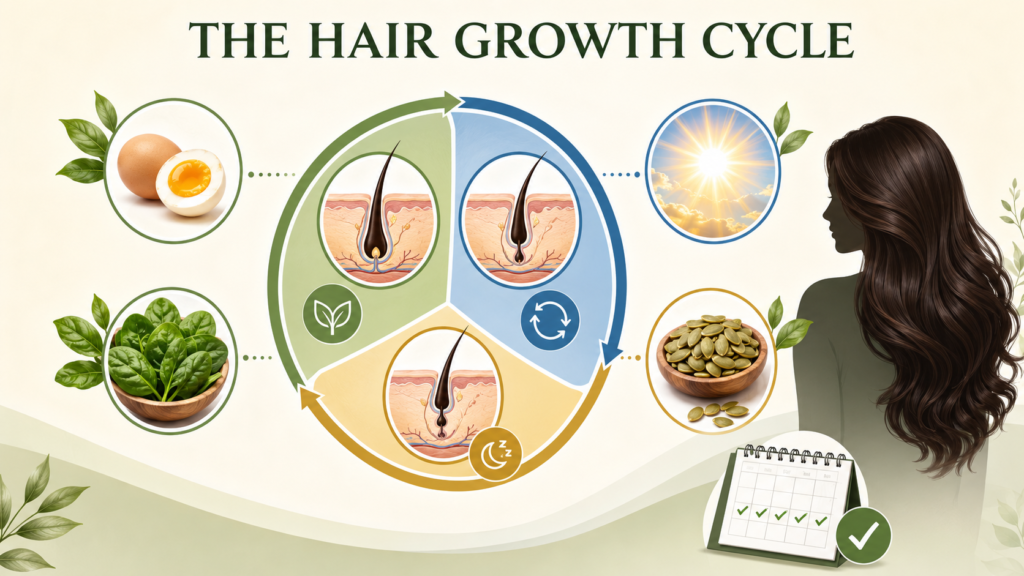
To understand exactly how nutrition dictates hair quality, we have to look at the intersection of nutrient availability and the hair growth cycle.
Internal Link: Chronic nutrient deficiencies often go hand-in-hand with systemic inflammation. Read Inflammaging: How Chronic Low-Grade Inflammation Drives Disease.
Hair is often the first visible signal of a system under strain. See how immune aging shows up across the body.
The Core Nutrients for Healthy Hair Architecture
Your hair is a living tissue beneath the scalp, and it requires a continuous supply of specific macro- and micronutrients to build its structure and maintain its growth cycle.
1. Protein – The Structural Foundation
Hair is almost entirely made of a tough, fibrous protein called keratin. If your daily protein intake is chronically low, your body cannot synthesize enough keratin to sustain healthy growth. This causes the hair shafts to become thin, brittle, and highly prone to breakage. Severe protein restriction can even force hair follicles to prematurely shut down to conserve amino acids.
Best sources: Lean meats, eggs, Greek yogurt, lentils, chickpeas, quinoa, and tofu.
Internal Link: Protein is also essential for metabolic flexibility. See Metabolic Flexibility: How to Train Your Body to Switch Between Carbs and Fat.
2. Iron and Ferritin – The Oxygen Supply Line
Iron is essential for producing hemoglobin, the protein in red blood cells that carries oxygen to your tissues. Your hair follicles require immense amounts of oxygen to sustain their rapid cell division.
The key storage marker is ferritin. When ferritin drops below a certain threshold (typically below 30–50 ng/mL), it can trigger a condition called Telogen Effluvium, where a massive percentage of hair follicles prematurely exit the growth phase and enter the shedding phase.
Best sources: Spinach, kale, chickpeas, lentils, red meat (in moderation), and iron-fortified cereals. Pair with vitamin C (citrus, bell peppers) to boost absorption.
3. Micronutrients – The Cellular Regulators
| Nutrient | Role in Hair Health | Deficiency Effect | Food Sources |
|---|---|---|---|
| Vitamin D | Initiates the growth (anagen) phase; regulates hair follicle cycling | Diffuse thinning, alopecia correlation | Fatty fish, egg yolks, sunlight; supplement if deficient |
| Zinc | Required for cell division and protein synthesis; supports follicle matrix | Structural root weakness, shedding | Oysters, lentils, pumpkin seeds, spinach |
| B Vitamins (including Biotin) | Cofactors for fat and protein metabolism; biotin supports keratin infrastructure | Noticeable thinning (true deficiency is rare) | Eggs, Greek yogurt, lean meats, whole grains |
Internal Link: Gut health influences nutrient absorption. Read Leaky Gut Syndrome 2026: Science-Backed Realities.
The Hair Growth Cycle: How Nutrients Interfere
To see how these nutrients interact dynamically, it helps to look at the three distinct phases every single hair follicle goes through:
| Phase | Duration | What Happens | Nutrient Dependence |
|---|---|---|---|
| Anagen (Growth) | 2–7 years | Cells divide rapidly at the root; hair grows actively | High: protein, iron, vitamin D |
| Catagen (Transition) | 2–3 weeks | Follicle shrinks and detaches from blood supply | Low |
| Telogen (Resting/Shedding) | ~3 months | Old hair rests until pushed out by new anagen hair | Very low |
The Shedding Delay
When metabolic stress or a sharp nutrient deficiency hits, the body panics and can force up to 30% of your active Anagen hairs to suddenly skip ahead into the Telogen resting phase.
Because the Telogen phase takes about 3 months to complete before the hair actually falls out, you typically won’t notice the shedding until 90 days after the nutritional deficiency or crash diet occurred. This delay is why many people don’t connect their current hair loss to a diet they changed three months ago.
Internal Link: Stress and cortisol also impact hair cycling. See The Gut-Brain-Skin Axis: How Microbiome Diversity Improves Mood and Complexion.
Common Dietary Pitfalls That Harm Hair Health
| Pitfall | Mechanism | Time to Shedding |
|---|---|---|
| Crash dieting / very low calorie intake | Body diverts energy away from non-essential tissues | 2–3 months |
| Low protein intake (<0.8 g/kg body weight) | Insufficient keratin synthesis | 2–4 months |
| Iron deficiency (low ferritin) | Reduced oxygen delivery to follicles | 3–5 months |
| Extremely low fat diets | Poor absorption of fat-soluble vitamins (A, D, E, K) | Variable |
| High sugar / ultra-processed diet | Promotes systemic inflammation and insulin resistance | Chronic |
Internal Link: High sugar intake drives systemic inflammation. Read Inflammaging for more.
Practical Takeaways: How to Support Healthy Hair Through Diet
- Prioritize protein at every meal – Aim for 20–30g of high-quality protein per meal (e.g., 3 eggs, a chicken breast, a cup of Greek yogurt, or a lentil bowl).
- Check your ferritin and vitamin D levels – Ask your doctor for a simple blood test. Optimal ferritin for hair growth is generally 50–100 ng/mL; optimal vitamin D is 40–60 ng/mL.
- Eat a diverse, whole-foods diet – Focus on leafy greens, colorful vegetables, legumes, eggs, fatty fish, and nuts. Variety ensures you cover all micronutrient bases.
- Avoid crash dieting – If you need to lose weight, aim for a slow, steady approach (0.5–1 lb per week) to avoid triggering telogen effluvium.
- Be patient – Because of the 3-month telogen delay, give any dietary change at least 4–6 months before evaluating its effect on hair thickness or shedding.
FAQ: Diet and Hair Health
Q: How long after changing my diet will I see improvements in my hair?
A: Because hair grows in cycles, it typically takes 3 to 6 months of consistent dietary improvement to notice visible changes in thickness, shine, or reduced shedding. The telogen phase alone lasts about 3 months before a hair falls out.
Q: Can taking biotin supplements reverse hair loss?
A: Biotin supplements are only effective if you have a true biotin deficiency (rare in people with normal diets). For most people, high-dose biotin does not improve hair health and can interfere with certain lab tests (like thyroid or cardiac markers). Focus on whole-food protein and iron first.
Q: Will eating more gelatin or collagen help my hair?
A: Collagen is broken down into amino acids, some of which are precursors for keratin. While there is some evidence that collagen supplements may improve hair strength, a diet rich in complete proteins (eggs, meat, legumes) is more reliable. Collagen is not a complete protein (it lacks tryptophan).
Q: I lost a lot of hair after a crash diet three months ago. Will it grow back?
A: Yes, in most cases. Telogen effluvium from temporary nutritional stress is usually reversible. Once you return to a balanced diet with adequate protein, iron, and calories, the shedding should stop within a few months, and new growth will begin. If shedding persists beyond 6 months, see a dermatologist.
Q: Can a high-sugar diet cause hair loss?
A: Indirectly, yes. High sugar intake promotes chronic inflammation and insulin resistance. Inflammation can damage hair follicles over time, and insulin resistance is linked to hormonal imbalances (like elevated androgens) that contribute to female and male pattern hair loss.
Q: Are there any specific blood tests I should ask for if I’m worried about hair loss?
A: Yes. Ask for: ferritin (iron stores), serum iron, total iron-binding capacity (TIBC), vitamin D (25-hydroxy) , zinc, vitamin B12, thyroid panel (TSH, free T3, free T4) , and complete blood count (CBC) to rule out anemia.
hair growth cycle
ferritin hair loss
vitamin d hair thinning
telogen effluvium
iron deficiency hair loss
telogen effluvium treatment
protein for hair growth
diet for hair growth
iron supplements for hair loss
telogen effluvium hair loss
chronic telogen effluvium
protein treatment for bleached hair
protein treatment for damaged hair
iron tablets for hair loss
keratin treatment for bleached hair
collagen peptides for hair growth

Julian Vance is the writer and editor behind RegenStep, translating peer-reviewed longevity, metabolic, and gut-health research into practical, actionable guides. Julian is not a licensed physician; content is reviewed against cited primary sources and is for informational purposes only. Always consult a qualified healthcare provider for personal medical advice.