
The recent news cycle surrounding Parkinson’s disease highlights a jarring contrast in modern medicine: while front-line diagnostics are still failing young patients due to outdated biases, the biochemical research occurring in the lab is making unprecedented leaps toward root-cause treatments.
Here is a breakdown of the two major narratives currently dominating the conversation around Parkinson’s disease.
The Diagnostic Blind Spot: Misdiagnosing Early-Onset Parkinson’s
A highly publicized case this week brought national attention to the severe diagnostic hurdles faced by young people suffering from neurodegenerative conditions.
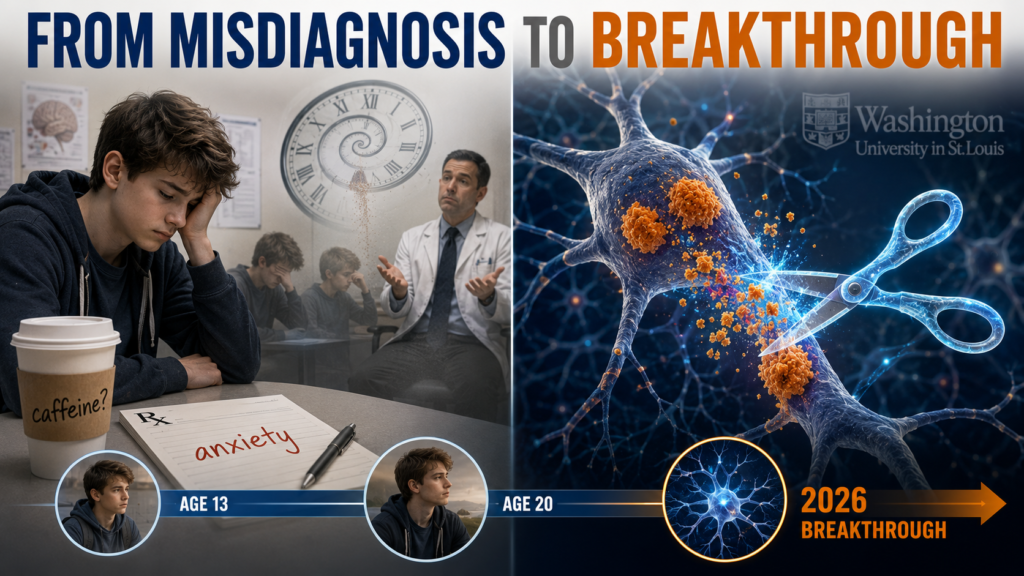
The story focuses on John Granahan, who began experiencing uncontrollable shaking and tremors at just 13 years old. For years, his symptoms were entirely dismissed by medical professionals who attributed the shaking to benign lifestyle factors, repeatedly telling him his tremors were simply from consuming “too much caffeine” or “drinking too much tea.”
It was not until age 20 that he finally received a definitive diagnosis of early-onset Parkinson’s disease.
Why This Matters
Granahan’s case highlights a dangerous cognitive bias in primary care. Because Parkinson’s is so heavily associated with the elderly, early-onset cases (which account for roughly 10% of all Parkinson’s diagnoses) are frequently dismissed as anxiety, stress, or caffeine overconsumption.
This diagnostic delay prevents young patients from accessing neuroprotective therapies when they are needed most—during the earliest stages of the disease’s progression.
Internal Link: Chronic neuroinflammation is a key driver of neurodegeneration. See Inflammaging: How Chronic Low-Grade Inflammation Drives Disease.
The Scientific Breakthrough: Engineering Enzymes to Clear Misfolded Proteins
While the clinical side is struggling with diagnostics, the research side just announced a major step forward in targeting the actual biological root of the disease.
On June 5, 2026, researchers from Washington University in St. Louis (WashU) published new findings regarding a high-tech method to engineer enzymes with the potential to fight ALS and Parkinson’s disease.
The Cellular Mechanism
Neurodegenerative diseases like Parkinson’s are primarily driven by the accumulation of misfolded proteins (specifically alpha-synuclein). These misfolded proteins clump together into toxic aggregates called Lewy bodies, which slowly suffocate and kill the dopamine-producing neurons in the brain.
The Current Standard of Care
Traditional treatments (like Levodopa) simply replace the missing dopamine to artificially manage the physical symptoms (shaking and stiffness). They do nothing to stop the brain cells from dying.
The WashU Breakthrough
The newly engineered enzymes act as microscopic “garbage disposals.” They are specifically designed to target, break apart, and clear out these toxic, misfolded proteins before they can destroy the neurons.
External Link: Washington University in St. Louis press release – June 5, 2026. Read the full study here.
Internal Link: Clearing toxic cellular debris is a theme in longevity science. Read Senolytics: How to Flush Zombie Cells Out of Your Body.
The Big Picture: Old Paradigm vs. New Horizon (2026)
| Feature | The Old Paradigm | The New Horizon (2026) |
|---|---|---|
| Diagnostics | Assuming tremors in the young are caused by lifestyle (caffeine/tea) | Recognizing early-onset neurodegeneration regardless of age |
| Treatment Focus | Symptom management (replacing lost dopamine) | Disease modification (engineering enzymes to stop neuronal death) |
| Biological Target | The nervous system’s chemical receptors | The misfolded proteins (alpha-synuclein) causing the damage |
We are currently caught in a transitional period. The medical system is still learning to catch neurodegenerative diseases earlier in a patient’s life, while the scientific community is rapidly developing the exact biological tools—like targeted enzyme therapy—needed to actually halt the disease once it is found.
Internal Link: Stem cell therapies are also being explored for Parkinson’s. See Stem Cell Therapy 2026: Proven Science vs. Expensive Fiction.
What This Means for Patients and Families
If you or a loved one are experiencing unexplained tremors, stiffness, or balance issues—regardless of age—do not accept a dismissal based on “too much coffee” or “just stress.”
- Advocate for a neurology referral. Early diagnosis, even without a cure, allows access to physical therapy, medications, and clinical trials that can slow progression.
- Stay informed about enzyme therapy. The WashU breakthrough is still in research phases, but it represents a fundamental shift toward disease modification rather than symptom management.
Internal Link: Metabolic health influences brain health. Read Metabolic Flexibility: How to Train Your Body to Switch Between Carbs and Fat.
FAQ: Early-Onset Parkinson’s and Enzyme Therapy
Q: What are the early signs of Parkinson’s in young adults?
A: Early signs include resting tremor (shaking in a hand or finger while at rest), stiffness in limbs or trunk, slow movement (bradykinesia), balance problems, and changes in handwriting (micrographia). These are often mistakenly attributed to caffeine, stress, or anxiety in younger patients.
Q: How common is early-onset Parkinson’s?
A: Approximately 10% of all Parkinson’s diagnoses occur before age 50. Diagnosing it early is critical because young patients have decades of life ahead and can benefit from early neuroprotective interventions.
Q: What is alpha-synuclein, and why does it matter?
A: Alpha-synuclein is a protein normally found in neurons. In Parkinson’s disease, it misfolds and aggregates into toxic clumps called Lewy bodies. These clumps disrupt cellular function and eventually kill dopamine-producing neurons. The new WashU enzyme therapy targets and breaks apart these toxic aggregates.
Q: When will the WashU enzyme therapy be available to patients?
A: As of June 2026, this is still in the research phase. It will need to go through preclinical optimization, safety studies, and human clinical trials—a process that typically takes 5 to 10 years. However, it represents a major conceptual breakthrough toward a root-cause treatment.
Q: Can lifestyle changes help slow Parkinson’s progression?
A: Yes. Regular exercise (especially aerobic and resistance training), a Mediterranean-style diet rich in antioxidants, adequate sleep, and stress management have all been associated with slower disease progression and better quality of life. These interventions support overall brain health and may reduce neuroinflammation.
Q: Why is caffeine often blamed for tremors?
A: Caffeine is a stimulant that can cause fine tremors in high doses. However, Parkinson’s tremors are distinct (resting tremor that improves with movement). Unfortunately, many physicians default to “reduce caffeine” without properly evaluating for neurodegenerative causes, leading to years of delayed diagnosis as seen in John Granahan’s case.
early-onset Parkinson’s misdiagnosis
Parkinson’s enzyme therapy 2026
WashU Parkinson’s breakthrough
John Granahan Parkinson’s
early-onset Parkinson’s
Parkinson’s misdiagnosis
parkinson’s disease

Julian Vance is the writer and editor behind RegenStep, translating peer-reviewed longevity, metabolic, and gut-health research into practical, actionable guides. Julian is not a licensed physician; content is reviewed against cited primary sources and is for informational purposes only. Always consult a qualified healthcare provider for personal medical advice.