
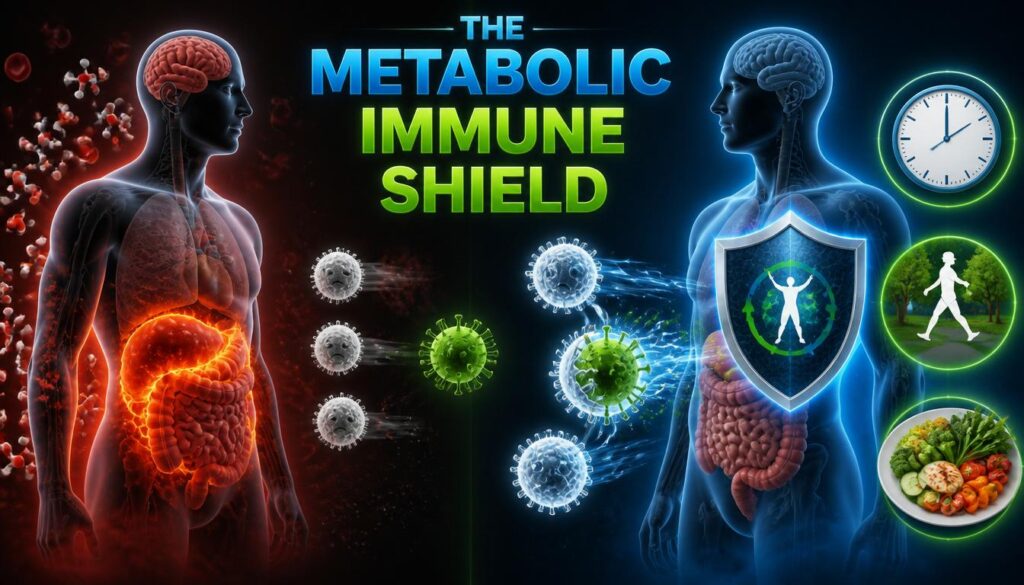
When flu season approaches or a new viral variant makes headlines, the mainstream narrative immediately shifts to reactive measures: stocking up on Vitamin C, hoarding zinc, and washing your hands. While basic hygiene is non-negotiable, the medical community’s understanding of immunity has undergone a massive paradigm shift.
We now know that your immune system is not an isolated fortress; it is an extension of your metabolism.
Let me introduce you to Robert, a 58-year-old accountant who used to catch every cold, flu, and stomach bug that passed through his office. “I was sick five or six times a year,” he told me. “I took Vitamin C religiously, but nothing helped.”
When we checked his blood work, Robert had insulin resistance, elevated fasting glucose, and a high hs-CRP (inflammation marker). His visceral fat was inflamed, and his immune system was constantly distracted. We didn’t give him more supplements. We put him on a metabolic flexibility protocol: intermittent fasting, Zone 2 cardio, and post-meal walks.
Six months later, Robert had lost 18 pounds, his blood sugar normalized, and he went through an entire winter without a single infection. “I used to think my immune system was weak,” he said. “Turns out, my metabolism was just broken.”
Robert’s story illustrates a critical truth: If your metabolic health is compromised—characterized by insulin resistance, chronic high blood sugar, or inflamed visceral fat—your immune system becomes sluggish, distracted, and easily overwhelmed. Conversely, optimal metabolic flexibility creates a hostile biological environment for invading pathogens.
Here is the exact cellular science behind why metabolic health is the ultimate, proactive shield against infectious disease.
External Link: A 2023 study in Nature Immunology demonstrated that hyperglycemia impairs neutrophil function and increases susceptibility to influenza. Read the summary here.
Metabolic health and immune age are tightly linked. Read how to restore immune function after 60.
The Immune System Is an Energy-Demanding Machine
To understand the link between metabolism and immunity, you have to look at how your body allocates energy.
Mounting a defense against a viral or bacterial invader requires an immediate, massive surge of cellular energy. When a pathogen enters your body, your immune cells (like T-cells and macrophages) must rapidly multiply and synthesize highly complex proteins to neutralize the threat.
This process requires your mitochondria—the power plants of your cells—to operate at peak efficiency. If you are metabolically inflexible, meaning your cells struggle to efficiently burn fat and glucose for fuel, your immune cells literally lack the ATP (cellular energy) required to fight the war. The virus replicates faster than your immune system can mount a response.
Internal Link: Metabolic flexibility is the foundation of energy optimization. Read Metabolic Flexibility: How to Train Your Body to Switch Between Carbs and Fat.
How Metabolic Dysfunction Paralyzes Immunity
The biological consequences of a poor diet and sedentary lifestyle do not just make you gain weight; they actively disarm your immune defenses through two primary mechanisms.
1. Glycation and White Blood Cell Paralysis
When you have chronic, low-grade high blood sugar (often driven by a highly processed diet), the excess glucose in your bloodstream acts like toxic biological syrup. It aggressively binds to proteins and lipids in a process called glycation.
This glycation physically coats your white blood cells. Studies on phagocytosis (the process where your white blood cells “eat” bacteria and viruses) show that an acute spike in blood sugar can paralyze your immune cells, reducing their pathogen-destroying capacity by up to 50% for several hours after a high-glycemic meal.
2. Visceral Fat and the “Distracted” Immune System
As we look deeper into the mechanisms of biological aging, visceral fat (the deep belly fat surrounding your organs) is recognized not as dormant storage, but as an active, highly toxic endocrine organ.
Visceral fat constantly pumps pro-inflammatory cytokines into your bloodstream. Your immune system recognizes these cytokines as a threat and launches a localized attack against your own fat tissue. Because your immune system is locked in a constant, low-grade war against your own inflamed tissue, it is entirely distracted. When a real, external threat like a respiratory virus enters the lungs, the immune response is delayed and disorganized.
Internal Link: Chronic inflammation is the common thread. See Inflammaging: How Chronic Low-Grade Inflammation Drives Disease.
The Protocol: Building the Metabolic Shield (What Robert Did)
To build an impenetrable biological defense, you must optimize your metabolic machinery. You cannot wait until you feel sick to fix your cells. Here is the proactive, longevity-focused protocol for immune resilience.
1. Upregulate Autophagy Through Fasting
Your immune system has a cellular turnover rate. Over time, immune cells become damaged, sluggish, and senescent (“zombie” cells). Intermittent fasting or time-restricted eating (like a 16:8 window) triggers a biological process called autophagy. This is your body’s cellular recycling program. Fasting signals your body to hunt down and dismantle these weak, senescent immune cells, forcing your stem cells to generate brand-new, highly aggressive white blood cells in their place.
Internal Link: Clearing senescent cells is key. Read Senolytics: How to Flush Zombie Cells Out of Your Body.
2. Build Mitochondrial Density with Zone 2 Cardio
Remember, a robust immune response requires massive amounts of ATP. You can increase your cellular energy capacity by building more mitochondria. Daily Zone 2 cardiovascular training—exercising at a steady pace where you can comfortably hold a conversation—is the most potent biological trigger for mitochondrial biogenesis.
Robert started with 30-minute incline walks on the treadmill, five days a week. Within three months, his energy was unrecognizable.
3. Stabilize Postprandial Glucose
To prevent your white blood cells from becoming paralyzed by glycation, you must flatten your glucose spikes after meals (postprandial glucose). You can hack this mechanism by:
- Prioritizing protein and healthy fats at meals
- Eating fibrous vegetables first to coat the stomach
- Taking a 10-minute walk immediately after your largest meal to allow your muscles to absorb circulating glucose
Internal Link: Blood sugar stability is also crucial for natural GLP-1 function. See Natural GLP-1: How to Boost Ozempic-Like Effects with Food.
Quick Reference: The Metabolic Defense Matrix
| Biological State | Impact on Immune Cells | Viral/Bacterial Consequence |
|---|---|---|
| High Blood Sugar | Paralyzes phagocytosis (white blood cells cannot “eat” pathogens) | Viruses replicate unchecked in the early stages of infection |
| Inflamed Visceral Fat | Distracts the immune system; drives chronic low-grade inflammation | Leads to overreactions (cytokine storms) when a real infection hits |
| Metabolically Flexible | High mitochondrial efficiency; abundant cellular energy | Rapid, coordinated immune response; swift pathogen neutralization |
| Fasted State | Triggers autophagy; clears out senescent immune cells | Replaces weak cells with fresh, highly capable defense cells |
True immunity cannot be bought in a supplement aisle. It is forged at the cellular level by how efficiently your body processes fuel. By aggressively managing your blood sugar, clearing out senescent cells, and building robust mitochondria, you transform your metabolism into an active, lethal shield against external pathogens.
Robert no longer dreads flu season. “I used to budget for sick days,” he says. “Now I budget for hiking trips.”
FAQ: Metabolic Health and Immunity
Q: How does high blood sugar weaken the immune system?
A: High blood sugar causes glycation, where glucose molecules coat white blood cells. This physically impairs their ability to engulf and destroy pathogens (phagocytosis). Studies show that even a single high-glycemic meal can reduce immune function by up to 50% for several hours.
Q: What is autophagy, and how does fasting boost immunity?
A: Autophagy is your body’s cellular recycling process. During fasting, your cells break down damaged or senescent components—including old, sluggish immune cells—and replace them with fresh, highly functional ones. This “immune cell turnover” keeps your defense system young and aggressive.
Q: How long does it take to see immune benefits from metabolic improvements?
A: Many people notice reduced frequency of colds and faster recovery within 3 to 6 months of consistent dietary and exercise changes. However, acute benefits (like reduced post-meal immune paralysis) can occur immediately after stabilizing blood sugar.
Q: Can someone with type 2 diabetes still improve their immune resilience?
A: Absolutely. While diabetes does impair immune function, improving blood sugar control through diet, exercise, and medication (as prescribed) can significantly restore immune capacity. Even modest reductions in HbA1c have been shown to improve neutrophil function.
Q: What is the best exercise for immune support?
A: Zone 2 cardio (steady-state exercise at 60-70% of max heart rate) is the most effective for building mitochondrial density. Examples: brisk walking, jogging, cycling, or rowing at a conversational pace for 30-60 minutes. Avoid excessive high-intensity training when already sick, as it can temporarily suppress immunity.
Q: Does intermittent fasting weaken the immune system?
A: No, when done correctly. Short-term fasting (12-16 hours) actually enhances immune function by triggering autophagy and reducing inflammation. However, prolonged fasting (multiple days) or extreme calorie restriction can suppress immunity. A daily 14-16 hour fasting window is generally safe and beneficial for most healthy adults.
metabolic health shield against infections
visceral fat inflammation
Zone 2 cardio immune
postprandial glucose immunity
metabolic health immune system
metabolic flexibility infection resistance
blood sugar immunity
autophagy viral defense

Julian Vance is the writer and editor behind RegenStep, translating peer-reviewed longevity, metabolic, and gut-health research into practical, actionable guides. Julian is not a licensed physician; content is reviewed against cited primary sources and is for informational purposes only. Always consult a qualified healthcare provider for personal medical advice.