
For decades, the western world viewed the sauna as a luxury—a relaxing spa amenity to sweat out a hangover or unwind after a heavy lifting session. However, clinical longevity researchers have radically shifted this perspective.
The sauna is no longer just a place to relax; it is a highly potent, clinically validated cardiovascular and neuroprotective intervention.
By intentionally exposing your body to extreme heat, you trigger a biological phenomenon known as hormesis—a brief, acute stressor that forces your cells to adapt, repair, and grow stronger. From skyrocketing your growth hormone to drastically reducing your risk of Alzheimer’s, here is the exact cellular science of “Sauna as Medicine” and the protocols required to unlock its longevity benefits.
Let me introduce you to Robert, a 55‑year‑old former marathon runner who thought his best years were behind him. “My knees were shot, my blood pressure was creeping up, and I felt like I was falling apart,” he told me. “I tried everything—supplements, diets, physical therapy.”
On a friend’s recommendation, Robert started a sauna protocol: three sessions per week at 185°F, 20 minutes each, followed by a cold shower. After six months, his resting heart rate dropped from 72 to 58, his blood pressure normalized, and he reported better sleep and mental clarity. “I didn’t think a room full of hot air could change my biology,” he says, “but it completely did.”
Robert’s story illustrates the science of thermal stress. Here is how it works.
External Link: A 2015 JAMA Internal Medicine study on the KIHD cohort found that frequent sauna users had a 50% lower risk of fatal cardiovascular events [11†L36-L37]. A 2021 review in Experimental Gerontology confirmed sauna bathing as a probable means to extend healthspan [12†L17-L19] here.
Heat stress has the strongest observational support of any hormetic practice. See where it ranks among longevity interventions.
The Master Mechanism: Heat Shock Proteins (HSPs)
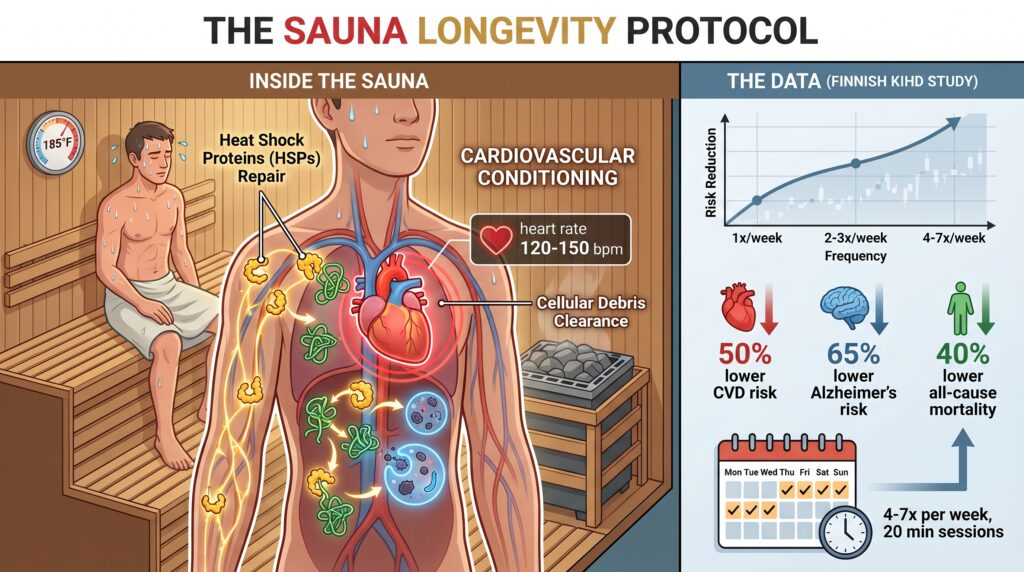
When you step into a sauna heated to 175°F (80°C) or higher, your core body temperature begins to rise. To survive this thermal stress, your body deploys a molecular emergency response crew known as Heat Shock Proteins (HSPs) .
As we age, the proteins inside our cells naturally begin to misfold and clump together. This accumulation of “cellular junk” is the primary driver of neurodegenerative diseases, muscle wasting, and biological aging .
When activated by heat, Heat Shock Proteins act like microscopic chaperones. They hunt down these misfolded proteins, unravel them, and repair their structural integrity . If a protein is too damaged to fix, HSPs tag it for destruction and recycling (a process related to autophagy). By taking regular saunas, you are essentially bathing your brain and body in these protective repair enzymes. Heat exposure also activates the Nrf2 antioxidant pathway, reducing oxidative damage to lipids, proteins, and DNA .
Internal Link: Hormesis is the biological principle behind sauna’s benefits. Read Hormesis: The Science of How Low‑Dose Stress Makes You Stronger.
The Cardiovascular Mimetic: A Workout While Sitting Still
One of the most profound benefits of the sauna is its impact on the cardiovascular system. Heat stress forces your blood vessels to rapidly dilate (vasodilation) to move blood to the surface of your skin to cool you down .
During a 20‑minute session in a traditional dry sauna, your heart rate can elevate to 120–150 beats per minute. Biologically, your heart and vascular system believe you are engaged in moderate‑intensity cardiovascular exercise.
- Endothelial Health: Regular vasodilation exercises the thin layer of cells lining your blood vessels (the endothelium), keeping them elastic and responsive. This improves nitric oxide production and reduces arterial stiffness .
- Plasma Volume Expansion: Heat stress forces your body to produce more blood plasma. More plasma means your heart doesn’t have to work as hard to pump blood, effectively lowering your resting heart rate over time and increasing your athletic endurance .
Observational studies strongly indicate that frequent sauna users (4‑7 times per week) experience a 63% reduction in sudden cardiac death and a 61% reduction in stroke. Regular sauna use also lowers both systolic and diastolic blood pressure, with effects persisting beyond the immediate post‑sauna period .
Internal Link: Cardiovascular health is a pillar of metabolic fitness. Read Metabolic Flexibility: How to Train Your Body to Switch Between Carbs and Fat.
The Data: The Finnish Longevity Study
The most compelling evidence for sauna as medicine comes from the Kuopio Ischemic Heart Disease (KIHD) study, led by Dr. Jari Laukkanen. Researchers tracked over 2,300 Finnish men for more than 20 years to observe the long‑term effects of traditional sauna bathing .
The data revealed a staggering dose‑dependent response . Compared to men who used the sauna only once a week, those who used it 4 to 7 times a week experienced:
| Outcome | Risk Reduction |
|---|---|
| Fatal cardiovascular disease | 50% lower risk |
| Sudden cardiac death | 63% lower risk |
| Alzheimer’s disease and dementia | 65% lower risk |
| All‑cause mortality | 40% lower risk |
In the world of geroscience, finding a single behavioral intervention that reduces your risk of dying from any cause by 40% is practically unheard of. Importantly, these protective effects persisted even after adjusting for physical activity, socioeconomic status, and established cardiovascular risk factors .
Internal Link: Reducing all‑cause mortality is the ultimate goal of longevity habits. Read The Circadian Code: How Timing Your Habits Unlocks Biological Optimization.
The Biohacker’s Sauna Protocol
To replicate the benefits seen in clinical trials, you have to hit specific thresholds for temperature and duration. Sitting in a lukewarm room will not trigger Heat Shock Proteins.
The Clinical Minimums
| Parameter | Recommendation |
|---|---|
| Temperature | 175°F to 195°F (80°C to 90°C) for a traditional dry sauna |
| Duration | 15 to 20 minutes per session (heart rate should be elevated; profuse sweating) |
| Frequency | 3 to 4 times per week (aim for 57+ minutes of heat exposure per week) |
A 2021 review in Experimental Gerontology noted that sauna bathing has emerged as a probable means to extend healthspan based on compelling data from observational, interventional, and mechanistic studies . Sessions lasting more than 19 minutes were associated with a significantly lower risk of sudden cardiac death compared to sessions of less than 11 minutes .
Advanced Hacks
The Growth Hormone Spike: To maximize Human Growth Hormone (HGH) release, researchers suggest breaking up your heat exposure. Two 20‑minute sauna sessions at 176°F (80°C), separated by a 30‑minute cooling period, have been shown to produce GH levels two‑ to five‑fold higher than baseline. More intensive protocols (two 15‑minute rounds at 100°C) may increase GH by up to 16‑fold.
Contrast Therapy: Follow your sauna session with a 1‑ to 3‑minute cold plunge (or freezing cold shower). This massive swing from vasodilation to vasoconstriction acts as a powerful “pump” for the lymphatic system and releases a massive surge of norepinephrine (focus) and dopamine (mood) . A 2016 Dutch study found that individuals who practiced hot‑cold contrast showers had 29% fewer sick days than controls .
Traditional vs. Infrared: Which Is Better?
Most of the long‑term clinical data on longevity and cardiovascular health (including the famous Finnish study) was conducted using traditional dry saunas hitting temperatures of 175°F+ . Infrared saunas typically only reach 120°F‑140°F. While infrared can penetrate the skin deeper and is excellent for joint pain and mild sweating, it generally does not raise core body temperature fast enough to trigger a massive Heat Shock Protein response.
For pure longevity, traditional is the gold standard.
Safety Considerations
While incredibly safe for the vast majority of people, you should avoid extreme thermal stress if you are:
- Pregnant
- Have unstable angina
- Have suffered a recent heart attack
- Suffer from severe aortic stenosis
Because the sauna causes you to lose massive amounts of water and electrolytes, staying heavily hydrated before, during, and after your session is mandatory to prevent fainting or dangerous blood pressure drops.
The Bottom Line: Stress Is Medicine
Robert now follows a weekly sauna protocol: four sessions per week, 20 minutes each, at 185°F, with a cold shower to finish. “I used to think rest was the answer,” he says. “Now I know that the right kind of stress—in the right dose—is what heals.”
The sauna is not just a luxury. It is a clinically validated longevity intervention that reduces cardiovascular mortality, protects against neurodegenerative disease, and triggers cellular repair through heat shock proteins and hormesis.
FAQ
Q: Is a sauna medically beneficial?
A: Yes. Large prospective cohort studies have shown that frequent sauna use (4‑7 times per week) is associated with a 50% lower risk of fatal cardiovascular disease, a 65% lower risk of Alzheimer’s disease, and a 40% lower risk of all‑cause mortality .
Q: Is sauna good in luteal phase?
A: While specific research on sauna use during the luteal phase is limited, general guidance suggests listening to your body. Some women may experience increased heat sensitivity or vasodilation during this phase. If you feel lightheaded or overheated, reduce session time or temperature. Always consult your healthcare provider.
Q: Does sauna help Hashimoto’s?
A: Sauna use may help reduce systemic inflammation and improve stress resilience, which could be beneficial for autoimmune conditions like Hashimoto’s. However, because heat stress can temporarily affect thyroid hormone levels, it is essential to monitor your symptoms and consult your endocrinologist before starting a regular sauna routine.
Q: What is the 200 rule for saunas?
A: The “200 rule” is a guideline for sauna safety: 200 = 20 minutes at 200°F (93°C) for 20 minutes—but only if you are acclimated. For beginners, start at lower temperatures and shorter durations. The rule is a reminder that heat stress must be respected; always listen to your body and hydrate adequately.
Q: Traditional vs. Infrared Saunas: Which is better?
A: For longevity and cardiovascular benefits (Heat Shock Protein activation), traditional dry saunas (175°F‑195°F) have the strongest clinical evidence. Infrared saunas are excellent for joint pain and relaxation but do not raise core body temperature as rapidly.
Q: Does the sauna actually “detox” you?
A: Yes, but not in the way marketing companies claim. Your liver and kidneys do the heavy lifting of detoxification. However, sweating is a clinically verified pathway for excreting specific heavy metals (like cadmium, lead, and mercury) and endocrine‑disrupting chemicals (like BPA and phthalates) that your kidneys struggle to process.
Q: Can I use the sauna immediately after a workout?
A: Yes. Using the sauna post‑workout is highly recommended. It prolongs the cardiovascular benefits of your training, increases blood flow to repairing muscles, and helps clear lactic acid faster, significantly reducing Delayed Onset Muscle Soreness (DOMS).
Q: Is the sauna safe for everyone?
A: While generally safe, avoid sauna use if you are pregnant, have unstable angina, have suffered a recent heart attack, or have severe aortic stenosis. Always stay heavily hydrated before, during, and after your session.
- Is a sauna medically beneficial?
- Is sauna good in luteal phase?
- Does sauna help Hashimoto’s?
- What is the 200 rule for saunas?
- sauna as medicine
- sauna longevity
- heat shock proteins
- sauna cardiovascular benefits
- Finnish sauna study
- hormesis heat therapy
- sauna

Julian Vance is the writer and editor behind RegenStep, translating peer-reviewed longevity, metabolic, and gut-health research into practical, actionable guides. Julian is not a licensed physician; content is reviewed against cited primary sources and is for informational purposes only. Always consult a qualified healthcare provider for personal medical advice.