
You are exhausted, your weight won’t budge despite strict dieting, and your doctor keeps telling you your fasting blood sugar is “normal.” Yet, deep inside your cells, a silent metabolic crisis is unfolding.
It is estimated that up to 88% of American adults are metabolically inflexible, and the primary culprit is Insulin Resistance.
Long before you are diagnosed with prediabetes or Type 2 Diabetes, your body spends years—often decades—sending out physical distress signals. Because these symptoms are often dismissed as “normal aging” or “bad genetics,” millions of people miss the critical window to reverse the condition.
Let me introduce you to Margaret, a 57‑year‑old retired teacher who thought she was doing everything right. “I ate ‘healthy’ granola for breakfast, walked every day, and avoided sugar,” she told me. “But I couldn’t lose weight, I crashed after lunch, and I had these weird dark patches on my neck that wouldn’t wash off.”
Margaret’s doctor told her everything was “fine” because her fasting glucose was normal. But we ran a fasting insulin test—her insulin was three times higher than optimal. Margaret had been insulin resistant for years. We shifted her to a 16:8 fasting schedule, swapped her granola for eggs and avocado, and added 10‑minute walks after meals. Within three months, her energy returned, her sugar cravings vanished, and the skin patches faded. “I wasn’t broken,” she says. “I was just missing the right signals.”
Here is the exact cellular science of what insulin resistance is, the seven silent warning signs your body is sending you, and how to biology‑hack your way out of the metabolic trap.
/External Link: Dr. Joseph Kraft’s research on insulin resistance and the “Kraft Test” found that over 80% of adults with normal fasting glucose still had abnormal insulin responses. Read more here.
The Cellular Trap: What Is Insulin Resistance?
Every time you consume carbohydrates or sugar, your digestive system breaks them down into glucose (blood sugar). In response, your pancreas releases insulin.
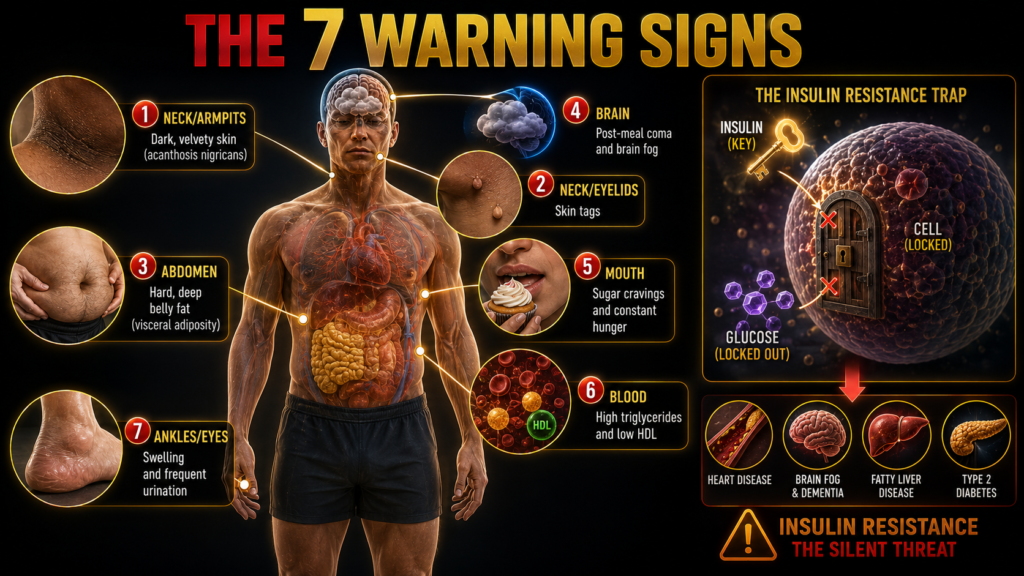
Think of insulin as a key. Its job is to unlock the doors of your muscle, liver, and fat cells so that glucose can enter and be burned for energy.
However, when you chronically overload your system with highly processed carbohydrates, frequent snacking, and high stress, you flood your bloodstream with insulin. Over time, your cells become “deaf” to the signal. They change their locks. They refuse to open the door. This is insulin resistance.
Because the glucose is locked out of the cells, it builds up in the bloodstream. Panicking, the pancreas pumps out even more insulin to force the doors open. This state of chronically elevated insulin (hyperinsulinemia) actively blocks fat burning, drives systemic inflammation, and accelerates cellular aging.
Internal Link: Insulin resistance is a core feature of metabolic inflexibility. Read Metabolic Flexibility: How to Train Your Body to Switch Between Carbs and Fat.
The 7 Silent Warning Signs
Do not wait for a high fasting glucose test. By the time your blood sugar is elevated, your insulin has likely been dysfunctional for years. Look for these seven clinical warning signs.
1. Dark, Velvety Skin Patches (Acanthosis Nigricans)
This is one of the most visible and heavily ignored clinical signs of severe insulin resistance. Chronically high levels of circulating insulin cause skin cells to reproduce rapidly. This creates patches of thickened, dark, velvety skin, typically appearing on the back of the neck, in the armpits, or in the groin creases. It is often mistaken for “dirt” that won’t wash off.
2. An Outbreak of Skin Tags
Skin tags are small, fleshy growths that hang off the skin. While occasional skin tags are normal, a sudden outbreak of them—especially around the neck, eyelids, or armpits—is highly correlated with hyperinsulinemia. The excessive insulin acts as a growth factor, stimulating the rapid, abnormal growth of epithelial tissue.
3. Stubborn Belly Fat (Visceral Adiposity)
Not all body fat is created equal. Subcutaneous fat (the pinchable fat on your arms and legs) is relatively metabolically benign. However, visceral fat—the hard, deep belly fat that wraps around your organs—is a direct symptom of insulin resistance. Because insulin is a fat‑storage hormone, chronic levels force your body to preferentially store fat right around your liver and midsection, completely locking out your ability to burn it.
4. The “Post‑Meal Coma” (Reactive Hypoglycemia)
If you eat a meal (especially one high in carbohydrates like pasta or a sandwich) and feel an overwhelming, almost narcotic need to take a nap 45 minutes later, your insulin is misfiring. Your pancreas overreacts to the carbs by releasing a massive, disproportionate surge of insulin. This violently crashes your blood sugar, leaving you exhausted, shaky, and dealing with intense brain fog.
5. Endless Sugar Cravings (Cellular Starvation)
The ultimate paradox of insulin resistance is that you are starving in a sea of plenty. You have plenty of glucose in your blood, but because the cellular “locks” are broken, the energy cannot get inside the cell. Your brain senses this cellular starvation and triggers intense, physical cravings for fast‑acting carbohydrates and sugar to try and get energy quickly.
6. The Silent Lipid Shift (High Triglycerides & Low HDL)
If you look at your standard blood panel, ignore the total cholesterol for a moment and look at the ratio between your Triglycerides and your HDL (good) cholesterol. Insulin resistance causes the liver to aggressively convert excess carbohydrates into triglycerides while simultaneously suppressing the production of HDL. A Triglyceride‑to‑HDL ratio of over 2.0 is a glaring red flag for metabolic dysfunction.
7. Swollen Ankles and Frequent Urination
Insulin dictates how your kidneys handle water and sodium. High insulin tells the kidneys to hold onto sodium, which leads to fluid retention, puffy eyes in the morning, and swollen ankles (edema) . Conversely, if your blood sugar is starting to chronically spill over, your kidneys will work overtime to flush it out, causing you to wake up multiple times in the middle of the night to urinate.
Internal Link: Chronic inflammation and insulin resistance are deeply connected. Read Inflammaging: How Chronic Low‑Grade Inflammation Drives Disease.
The Insulin Resistance Warning Signs Summary
| Warning Sign | What It Looks Like | Why It Happens |
|---|---|---|
| Dark Skin Patches | Velvety, dark skin on neck, armpits, groin | Insulin acts as a growth factor on skin cells |
| Skin Tags | Small fleshy growths, especially on neck/eyelids | Hyperinsulinemia stimulates abnormal tissue growth |
| Stubborn Belly Fat | Hard, deep fat around the midsection | Insulin forces fat storage around organs |
| Post‑Meal Coma | Intense fatigue 45 min after carb‑heavy meals | Overreactive insulin crashes blood sugar |
| Sugar Cravings | Constant need for carbs and sugar | Cellular starvation despite abundant blood sugar |
| High TG / Low HDL | TG:HDL ratio > 2.0 on blood work | Liver converts carbs to fat; suppresses protective cholesterol |
| Swollen Ankles / Frequent Urination | Puffy eyes, edema, waking to urinate | Insulin alters kidney sodium and fluid handling |
The Biological Reset: How to Reverse It (What Margaret Did)
Insulin resistance is not a life sentence. It is a highly reversible environmental condition. By changing the biological inputs, you can force your cells to resensitize their insulin receptors.
Diet is the foundation of that reset. For the specifics of what to eat and what to cut, follow our insulin resistance diet guide and 7-day meal plan.
1. Fasting / Time‑Restricted Eating
The fastest way to lower your baseline insulin is to stop eating constantly. Practicing a 16:8 intermittent fasting schedule gives your pancreas a massive 16‑hour break, allowing circulating insulin levels to drop to baseline.
Margaret started with a 14:10 schedule and worked up to 16:8 over two weeks.
2. Deplete Muscle Glycogen
Skeletal muscle is the largest “sink” for glucose in your body. Heavy resistance training (weightlifting) empties the glucose stored in your muscles. Empty muscles act like sponges, rapidly pulling glucose out of the blood without needing high amounts of insulin.
Margaret added two weekly strength sessions to her routine.
3. The Post‑Meal Walk
Walking for just 10 to 15 minutes immediately after a meal activates the GLUT4 transporters in your leg muscles. These transporters pull sugar directly out of the bloodstream independently of insulin, cutting your post‑meal glucose spike in half.
Margaret started walking her dog right after dinner. “It made such a difference,” she says.
Internal Link: Circadian timing enhances metabolic health. Read The Circadian Code: How Timing Your Habits Unlocks Biological Optimization.
The Insulin Reversal Matrix
| Intervention | Mechanism | Impact on Insulin | Protocol |
|---|---|---|---|
| Time‑Restricted Eating | Lowers baseline insulin by giving pancreas a break | Significant reduction in fasting insulin | 16:8 daily fast |
| Resistance Training | Depletes muscle glycogen; increases GLUT4 transporters | Improves insulin sensitivity within weeks | 2‑3 sessions/week |
| Post‑Meal Walk | Activates GLUT4 independently of insulin | Reduces post‑meal glucose spikes by 50% | 10‑15 min after meals |
| Carbohydrate Restriction | Reduces the need for insulin release | Rapidly lowers fasting insulin | Focus on protein, fats, and fiber |
The Bottom Line: Your Body Is Talking
Margaret now follows a daily 16:8 fasting schedule, lifts weights twice a week, and walks after dinner. “I spent years fighting my body,” she says. “Now I finally understand the signals it was sending.”
If you recognize yourself in any of these seven warning signs, do not wait for your fasting glucose to rise. Your body is already communicating. It is time to listen.
FAQ: Insulin Resistance
Q: Can you be insulin resistant with normal blood sugar?
A: Yes. This is the biggest misconception in modern medicine. Your pancreas will compensate for insulin resistance by overproducing insulin for years, successfully keeping your blood sugar in the “normal” range. By the time your fasting glucose finally rises, your pancreas is exhausted and you are already at the doorstep of Type 2 Diabetes. You must test fasting insulin—not just glucose—to get the full picture.
Q: What is the best blood test for insulin resistance?
A: A standard fasting glucose test is not enough. You must ask your doctor for a Fasting Insulin test. Optimal fasting insulin should be under 5 μIU/mL. You can also calculate your HOMA‑IR (Homeostatic Model Assessment of Insulin Resistance) score using your fasting glucose and fasting insulin numbers to get an exact metabolic baseline.
Q: How long does it take to reverse insulin resistance?
A: While it takes years to develop, you can begin reversing insulin resistance remarkably fast. Clinical data shows that strict carbohydrate restriction, combined with intermittent fasting and daily movement, can dramatically improve cellular insulin sensitivity in as little as 3 to 6 weeks.
Q: Do artificial sweeteners trigger an insulin response?
A: It depends on the sweetener. While they contain zero calories, some studies suggest that the intense sweet taste of artificial sweeteners (like sucralose or aspartame) can trigger a “cephalic phase insulin release” —meaning the brain tastes sweet and preemptively releases insulin anyway. For a true metabolic reset, sticking to water, black coffee, and tea is the gold standard.
Q: Is insulin resistance the same as prediabetes?
A: No. Insulin resistance is the underlying cause of prediabetes and Type 2 Diabetes. Prediabetes is diagnosed when blood glucose levels are already elevated. Insulin resistance can exist for 10‑20 years before glucose levels rise enough for a prediabetes diagnosis.
Q: Does stress affect insulin resistance?
A: Yes. Chronic stress raises cortisol, which promotes insulin resistance by increasing blood sugar and promoting visceral fat storage. Managing stress through sleep, movement, and mindfulness is essential for reversing insulin resistance.
Q: Can I take supplements to help reverse insulin resistance?
A: Some supplements—like magnesium, berberine, and alpha‑lipoic acid—have shown modest benefits in improving insulin sensitivity. However, supplements are adjuncts to the core interventions: fasting, exercise, and a whole‑food diet.
acanthosis nigricans
skin tags insulin resistance
fasting insulin test
insulin resistance symptoms
warning signs insulin resistance
reverse insulin resistance
insulin resistance skin signs
insulin resistance

Julian Vance is the writer and editor behind RegenStep, translating peer-reviewed longevity, metabolic, and gut-health research into practical, actionable guides. Julian is not a licensed physician; content is reviewed against cited primary sources and is for informational purposes only. Always consult a qualified healthcare provider for personal medical advice.