
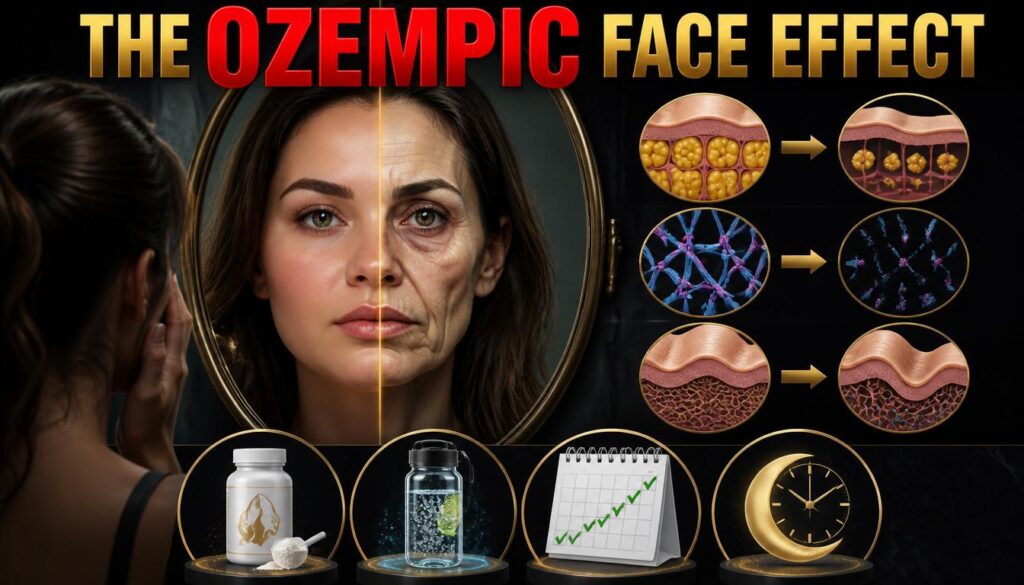
The GLP‑1 receptor agonist revolution is here. Medications like Ozempic, Wegovy, and Mounjaro are completely reshaping the modern landscape of weight loss and metabolic health. But as millions of patients shed pounds at unprecedented speeds, a startling side effect has gone viral: “Ozempic Face.”
Patients are looking in the mirror and realizing their bodies look a decade younger, but their faces look a decade older. They are experiencing sudden hollowing of the cheeks, deep wrinkles, sagging jowls, and a gaunt, tired expression.
Let me introduce you to Linda, a 55‑year‑old accountant who lost 45 pounds on Ozempic over four months. “I was thrilled with my new body,” she told me. “But when I looked in the mirror, I didn’t recognize my face. I looked haggard, tired, and older than my mother.”
Linda’s experience is not unique. She had lost weight too quickly, and her skin couldn’t keep up. We shifted her focus to skin preservation protocols: collagen supplementation, electrolyte hydration, and slower, more intentional weight loss pacing. Within six months, her skin had tightened noticeably, and she regained her confidence. “I wish I had known how to protect my face from the start,” she says. “But it’s never too late to repair.”
To be clear: the medication itself is not actively attacking your skin cells. “Ozempic Face” is a biological consequence of gravity, physics, and rapid fat depletion. Here is the exact cellular science behind why rapid weight loss ages your face, and the biohacking protocols you can use to prevent and reverse the “deflated balloon” effect.
External Link: A 2024 review in JAMA Dermatology highlighted the prevalence of facial volume loss associated with GLP‑1 receptor agonist weight loss. Read more here.
Slower, food-led fat loss protects the skin. Here is the science-based insulin resistance diet guide.
The Biology of Facial Aging: Why Do We Look Gaunt?
To understand Ozempic Face, you have to understand the architectural structure of a youthful face. Your skin does not just drape over your skull; it is supported by complex layers of scaffolding.
1. The Loss of Structural Fat Pads
Youthfulness is defined by facial volume. You have distinct compartments of subcutaneous fat in your cheeks, under your eyes, and along your jawline. These fat pads act like structural scaffolding, keeping the skin taut and lifted. When you lose weight rapidly via GLP‑1 medications, your body indiscriminately burns fat from everywhere—including your face. When those fat pads shrink rapidly, the scaffolding collapses, leading to hollowed cheeks and sunken eyes.
2. The Collagen and Elastin Lag (The Balloon Effect)
Imagine a fully inflated balloon. If you slowly let the air out over a week, the rubber has time to contract. If you let all the air out in two seconds, the rubber becomes wrinkled and saggy.
Your skin relies on two proteins for its structural integrity:
- Collagen: Provides firmness and structure.
- Elastin: Provides the “snap‑back” elasticity.
When fat disappears too quickly, your skin’s collagen and elastin production simply cannot keep up with the changing volume. The skin is left physically stretched out with nothing underneath to support it. This is the “deflated balloon” effect.
3. The Caloric Deficit Trap: Malnutrition of the Skin
GLP‑1 medications work by profoundly suppressing appetite and slowing gastric emptying. While this is great for weight loss, it drastically reduces your daily intake of essential micronutrients, amino acids, and healthy fats. Your body is a survival machine; in a severe caloric deficit, it will prioritize sending nutrients to your heart, brain, and liver. Your skin, hair, and nails are cut off from the nutrient supply line, leading to a dull, gray, and aged complexion.
Internal Link: Nutrient prioritization during caloric deficits can trigger cellular stress. Read Autophagy Activation: How Fasting Triggers Cellular Cleanup.
The Prevention Protocol: How to Protect Your Skin (What Linda Did)
You do not have to choose between a healthy body weight and a youthful face. By applying targeted regenerative strategies, you can mitigate the sagging and help your skin contract as you lose weight.
1. Hyper‑Dose Amino Acids and Collagen Peptides
Because you are eating significantly less, every calorie must be structurally valuable. Your body needs massive amounts of glycine, proline, and hydroxyproline to synthesize new skin tissue.
The Fix: Supplement daily with high‑quality, hydrolyzed collagen peptides (15‑20 grams) and ensure you are hitting a high daily protein target (at least 0.8 to 1 gram of protein per pound of your target body weight) to give your skin the raw materials it needs to repair the matrix.
Internal Link: Protein is essential for tissue repair. Read Metabolic Flexibility: How to Train Your Body to Switch Between Carbs and Fat.
2. Trigger Targeted Autophagy (Regenerative Fasting)
While it sounds counterintuitive to fast when you are already eating less, strategic time‑restricted eating (like a 16‑hour daily fast) can stimulate autophagy. This is your body’s cellular recycling program. When activated, autophagy breaks down old, damaged, and loose cellular structures (like sagging skin cells) and replaces them with fresh, tight tissue.
Internal Link: Regenerative fasting can trigger cellular renewal. Read Regenerative Fasting Protocols: Unlocking Your Body’s Hidden Stem Cell Superpower.
3. Hydrate at the Intracellular Level
GLP‑1 medications blunt the thirst mechanism, leaving many users chronically dehydrated. Dehydrated skin instantly looks older, accentuating every fine line.
The Fix: Drinking plain water isn’t enough; you need intracellular hydration. Add high‑quality electrolytes (sodium, potassium, and magnesium) to your water to ensure the fluid is actually pulled inside your cells, keeping your skin plump and resilient.
4. Pacing the Weight Loss
The most effective way to prevent Ozempic Face is to control the rate of descent. Losing 1 to 2 pounds per week gives your skin’s elastin a fighting chance to contract and tighten around your shrinking frame. Rapid drops of 5+ pounds a week practically guarantee skin sagging. Work with your physician to find a drug dosage that suppresses cravings without starving your system.
The Ozempic Face Prevention Matrix
| Risk Factor | Biological Mechanism | Prevention Protocol |
|---|---|---|
| Rapid Fat Loss | Facial fat pads shrink, scaffolding collapses | Pace weight loss: 1‑2 lbs/week |
| Collagen/Elastin Lag | Skin stretched with no underlying support | Daily collagen peptides (15‑20g); high protein intake |
| Caloric Deficit Malnutrition | Skin starved of nutrients; dull, aged complexion | Nutrient‑dense meals; quality protein; healthy fats |
| Dehydration | Blunted thirst; skin loses plumpness | Electrolyte‑enhanced hydration; monitor urine color |
| Autophagy Deficiency | Old cellular structures accumulate; sagging persists | 16‑hour daily fasting window to trigger skin cell turnover |
Can Ozempic Face Be Reversed?
Yes, but it requires time and consistency.
| Intervention | Timeline | Effectiveness |
|---|---|---|
| Natural Skin Tightening | 12‑18 months of stable weight | Moderate to high (depends on age, genetics, and elastin levels) |
| Collagen Supplementation | 3‑6 months of consistent use | Moderate (improves texture and elasticity) |
| Prescription Retinoids (Tretinoin) | 3‑6 months | High (stimulates collagen production in upper skin layers) |
| Microneedling / RF Treatments | 3‑6 sessions over 6 months | High (stimulates deep collagen remodeling) |
| Dermal Fillers (Hyaluronic Acid) | Immediate; lasts 12‑18 months | Very high (replaces lost volume) |
The Bottom Line: You Don’t Have to Choose
Linda now follows a daily protocol: collagen peptides, electrolyte‑enhanced hydration, and a 16‑hour overnight fast. “I wish I had started these habits before I lost the weight,” she says. “But my skin is finally catching up.”
Weight loss should be a liberation, not a trade‑off. By pacing your loss, feeding your skin the structural building blocks it needs, and supporting cellular turnover through autophagy, you can lose the weight without losing your youthful glow.
FAQ: Ozempic Face
Q: How to prevent Ozempic face aging?
A: Prevention is key. The most effective strategies are: pace your weight loss (1‑2 lbs/week), supplement with collagen peptides (15‑20g daily), maintain high protein intake (0.8‑1g per pound of target body weight), stay hydrated with electrolytes, and practice time‑restricted eating (16‑hour daily fast) to stimulate autophagy and skin cell turnover.
Q: How to stop face looking old when losing weight?
A: Focus on preserving facial volume and supporting skin elasticity. This means slowing down your weight loss rate, providing structural building blocks (collagen, protein, healthy fats), and using topical interventions like prescription retinoids (Tretinoin) and professional treatments (microneedling) to stimulate collagen production.
Q: What is the cure for Ozempic face?
A: There is no single “cure,” but a combination of strategies can reverse or significantly improve the condition: natural skin tightening (12‑18 months of stable weight), collagen supplementation, dermal fillers (for immediate volume restoration), and collagen‑stimulating treatments (microneedling, radiofrequency, or laser).
Q: Does taking collagen help prevent Ozempic face?
A: Yes. Hydrolyzed collagen peptides provide the precise amino acids (glycine, proline, and hydroxyproline) required for skin matrix synthesis. Clinical studies show that daily collagen supplementation (15‑20g) significantly improves skin elasticity and moisture. While it cannot replace lost facial fat, it helps the skin contract and tighten as volume decreases.
Q: Does this only happen with Ozempic?
A: No. “Ozempic Face” is just a catchy internet term. This exact phenomenon occurs with any form of rapid, massive weight loss, including bariatric surgery, extreme crash dieting, or using other GLP‑1 medications like Wegovy or Mounjaro.
Q: Do topical creams fix sagging skin?
A: Over‑the‑counter creams cannot replace lost facial fat pads. However, prescription‑strength retinoids (like Tretinoin) can significantly accelerate cellular turnover and stimulate new collagen production in the upper layers of the skin, improving texture and mild laxity over time.
Q: Why do some people get it and others don’t?
A: Genetics, age, and starting weight play massive roles. Younger patients (under 40) have significantly more natural elastin, allowing their skin to bounce back rapidly. Older patients naturally produce less collagen, making them much more susceptible to permanent volume loss and sagging when dropping weight quickly.
Ozempic face
Ozempic face
rapid weight loss skin aging
GLP‑1 side effects
prevent Ozempic face
collagen for skin sagging
facial volume loss
collagen peptides
skin elasticity weight loss
How to prevent Ozempic face aging?
How to stop face looking old when losing weight?
What is the cure for Ozempic face?
Does taking collagen help prevent Ozempic face?
The Biology of Facial Aging: Why Do We Look Gaunt?
To understand Ozempic Face, you have to understand the architectural structure of a youthful face. Your skin does not just drape over your skull; it is supported by complex layers of scaffolding.
Can Ozempic Face Be Reversed?
Yes, but it requires time and consistency.

Julian Vance is the writer and editor behind RegenStep, translating peer-reviewed longevity, metabolic, and gut-health research into practical, actionable guides. Julian is not a licensed physician; content is reviewed against cited primary sources and is for informational purposes only. Always consult a qualified healthcare provider for personal medical advice.