
For years, the longevity movement was defined by lifestyle design: fasting windows, ice baths, and meticulous sleep hygiene. While these foundational behaviors alter your underlying biology, the cutting edge of geroscience has moved into the pharmacy.
We are currently witnessing a massive pharmaceutical race to see which molecule will become the world’s first officially recognized “anti-aging” drug.
At the absolute forefront of this race are two radically different compounds: Metformin, a cheap, decades-old frontline type 2 diabetes medication, and Rapamycin, a potent immunosuppressant originally discovered in the soil of Easter Island. Both molecules have demonstrated an uncanny ability to extend lifespan in animal models, but as human clinical trial data trickles in, scientists are discovering that managing cellular aging with a pill is a delicate, double-edged sword.
Let me introduce you to Eleanor, a 62‑year‑old former competitive swimmer with prediabetes. “My doctor suggested Metformin to lower my blood sugar,” she told me. “But I read that it might blunt my muscle gains from swimming. I don’t want to trade my metabolic health for my athletic ability.”
Eleanor’s dilemma is at the heart of modern longevity medicine. After reviewing the data on the MASTERS trial and the RAPA‑EX‑01 study, she and her doctor opted for a low‑dose, intermittent protocol: Metformin only five days a week, with a 48‑hour break around her hardest training days. Six months later, her blood sugar normalized, and she maintained her swim times. “I’m not taking the easy path,” she says. “I’m learning to use these tools strategically.”
Here is a structured synthesis of the science, the clinical trial data, and the crucial caveats.
External Link: The TAME (Targeting Aging with Metformin) trial is a landmark study. Read more here.
These are the two repurposed drugs with the most serious research behind them. See the honest status report on the pharmacological frontier.
Metformin: The Metabolic Mimic and Regulatory Trailblazer
Metformin is the unsexy workhorse of the longevity world. Synthesized from the French lilac plant and used safely by hundreds of millions of diabetics for over sixty years, it costs pennies per dose.
The Molecular Mechanism
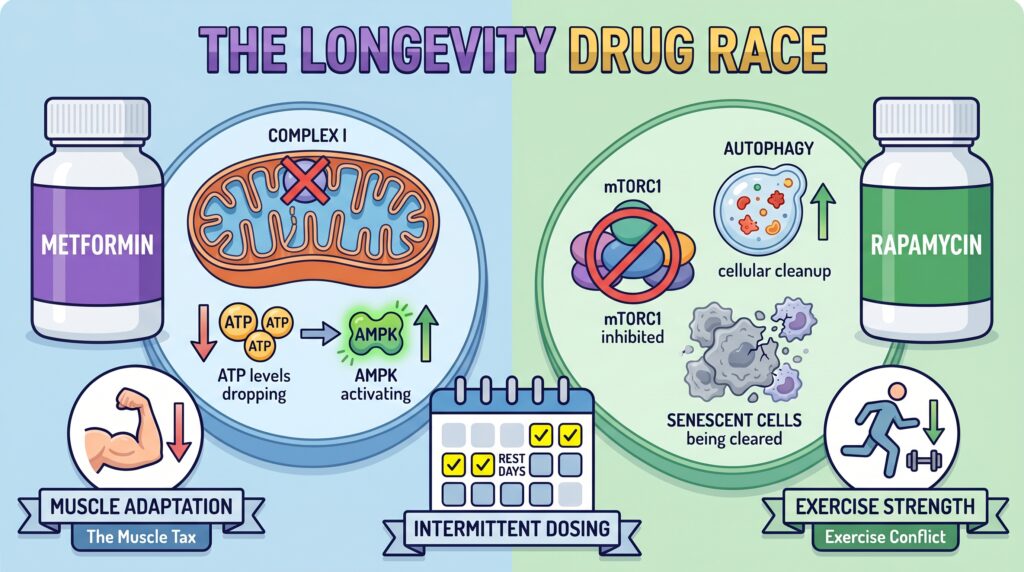
Metformin acts as a mild, transient toxin to your cellular power plants. It subtly inhibits Complex I of the mitochondrial electron transport chain. This slight disruption causes a drop in cellular energy (ATP). Your body detects this drop and activates AMPK (AMP‑activated protein kinase), the master energy sensor. AMPK acts like a biological austerity check: it shuts down fat and glucose production, forces the body to pull sugar out of the bloodstream, and mimics the cellular benefits of severe caloric restriction.
The Grand Vision: The TAME Trial
Metformin’s biggest contribution to longevity isn’t just chemical; it is regulatory. Led by the American Federation for Aging Research (AFAR), the TAME trial is a massive, multi‑center study tracking over 3,000 older adults.
- The Regulatory Goal: TAME is not designed to see if Metformin cures a single disease. Instead, it tracks whether the drug delays the onset of all major age‑related chronic diseases (cancer, cardiovascular disease, dementia). If successful, it will force the FDA to recognize “aging” itself as a treatable medical condition, opening the floodgates for insurance coverage and drug development.
The Catch: The Muscle Tax
Metformin is an exceptional tool for those with metabolic dysfunction, but for completely healthy, active adults, human data has revealed a major caveat. The MASTERS trial showed that Metformin can actively blunt the hyper‑adaptation to exercise. Because it inhibits mitochondrial energy production, it curtails the gains in muscle mass and VO₂ max that you would normally achieve from a rigorous workout routine.
Internal Link: VO₂ max is the #1 predictor of longevity. Read VO₂ Max: Why Cardiorespiratory Fitness Is the Number One Predictor of Longevity.
Rapamycin: The Cellular Dimmer Switch
If Metformin is a gentle metabolic nudge, Rapamycin is a precision sledgehammer targeting the root architecture of growth and decay. Discovered in the 1970s as a byproduct of the soil bacterium Streptomyces hygroscopicus, it was initially approved at high doses to prevent organ rejection in kidney transplant patients.
The Molecular Mechanism
Rapamycin is the most potent natural inhibitor of mTORC1 (mechanistic target of rapamycin complex 1). As discussed in longevity architecture, mTOR is the general manager of cell growth. When mTOR is active, cells build protein, divide, and grow.
When Rapamycin suppresses mTORC1, it acts like a cellular dimmer switch. It shifts the cell out of “growth mode” and directly into autophagy (deep cellular cleanup). It forces cells to recycle damaged proteins, clear out senescent “zombie” cells, and quiet down the systemic, age‑related inflammation known as inflammaging. In mice, Rapamycin consistently extends lifespan by 10–25%, even when started late in life.
Internal Link: Autophagy is a key longevity pathway. See Autophagy Activation: How Fasting Triggers Cellular Cleanup.
The Human Reality: PEARL and RAPA‑EX‑01
Translating mouse data to humans has provided a sobering reality check.
- The PEARL Trial: The highly anticipated PEARL trial evaluated low‑dose, weekly Rapamycin in healthy older adults. The primary hypothesis failed—Rapamycin did not significantly reduce visceral belly fat. However, secondary data revealed fascinating, sex‑specific benefits: women taking the higher dose (10 mg/week) experienced significant improvements in lean muscle mass and reductions in self‑reported pain.
- The Exercise Conflict (RAPA‑EX‑01): Published clinical data from the RAPA‑EX‑01 trial evaluated whether combining weekly Rapamycin with an exercise program enhanced functional gains in older adults. The results were clear: Rapamycin did not help. In fact, it modestly attenuated the strength gains from the exercise program and increased the burden of minor side effects (like mouth ulcers).
Internal Link: Exercise is essential for longevity. Read Zone 2 Cardio vs. HIIT for Longevity.
Head‑to‑Head: The Longevity Contenders
| Biological Feature | Metformin | Rapamycin (Sirolimus) |
|---|---|---|
| Original Indication | Type 2 Diabetes | Organ Transplant Immunosuppression |
| Primary Cellular Target | AMPK Activation (via Mitochondrial Complex I) | Direct mTORC1 Inhibition |
| Longevity Pathway | Mimics caloric restriction; optimizes insulin sensitivity | Triggers profound autophagy; clears senescent cells |
| Major Human Trial | TAME Trial | PEARL Trial / VIBRANT (ovarian aging) |
| The Primary “Catch” | Blunts muscle and VO₂ max adaptations to exercise; risk of B12 deficiency | Can suppress muscle protein synthesis; can cause mouth sores and lipid shifts |
Internal Link: Clearing senescent cells is another approach. See Senolytics: How to Flush Zombie Cells Out of Your Body.
The Verdict: Intermittent Dosing Is the Future
The pharmaceutical race to slow human aging has made one thing abundantly clear: you cannot safely keep the cellular repair switch turned on permanently. Both Metformin and Rapamycin operate by convincing your body that it is starving, triggering emergency cleanup protocols that protect your DNA and clear out toxic debris. However, because they turn down the body’s growth pathways, they inherently conflict with the physical signals generated by weightlifting and intense exercise.
The future of pharmaceutical longevity belongs to a highly calculated, intermittent dosing protocol—knowing exactly when to use these molecules to clean the cellular slate, and when to turn them off to allow the body to build back stronger.
Eleanor now follows a weekly schedule: Metformin on Monday–Friday, off on Saturday and Sunday (her hardest training days). She also checks her B12 levels annually and prioritizes protein intake. “I’m not afraid of medication,” she says. “I’m just smarter about when I use it.”
Internal Link: Metabolic flexibility supports both drug efficacy and exercise recovery. Read Metabolic Flexibility: How to Train Your Body to Switch Between Carbs and Fat.
FAQ: Metformin and Rapamycin for Longevity
Q: Can I take Metformin or Rapamycin for anti‑aging if I am healthy and not diabetic?
A: Off‑label use is controversial. Metformin is generally safer and has decades of safety data, but the muscle‑blunting effect is real. Rapamycin has more significant side effects (mouth ulcers, lipid elevations, potential immune suppression). Most longevity physicians recommend starting with lifestyle interventions (diet, exercise, sleep) before adding any pharmaceutical. If you are curious, discuss with a knowledgeable doctor.
Q: Do these drugs interfere with exercise gains?
A: Yes, both can. The MASTERS trial showed Metformin blunts the VO₂ max and muscle mass gains from exercise. The RAPA‑EX‑01 trial showed Rapamycin modestly attenuated strength gains from a resistance program. Intermittent dosing (taking the drug only on rest days or a few days per week) may mitigate this conflict.
Q: What are the common side effects of long‑term use?
A: Metformin: gastrointestinal distress (diarrhea, nausea), vitamin B12 deficiency (annual monitoring recommended), and potentially reduced exercise adaptation. Rapamycin: mouth ulcers, elevated LDL cholesterol and triglycerides, fatigue, and increased infection risk due to immune modulation.
Q: Is the TAME trial finished? When will we have results?
A: The TAME trial is ongoing. Results are expected in the late 2020s. If successful, it would be the first trial to convince the FDA that aging itself is a treatable condition.
Q: Which is better for longevity: Metformin or Rapamycin?
A: There is no clear winner. Metformin has better safety data and is more studied in humans, but its effects may be limited to those with metabolic dysfunction. Rapamycin is more potent in animal models, but human data is mixed and side effects are more concerning. Many researchers believe combination or cycling strategies will ultimately win.
Q: Can I just take these drugs instead of fasting or exercising?
A: No. Neither drug replicates the full benefits of lifestyle interventions. Exercise improves VO₂ max, muscle mass, bone density, and mental health in ways no pill can match. Fasting triggers autophagy through a different (and broader) pathway than either drug. Think of these molecules as adjuncts to a healthy lifestyle, not replacements.
Metformin anti‑agin
Metformin
, Rapamycin longevity
TAME trial, PEARL trial
MASTERS trial
RAPA‑EX‑01
AMPK vs mTOR
Metformin vs Rapamycin aging
pharmaceutical longevity
intermittent dosing
muscle adaptation

Julian Vance is the writer and editor behind RegenStep, translating peer-reviewed longevity, metabolic, and gut-health research into practical, actionable guides. Julian is not a licensed physician; content is reviewed against cited primary sources and is for informational purposes only. Always consult a qualified healthcare provider for personal medical advice.