
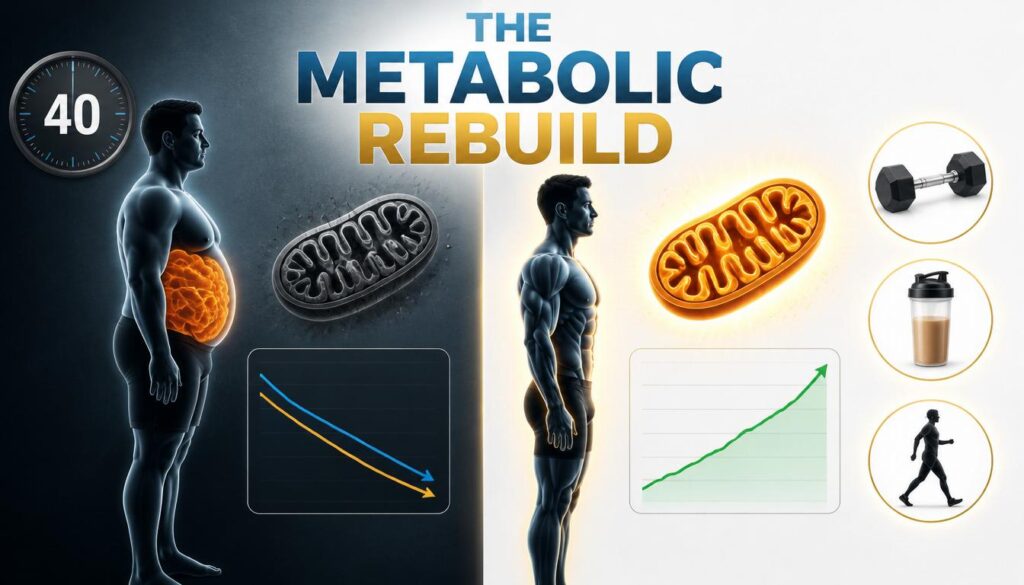
You hit your 40th birthday, and suddenly, the biological rules seem to change. You are eating the exact same diet and doing the exact same cardio routines that kept you lean in your 30s, but now the scale is creeping up, your energy is tanking, and a stubborn layer of visceral fat is settling around your midsection.
For decades, the medical community told us this was simply the inevitable reality of aging. We were told that our basal metabolic rate (BMR) just “breaks” after 40.
Recent landmark science has completely shattered that myth.
A massive 2021 study published in the journal Science analyzed the metabolic rates of 6,400 people across 29 countries. The shocking result? Human metabolism does not naturally slow down between the ages of 20 and 60.
If your metabolism hasn’t biologically crashed, why is it so much harder to lose weight after 40? The answer lies not in an unavoidable biological clock, but in a gradual, silent shift in your body composition, cellular efficiency, and hormone profile.
Let me introduce you to David, a 45‑year‑old accountant who thought his metabolism was permanently broken. “I was eating the same lunch I ate at 30, but I gained 20 pounds and felt exhausted all the time,” he told me. “My doctor said it was just aging.”
David wasn’t broken. He had simply lost muscle mass, his mitochondria were sluggish, and his testosterone had dropped. We shifted his focus to building muscle, protein timing, and Zone 2 cardio. Within six months, he lost 18 pounds, his energy returned, and his body composition transformed. “I didn’t need to eat like a bird,” he says. “I needed to train like an athlete.”
Here is the exact cellular science of why your metabolism feels broken after 40, and the actionable biohacking protocols to rebuild your metabolic engine.
External Link: A 2021 study in Science analyzed the metabolic rates of 6,400 people across 29 countries and found that metabolism remains stable between ages 20 and 60. Read more here.
The Big Three: Why Your Metabolism Actually Slows Down
If your internal metabolic rate remains stable until 60, what is causing the mid‑life weight gain? The “slowdown” is actually a combination of three highly reversible physiological traps.
1. The Sarcopenia Trap (Muscle Loss)
Muscle tissue is incredibly metabolically expensive; it burns calories 24/7 just to exist. Starting around age 30, adults who do not actively engage in heavy resistance training begin to lose 3% to 8% of their muscle mass per decade—a condition known as Sarcopenia.
By the time you hit 40, you may weigh the same on the scale as you did at 25, but you are carrying significantly less muscle and significantly more fat. Because you have a smaller metabolic “engine,” your body requires fewer calories to survive. If you eat the same amount of food you did in your 20s, you will now store it as fat.
2. Mitochondrial Dysfunction
Your mitochondria are the microscopic power plants inside your cells responsible for converting food and oxygen into energy (ATP). As we age, oxidative stress and environmental toxins damage these power plants. They become sluggish and inefficient.
Instead of burning fat for fuel, dysfunctional mitochondria struggle to process energy, leading to profound chronic fatigue. Because your cells aren’t burning energy efficiently, your body defaults to storing the excess calories in your adipose (fat) tissue.
3. The Hormonal Shift (Estrogen and Testosterone)
In our 40s, both men and women experience a significant shift in sex hormones.
| Gender | Hormonal Change | Metabolic Effect |
|---|---|---|
| Women (Perimenopause) | Estrogen levels drop | Estrogen protects against insulin resistance; its loss causes fat storage to shift from hips/thighs to visceral belly fat |
| Men (Andropause) | Testosterone levels decline | Testosterone drives muscle protein synthesis; its loss accelerates lean muscle loss, shrinking BMR |
Internal Link: Visceral fat is driven by hormonal shifts. Read Insulin Resistance Symptoms: 7 Warning Signs Your Body Is Sending You.
The Reversal Protocol: Rebuilding the Metabolic Engine (What David Did)
You cannot fix a 40‑year‑old metabolism by eating like a bird and spending an hour on the elliptical machine. Severe caloric restriction will only cannibalize the little muscle you have left, slowing your metabolism even further. You must trigger a structural adaptation.
1. Lift Heavy: The Muscle Protein Synthesis Trigger
To reverse Sarcopenia, you must send a mechanical signal to your body that it requires muscle to survive. Heavy resistance training (lifting weights in the 5‑to‑10 rep range) causes micro‑tears in the muscle fibers. In response, your body spends massive amounts of calories repairing and building denser muscle tissue.
By adding just 3 to 5 pounds of lean muscle to your frame, you permanently increase your 24/7 resting metabolic rate.
David started lifting weights twice a week. “I started with just 20‑minute sessions,” he says. “Within two months, I could see my shoulders changing. The weight on the scale didn’t move much at first, but my clothes were looser.”
2. Prioritize the Leucine Threshold
As you age, your body becomes less efficient at using the protein you eat—a phenomenon called anabolic resistance. To force your muscles to grow, you must hit the Leucine Threshold.
Leucine is the amino acid that flips the switch for muscle building (mTOR). To hit this threshold, you need to consume at least 30 to 40 grams of high‑quality protein per meal. Snacking on 10 grams of protein here and there will not trigger the metabolic response.
Internal Link: Protein is essential for metabolic health. Read Metabolic Flexibility: How to Train Your Body to Switch Between Carbs and Fat.
3. Zone 2 Cardio for Mitochondrial Biogenesis
To fix broken mitochondria, you need to force your cells to build new ones. This process is called Mitochondrial Biogenesis, and its ultimate trigger is Zone 2 Cardio.
Zone 2 is steady‑state cardiovascular exercise (like brisk walking, light cycling, or rucking) done at a conversational pace (roughly 60‑70% of your max heart rate) for 45 to 60 minutes. Zone 2 specifically trains your cells to burn fat for fuel rather than carbohydrates, restoring your metabolic flexibility.
David swapped his high‑intensity spin classes for daily 45‑minute incline walks. “I thought I wasn’t working hard enough,” he says. “But my energy improved, and the fat started melting.”
Internal Link: Zone 2 cardio is the foundation of mitochondrial health. Read Zone 2 Cardio vs. HIIT for Longevity.
The Metabolic Reversal Matrix
| Intervention | Mechanism | Impact on Metabolism | Protocol |
|---|---|---|---|
| Heavy Resistance Training | Triggers muscle protein synthesis; increases muscle mass | High (permanent increase in resting metabolic rate) | 2‑3 sessions/week, 5‑10 rep range |
| Leucine Threshold (30‑40g protein/meal) | Activates mTOR; overcomes anabolic resistance | High (stimulates muscle growth) | 30‑40g protein per meal |
| Zone 2 Cardio | Drives mitochondrial biogenesis; restores fat oxidation | High (improves metabolic flexibility) | 45‑60 min daily, conversational pace |
| Sleep Optimization | Lowers cortisol; supports muscle repair | Moderate (foundational) | 7‑8 hours, consistent schedule |
The Bottom Line: You Are Not Broken
David now follows a weekly routine: two heavy resistance training sessions, daily Zone 2 cardio, and 30‑40g of protein at each meal. “I used to think my metabolism was destiny,” he says. “Now I know it’s something I can actively rebuild.”
Your metabolism does not break at 40. But it does respond to the signals you send it. If you stop challenging your muscles, stop building mitochondria, and stop managing hormones, your body will adapt accordingly. If you start lifting, start feeding muscle, and start moving in the right zones, your metabolism will adapt right back.
FAQ: Metabolism After 40
Q: Does human metabolism naturally slow down at age 40?
A: No. Landmark clinical research (the 2021 Science study involving 6,400 participants across 29 countries) reveals that your basal metabolic rate (adjusted for fat‑free mass) remains incredibly stable between the ages of 20 and 60. The perceived “slowdown” is actually caused by progressive loss of lean muscle mass and a decrease in daily non‑exercise physical activity (NEAT).
Q: Why am I gaining belly fat in my 40s even though my diet hasn’t changed?
A: As sex hormones decline (estrogen in women, testosterone in men), the body becomes more susceptible to insulin resistance. High insulin levels combined with chronic stress (cortisol) force the body to redistribute fat storage, moving it from the extremities directly to the visceral area deep inside the abdomen.
That redistribution toward visceral fat is largely insulin-driven, which is why the diet chapter matters most after 40 — see the foods that improve insulin resistance.
Q: What is the worst exercise for metabolism after 40?
A: Endless, moderate‑intensity “chronic cardio” combined with severe caloric restriction is the worst combination. This protocol raises cortisol (stress hormones) and triggers the body to cannibalize lean muscle tissue for energy, which ultimately slows down your resting metabolic rate and makes rebound weight gain inevitable.
Q: How much protein do I need over 40 to protect my metabolism?
A: Due to age‑related anabolic resistance, adults over 40 should aim for a higher daily protein intake to preserve lean muscle mass. The clinical consensus suggests aiming for 0.8 to 1 gram of protein per pound of your target body weight, ideally distributed into large doses of 30‑40+ grams per meal.
Q: Can I reverse metabolism slowdown without lifting weights?
A: It is possible but much harder. Resistance training is the most potent signal for muscle preservation. Without it, any weight loss will include significant muscle loss, which will lower your resting metabolic rate. If you cannot lift weights, use bodyweight exercises (push‑ups, squats, lunges) or resistance bands.
Q: Does intermittent fasting help or hurt metabolism after 40?
A: Intermittent fasting can be highly effective when done correctly. However, if you are also in a severe caloric deficit, fasting can accelerate muscle loss. To protect your metabolism, ensure you are hitting your protein target within your eating window and including resistance training. A 16:8 schedule with adequate protein is generally safe and effective.

Julian Vance is the writer and editor behind RegenStep, translating peer-reviewed longevity, metabolic, and gut-health research into practical, actionable guides. Julian is not a licensed physician; content is reviewed against cited primary sources and is for informational purposes only. Always consult a qualified healthcare provider for personal medical advice.