
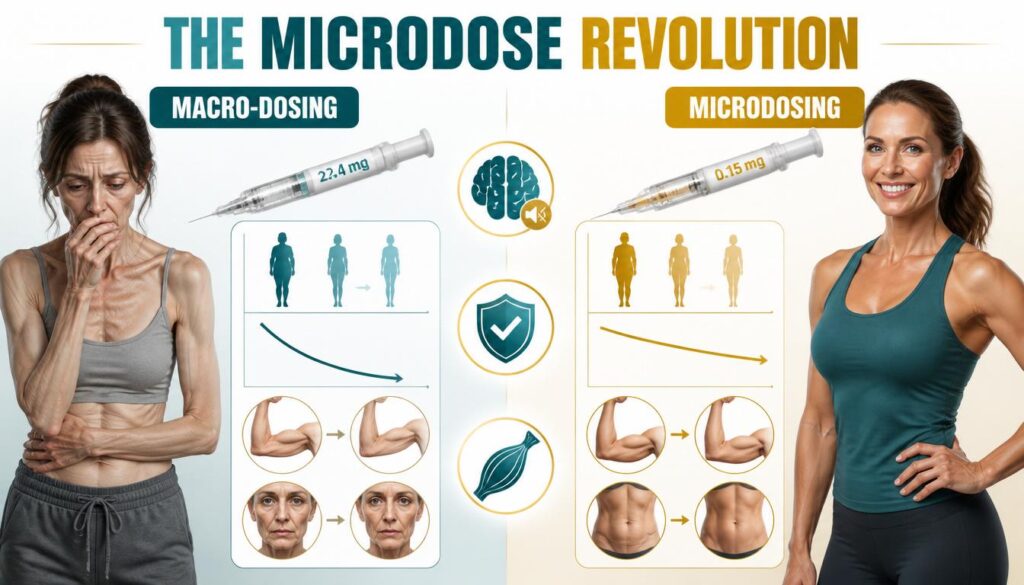
The GLP‑1 receptor agonist revolution is here. Medications like Ozempic, Wegovy, and Mounjaro have completely rewired the landscape of modern obesity medicine. But as millions of patients ramp up to the maximum clinical dosages, a startling reality has emerged: the biological cost of rapid, pharmaceutical weight loss is incredibly high.
Standard high‑dose protocols often result in profound nausea, severe lean muscle wasting (sarcopenia), gastrointestinal paralysis, and the rapid facial volume loss known as “Ozempic Face.”
In response, the functional medicine and biohacking communities have pioneered a radical new approach to these peptides: GLP‑1 Microdosing.
Instead of using the drug to bludgeon the appetite into submission, doctors are using fractional doses to gently repair metabolic signaling, lower systemic inflammation, and eliminate cravings—without sacrificing muscle mass or quality of life. But is it safe? And what does the science actually say?
Let me introduce you to Jennifer, a 44‑year‑old marketing director who had struggled with metabolic syndrome and stubborn weight for years. “I knew Ozempic worked,” she told me. “But I was terrified of the stories about muscle loss, nausea, and looking gaunt. I didn’t want to lose my face along with the weight.”
Jennifer’s doctor suggested a microdosing protocol: starting at just 0.10 mg of semaglutide weekly, far below the standard starting dose of 0.25 mg, and staying there indefinitely. Within three months, her cravings had quieted, her inflammation markers dropped, and she lost 6 pounds of pure fat without losing muscle. “I never had nausea,” she says. “I actually felt like my metabolism was healing, not being forced.”
Jennifer’s experience reflects what many functional medicine practitioners are now observing. Here is the exact science behind GLP‑1 microdosing and why it is becoming the ultimate metabolic longevity hack.
External Link: A 2026 commentary in the Journal of the American Association of Nurse Practitioners highlighted the growing trend of GLP‑1 microdosing and the associated risks.
Whatever dose you take, the diet underneath decides the result. Start with our complete guide to eating for insulin resistance.
What Is GLP‑1 Microdosing?
The standard FDA‑approved titration schedule for a drug like Semaglutide (Ozempic/Wegovy) starts at 0.25 mg and systematically ramps up to a maximum dose of 2.4 mg. The primary objective is to maximize gastric emptying delay and induce a massive caloric deficit.
Microdosing flips this protocol upside down. A microdosing protocol involves starting at a fraction of the standard dose (sometimes as low as 0.05 mg to 0.125 mg) and staying there indefinitely. The patient never titrates up to the maximum dose. The goal is no longer rapid, shocking weight loss. The goal is to find the Minimum Effective Dose—the exact threshold where metabolic benefits are triggered, but the severe gastrointestinal side effects are avoided.
Internal Link: Understanding your metabolic baseline is key. Read Insulin Resistance Symptoms: 7 Warning Signs Your Body Is Sending You.
The 3 Biological Benefits of the Microdose
When you stop trying to starve the body and instead focus on metabolic repair, GLP‑1 agonists reveal three profound biological benefits that go far beyond the number on the scale.
1. Silencing “Food Noise” and Addiction Pathways
GLP‑1 receptors are not just located in the gut and pancreas; they are incredibly dense in the brain, particularly in the hypothalamus and the mesolimbic reward system (the dopamine center).
For people struggling with metabolic dysfunction, the brain constantly fixates on the next meal—a phenomenon known as “food noise.” A microdose of a GLP‑1 agonist stabilizes dopamine signaling in the brain. It quietens the obsessive thoughts about food, sugar, and even alcohol, returning the patient to a state of normal, neutral biological hunger.
2. Lowering Systemic “Silent” Inflammation
As highlighted in advanced blood panels, chronic, low‑grade inflammation (measured by hs‑CRP) is the primary driver of cardiovascular disease and biological aging.
Recent clinical trials have revealed that GLP‑1 medications are profoundly anti‑inflammatory. They directly reduce neuro‑inflammation in the brain and systemic inflammation in the blood vessels. Emerging research suggests that by lowering inflammation and improving insulin sensitivity, microdosed GLP‑1s may help break the cycle of hormonal imbalance that drives symptoms in conditions like PCOS.
Internal Link: Silent inflammation drives aging. Read Silent Inflammation Markers: The Blood Tests Your Doctor Isn’t Ordering.
3. Avoiding the Sarcopenia Trap (Muscle Loss)
The greatest danger of standard‑dose Ozempic is that patients lose their appetite entirely. When you only eat 800 calories a day, it is mathematically impossible to consume the 100+ grams of protein required to maintain your muscle mass. The body enters starvation mode and actively cannibalizes skeletal muscle for energy.
Because a microdose only blunts the appetite rather than destroying it, patients can easily consume enough calories to hit their “Leucine Threshold” (30‑40g of protein per meal). This allows them to lift heavy weights, protect their basal metabolic rate, and lose pure body fat rather than lean tissue.
Internal Link: Muscle preservation is critical after 40. Read Why Your Metabolism Slows After 40 (And the Science to Reverse It).
The Contrast: Macro‑Dosing vs. Micro‑Dosing
What Does the Science Say? (The 2026 Reality Check)
Despite the growing popularity of GLP‑1 microdosing, experts urge caution.
The Data Gap
There is no rigorous scientific data to support microdosing, according to bariatric medicine specialist Katy Williams of the University of Missouri. Clinical pharmacist Anne Komé of the University of North Carolina echoes this, stating that “there isn’t enough data to confirm that microdosing can help you live longer.”
The Regulatory Reality
All GLP‑1 medications come with strict, FDA‑approved titration schedules designed by pharmaceutical companies. Microdosing is strictly an “off‑label” approach. As Yale Medicine’s Dr. Jorge Moreno explains, microdosing refers to taking “a dose below the lowest available dose approved by the FDA.”
The Risks
Internal Link: Gut health affects medication absorption. Read SIBO: The Hidden Gut Infection Behind 78% of IBS Cases.
The Microdosing Protocol: What It Looks Like
For Ozempic, each pen has 72 unnumbered clicks, allowing health care professionals to adjust dosage based on how much medication the pen contains. The manufacturer beyond‑use date is 56 days. For Zepbound, single‑use vials do not have preservatives, which could lead to safety concerns if used multiple times.
The Off‑Ramp Strategy: Microdosing to Maintain Weight Loss
Many physicians use a microdosing protocol as an “off‑ramp.” Instead of quitting the medication “cold turkey”—which almost always results in a massive surge of returning hunger and rebound weight gain—patients slowly taper down to a microdose, allowing their natural metabolism and gut microbiome to adapt over several months.
Internal Link: Metabolic flexibility is key to sustainable weight management. Read Metabolic Flexibility: How to Train Your Body to Switch Between Carbs and Fat.
The Bottom Line: Slow and Steady Wins the Race
Jennifer now follows a stable microdosing protocol: 0.15 mg of semaglutide weekly, paired with strength training and a protein‑rich diet. “I don’t feel like I’m on a drug,” she says. “I feel like my body finally works the way it’s supposed to.”
GLP‑1 microdosing is not a magic bullet. It is an off‑label, experimental approach with real risks and limited data. But for patients who cannot tolerate standard doses or who want to avoid muscle loss and facial aging, it represents a promising frontier in personalized metabolic medicine.
The golden rule? Never microdose without medical supervision. And never forget that the drug is only one piece of the puzzle—diet, exercise, and sleep remain the foundation.
FAQ: GLP‑1 Microdosing
Q: What is considered a microdose of a GLP‑1?
A: While there is no official medical consensus, functional medicine practitioners generally consider a microdose to be anything below the standard starting clinical dose (e.g., 0.05 mg to 0.25 mg for Semaglutide, or 1.0 mg to 2.5 mg for Tirzepatide) maintained long‑term without titrating upward.
Q: Is GLP‑1 microdosing approved by the FDA?
A: No. Microdosing is strictly an “off‑label” approach. There are no clinical trials validating its safety or efficacy.
Q: Do you still lose weight on a microdose?
A: Yes, but at a much slower, more sustainable pace (typically 0.5 to 1 pound per week). One study found that participants on the lowest trial dose of semaglutide (0.05 mg/day) achieved 6.3%‑6.8% weight loss over one year.
Q: Can I microdose to get off Ozempic without gaining the weight back?
A: Yes. Many physicians use a microdosing protocol as an “off‑ramp” —slowly tapering down to allow natural metabolism to adapt.
Q: Why are so many doctors pushing GLP‑1?
A: GLP‑1 medications are highly effective for weight loss and blood sugar control. However, microdosing specifically is driven by patient demand for fewer side effects and lower costs, not by formal clinical guidelines.
Q: How do you microdose a GLP‑1?
A: Only with medical supervision. For Ozempic, dosing is adjusted by counting “clicks” on the pen. For Zepbound, single‑use vials pose safety risks if reused. Always consult a healthcare provider.

Julian Vance is the writer and editor behind RegenStep, translating peer-reviewed longevity, metabolic, and gut-health research into practical, actionable guides. Julian is not a licensed physician; content is reviewed against cited primary sources and is for informational purposes only. Always consult a qualified healthcare provider for personal medical advice.