
You decide to radically clean up your diet. You start eating daily spinach salads topped with avocado, drinking bone broth, and adding fermented foods like kombucha and sauerkraut to heal your gut.
Instead of feeling amazing, you feel terrible. You develop sudden brain fog, a racing heart, unexplained hives, nasal congestion, and severe migraines.
You go to an allergist, but all your traditional allergy panels come back negative. You aren’t crazy, and you don’t have a traditional food allergy. You are likely dealing with a biochemical overflow problem known as Histamine Intolerance (HIT).
Let me introduce you to Sarah, a 41‑year‑old yoga instructor who decided to “heal her gut” with fermented foods. “I started drinking kombucha daily, adding sauerkraut to my meals, and eating bone broth,” she told me. “Within a week, I had migraines, heart palpitations, and my skin broke out in hives. My doctor said I was fine.”
Sarah wasn’t fine. She had histamine intolerance. Her gut was damaged, her DAO enzyme production was low, and the fermented foods were flooding her histamine bucket. We shifted her to a low‑histamine elimination diet, added exogenous DAO supplementation before meals, and focused on healing her gut lining. Within six weeks, her symptoms resolved completely. “I was trying to heal myself,” she says, “but I was actually making myself sick.”
Sarah’s story is not uncommon. Here is the exact cellular science of why perfectly “healthy” foods can trigger massive systemic inflammation, what is happening to your gut enzymes, and the functional protocols to empty your histamine bucket.
External Link: A 2024 review in Nutrients confirmed that histamine intolerance is a distinct clinical entity with diagnostic and therapeutic challenges. Read more here.
Food reactions are a signal from the wider gut-brain-skin axis.
The “Bucket” Theory: What Is Histamine Intolerance?
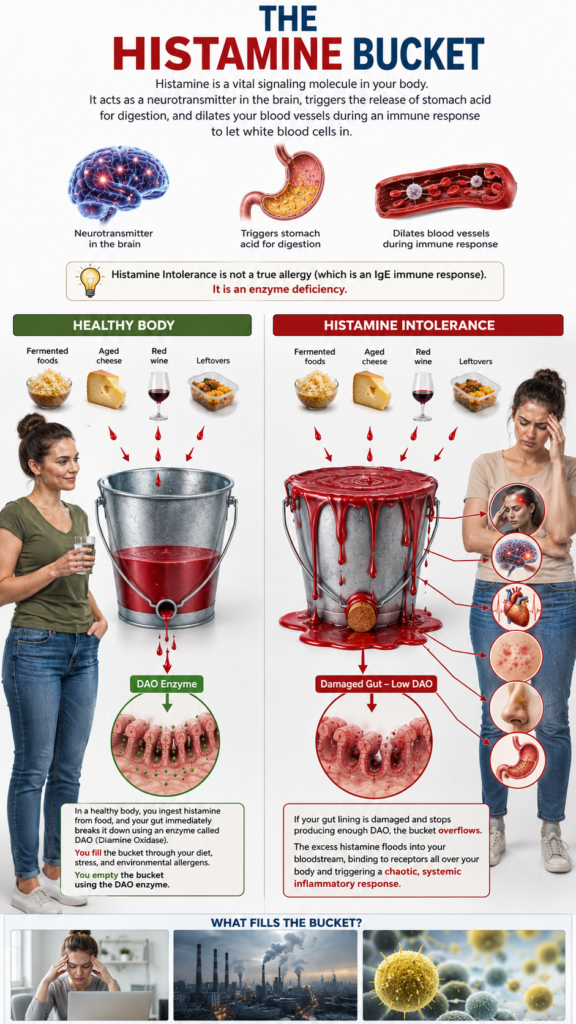
First, histamine is not the enemy. It is a vital signaling molecule in your body. It acts as a neurotransmitter in the brain, triggers the release of stomach acid for digestion, and dilates your blood vessels during an immune response to let white blood cells in.
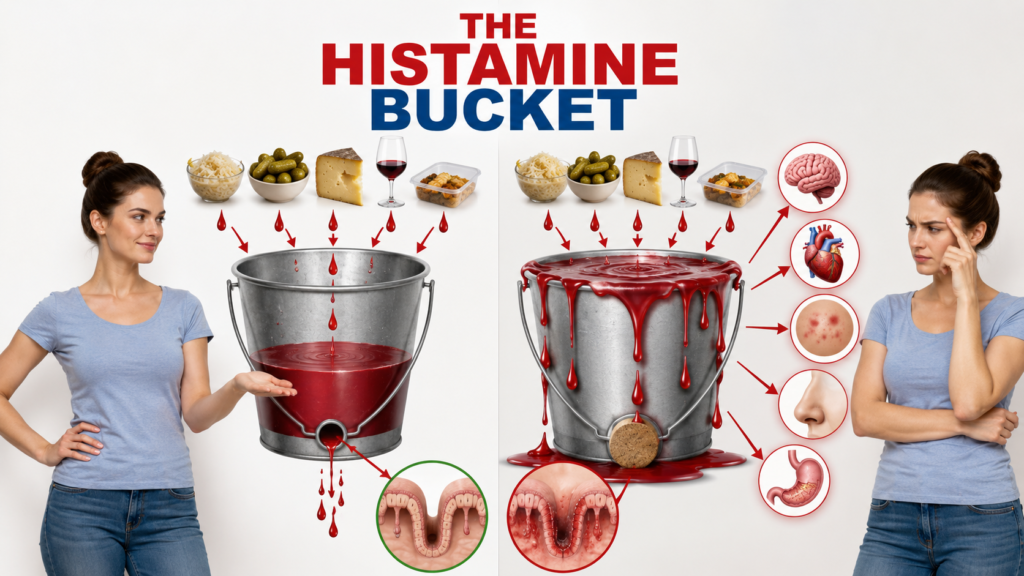
In a healthy body, you ingest histamine from food, and your gut immediately breaks it down using an enzyme called DAO (Diamine Oxidase).
Histamine Intolerance is not a true allergy (which is an IgE immune response). It is an enzyme deficiency.
You can think of your body as a histamine bucket:
- You fill the bucket through your diet, stress, and environmental allergens.
- You empty the bucket using the DAO enzyme.
If your gut lining is damaged and stops producing enough DAO, the bucket overflows. The excess histamine floods into your bloodstream, binding to receptors all over your body and triggering a chaotic, systemic inflammatory response.
Internal Link: Gut damage is often caused by underlying dysbiosis. Read The Dysbiosis Blueprint: The Silent Gut Collapse Sabotaging Your Metabolism.
The 6 Silent Signs Your Bucket Is Overflowing
Because histamine receptors are located everywhere—from your brain to your cardiovascular system—the symptoms of HIT are incredibly diverse, leading most doctors to misdiagnose it as generic anxiety or IBS.
| System | Symptoms |
|---|---|
| Cardiovascular | Sudden racing heart, palpitations, drop in blood pressure shortly after eating |
| Neurological | Severe migraines, persistent brain fog, intense unprovoked anxiety (histamine acts as an excitatory neurotransmitter) |
| Dermatological | Flushing (red, hot face), unexplained hives, eczema, chronic itching |
| Respiratory | Sudden runny nose, post‑nasal drip, asthma‑like wheezing after meals or wine |
| Digestive | Severe bloating, abdominal cramps, diarrhea |
| Sleep | Severe insomnia or waking up perfectly alert at 3:00 AM (histamine promotes wakefulness) |
The Trigger Foods: What to Avoid
When dealing with HIT, it is not just about avoiding “junk” food. You must avoid foods that either contain high levels of histamine or act as “histamine liberators” (foods that trigger your own mast cells to release histamine).
The Highest Histamine Foods
| Category | Examples |
|---|---|
| Fermented Foods | Kombucha, sauerkraut, kefir, yogurt, kimchi (bacteria produce histamine during fermentation) |
| Aged Foods | Aged cheeses (cheddar, gouda, parmesan), cured meats (salami, pepperoni, bacon), aged steaks |
| Alcohol | Red wine and beer (high histamine + actively block DAO enzyme) |
| Leftovers | Histamine levels in meat increase exponentially every day it sits in the fridge; freeze immediately after cooking |
Histamine Liberators
| Category | Examples |
|---|---|
| Fruits | Avocados, tomatoes, citrus fruits |
| Vegetables | Spinach, eggplant |
| Other | Chocolate, nuts, and some food additives |
The Root Cause: Why Did Your Enzyme Stop Working?
Histamine intolerance is rarely a primary disease; it is a secondary symptom of a deeper biological breakdown.
1. SIBO and Gut Dysbiosis
Bacterial overgrowth damages the delicate microvilli lining the small intestine. Because the microvilli are where the DAO enzyme is produced, severe gut damage directly halts DAO production.
Internal Link: SIBO is a common underlying cause. Read SIBO: The Hidden Gut Infection Behind 78% of IBS Cases.
2. Genetics (MTHFR & DAO SNPs)
Some people are genetically predisposed to produce lower levels of DAO or struggle to methylate and clear histamine from the liver. The MTHFR gene mutation (present in up to 40‑60% of the population) directly impacts methylation—the primary pathway for clearing histamine from your system.
3. Medications
Over‑the‑counter drugs like NSAIDs (ibuprofen) , antidepressants, and acid blockers actively inhibit the DAO enzyme.
The Biohacking Protocol: How to Fix HIT (What Sarah Did)
To reverse histamine intolerance, you have to tackle both sides of the equation: stop filling the bucket, and fix the leak.
1. The Low‑Histamine Elimination Diet
For 4 to 6 weeks, strictly remove all fermented foods, aged meats, alcohol, avocados, and tomatoes. Focus on eating fresh, flash‑frozen meats and low‑histamine vegetables (like broccoli, asparagus, and zucchini). This rapidly starves the histamine supply and gives your nervous system a break.
2. Exogenous DAO Supplementation
While you are healing your gut, you can temporarily outsource the enzyme work. You can take a DAO enzyme supplement 15 minutes before a meal. If you eat a meal with histamine, the exogenous DAO will break it down in your digestive tract before it can cross into your bloodstream.
3. Mast Cell Stabilizers (Quercetin & Vitamin C)
Your body’s immune cells (mast cells) contain histamine. You can make these cells less “leaky” by taking natural mast cell stabilizers. High doses of Vitamin C (a natural antihistamine) and Quercetin (a powerful plant polyphenol) help lock the histamine inside your mast cells, preventing systemic flares.
Internal Link: Quercetin is a powerful polyphenol. Read Polyphenol Power: The Cellular Science of Xenohormesis and Longevity.
4. Heal the Gut Lining
The ultimate cure for HIT is restoring your body’s ability to make its own DAO. This requires eradicating gut infections (like SIBO or Candida) and rebuilding the intestinal microvilli using supplements like:
- L‑Glutamine (5‑10g daily)
- Zinc Carnosine
- Bone broth (only once tolerated)
Internal Link: Gut repair is foundational. Read The Gut Reset Protocol: Repairing Your Intestinal Barrier for Metabolic Resilience.
The Histamine Intolerance Reversal Protocol
| Phase | Objective | Interventions | Timeline |
|---|---|---|---|
| Phase 1: Empty the Bucket | Reduce histamine load | Low‑histamine elimination diet; avoid fermented foods, leftovers, alcohol | 2‑4 weeks |
| Phase 2: Outsource DAO | Break down dietary histamine | DAO enzyme supplement before meals; quercetin & vitamin C | 4‑8 weeks |
| Phase 3: Heal the Gut | Restore natural DAO production | Eradicate SIBO/dysbiosis; L‑glutamine, zinc carnosine | 2‑6 months |
| Phase 4: Reintroduce | Slowly test tolerance | Reintroduce histamine foods one at a time; monitor symptoms | Ongoing |
The Bottom Line: Your Gut Is the Problem
Sarah now follows a maintenance protocol: a low‑histamine diet, DAO supplements on high‑histamine days, and daily L‑glutamine to support her gut lining. “I spent years thinking I was allergic to everything,” she says. “Now I know my gut was just broken.”
Histamine intolerance is rarely a permanent condition. It is a signal that your gut lining is damaged and your enzyme production is compromised. Fix the gut, and the bucket will stop overflowing.
FAQ: Histamine Intolerance
Q: Is histamine intolerance the same as a food allergy?
A: No. A food allergy involves the immune system producing IgE antibodies against a specific protein (like peanuts), triggering an immediate, life‑threatening reaction (anaphylaxis). Histamine intolerance is a metabolic enzyme deficiency where a chemical builds up over time and overflows.
Q: Can probiotics cure histamine intolerance?
A: Probiotics are a double‑edged sword for HIT. Many common probiotic strains (like Lactobacillus casei or Lactobacillus bulgaricus) actually produce histamine in the gut and will make your symptoms worse. If you have HIT, you must use specific histamine‑degrading strains (like Bifidobacterium infantis or Lactobacillus rhamnosus).
Q: Why do leftovers trigger my symptoms?
A: Bacteria naturally exist on all food. As food sits in the refrigerator, these bacteria break down the amino acid histidine into histamine. A chicken breast that is perfectly safe to eat on Monday can be a massive histamine trigger by Wednesday. Freezing stops this bacterial conversion.
Q: What foods make histamine intolerance worse?
A: High‑histamine foods: fermented foods (kombucha, sauerkraut, kefir, yogurt), aged cheeses, cured meats, red wine, beer, and leftovers. Histamine liberators: avocados, tomatoes, spinach, eggplant, chocolate, and citrus fruits.
Q: Does MTHFR cause histamine intolerance?
A: Yes. The MTHFR gene mutation (present in up to 40‑60% of the population) directly impacts methylation—the primary pathway for clearing histamine from your system. If you have MTHFR, your liver struggles to break down histamine, making you more susceptible to HIT.
Q: What foods can calm a histamine reaction?
A: Fresh, flash‑frozen meats, broccoli, asparagus, zucchini, and fresh herbs (basil, parsley). These are low in histamine and support gut healing. Vitamin C‑rich foods (in moderation) can help stabilize mast cells.
Q: What does a histamine intolerance flare‑up feel like?
A: A flare‑up can feel like a severe allergic reaction without a clear trigger: sudden headaches, a racing heart, intense anxiety, facial flushing, hives, nasal congestion, and severe bloating. Symptoms typically appear 30‑90 minutes after eating a high‑histamine meal.
Q: Is histamine intolerance permanent?
A: For the vast majority of people, no. Unless you have a severe genetic DAO deficiency, HIT is usually a temporary symptom of severe gut dysbiosis, SIBO, or a leaky gut. Once you eradicate the underlying gut infection and rebuild the intestinal lining, your body will resume normal DAO production and you can slowly reintroduce histamine foods.
The “Bucket” Theory: What Is Histamine Intolerance?
First, histamine is not the enemy. It is a vital signaling molecule in your body. It acts as a neurotransmitter in the brain, triggers the release of stomach acid for digestion, and dilates your blood vessels during an immune response to let white blood cells in. In a healthy body, you ingest histamine from food, and your gut immediately breaks it down using an enzyme called DAO (Diamine Oxidase). Histamine Intolerance is not a true allergy (which is an IgE immune response). It is an enzyme deficiency. You can think of your body as a histamine bucket: If your gut lining is damaged and stops producing enough DAO, the bucket overflows. The excess histamine floods into your bloodstream, binding to receptors all over your body and triggering a chaotic, systemic inflammatory response.
The Root Cause: Why Did Your Enzyme Stop Working?
Histamine intolerance is rarely a primary disease; it is a secondary symptom of a deeper biological breakdown.

Julian Vance is the writer and editor behind RegenStep, translating peer-reviewed longevity, metabolic, and gut-health research into practical, actionable guides. Julian is not a licensed physician; content is reviewed against cited primary sources and is for informational purposes only. Always consult a qualified healthcare provider for personal medical advice.