
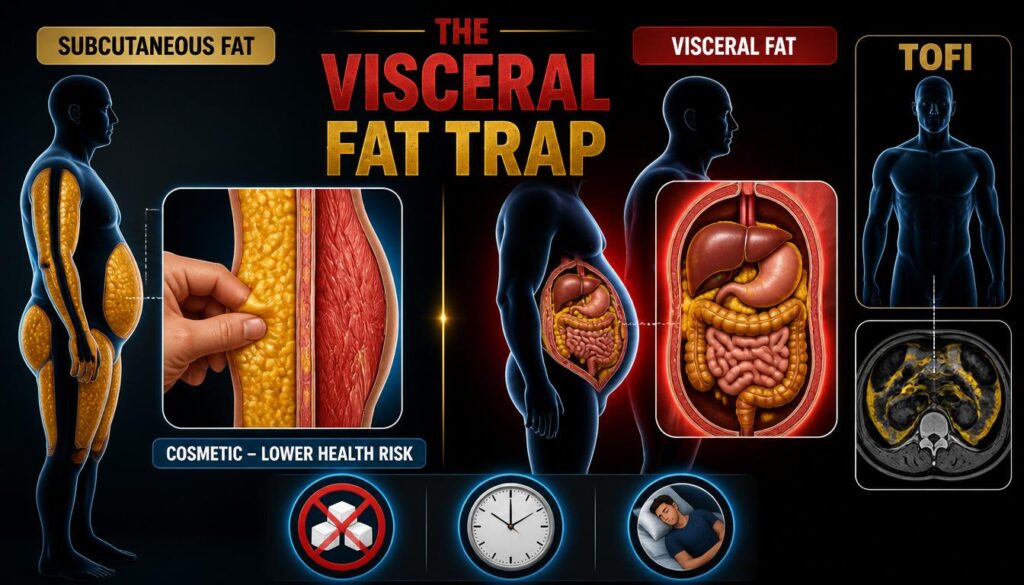
When most people look in the mirror and decide they need to lose weight, they are usually staring at the fat they can physically pinch—the soft tissue on their arms, thighs, or lower abdomen. We spend billions of dollars on cosmetic procedures, fad diets, and waist trainers trying to get rid of it.
But from a biological standpoint, you are fighting the wrong enemy.
The fat you can pinch is mostly cosmetic. The fat that is actively destroying your health, accelerating biological aging, and driving metabolic disease is the fat you cannot see.
Let me introduce you to Mark, a 49‑year‑old accountant who looked healthy on the outside. “I’m not overweight,” he told me. “My BMI is normal. But I have this hard belly that won’t budge, and my blood work is getting worse every year.”
Mark was a classic TOFI (Thin Outside, Fat Inside). He had a normal BMI but significant visceral fat wrapped around his organs. His fasting insulin was elevated, his hs‑CRP was high, and he was heading toward prediabetes. We shifted his focus to a visceral fat reduction protocol: eliminating liquid fructose, implementing time‑restricted eating, and managing his cortisol. Within six months, his waist shrank, his blood markers normalized, and he finally understood why his “normal” weight didn’t protect him. “I wasn’t fat,” he says. “But I was sick on the inside.”
Visceral fat and insulin resistance feed each other in a loop, so the eating pattern that lowers one lowers the other. The specifics are in our insulin resistance diet guide and 7-day meal plan.
Mark’s story is not uncommon. In the medical and biohacking communities, body fat is divided into two entirely different categories: Subcutaneous Fat and Visceral Fat. They don’t just look different; they act as completely different biological organs.
Here is the exact science of why visceral fat is a metabolic time bomb, how to tell if you have it, and the protocols to destroy it.
Subcutaneous Fat: The “Safe” Storage
Subcutaneous fat is the fat located directly beneath your skin. If you can pinch it, jiggle it, or grab it, it is subcutaneous.
Biologically speaking, this fat is relatively benign. Evolutionarily, it is exactly what fat was designed to be: a passive storage locker for excess energy and a layer of thermal insulation to keep you warm.
While carrying massive amounts of subcutaneous fat isn’t ideal for your joints, it does not actively attack your organs. In fact, people who genetically store most of their weight in their hips and thighs (a “pear” shape) generally have significantly lower rates of cardiovascular disease than those who store it in their midsection.
Visceral Fat: The Toxic Endocrine Organ
Visceral fat is the hard, deep fat that accumulates inside your abdominal cavity. It physically wraps itself around your vital organs—your liver, pancreas, intestines, and kidneys.
For decades, doctors thought visceral fat was just another storage locker. We now know that visceral fat is biologically active. It acts as a toxic endocrine organ.
Instead of just sitting there, visceral fat actively secretes inflammatory chemicals called adipokines and cytokines (like Interleukin‑6 and TNF‑alpha) directly into your bloodstream. These chemicals:
| Effect | Mechanism |
|---|---|
| Trigger Systemic Inflammation | Creates chronic, smoldering fire in blood vessels (raising hs‑CRP), driving arterial plaque buildup and heart disease |
| Cause Severe Insulin Resistance | Physically blocks muscle and liver cells from responding to insulin, keeping blood sugar high and pushing toward Type 2 Diabetes |
| Infiltrate the Liver | Drains directly into the portal vein, dumping free fatty acids into the liver, leading to Non‑Alcoholic Fatty Liver Disease (NAFLD) |
Internal Link: Visceral fat drives chronic inflammation. Read Silent Inflammation Markers: The Blood Tests Your Doctor Isn’t Ordering.
The TOFI Phenomenon: Thin Outside, Fat Inside
The most terrifying aspect of visceral fat is that you do not have to be clinically overweight to have it.
Medical science has identified a phenotype known as TOFI (Thin Outside, Fat Inside). These are individuals who look perfectly skinny in normal clothes and have a “normal” BMI on paper. However, because they eat a highly processed diet, consume high amounts of liquid fructose, and live highly stressed, sedentary lives, their abdominal cavities are packed with toxic visceral fat.
TOFIs are metabolic ticking time bombs; they suffer from the exact same rates of heart attacks, strokes, and diabetes as the clinically obese, but they receive no warning signs from the mirror or the bathroom scale.
How to Tell Which Fat You Have
The Pinch Test
- If your belly is large but soft, dimpled, and highly pinchable, it is mostly subcutaneous fat.
- If your belly is large, round, protrudes outward, and feels hard or firm to the touch (like a tight drum), that is visceral fat pushing your abdominal wall outward from the inside.
The Waist‑to‑Height Ratio
The golden rule of metabolic health is that your waist circumference (measured at the belly button) should be less than half of your height. If you are 72 inches tall, your waist must be under 36 inches. If it is higher, you are likely carrying dangerous visceral fat.
The Reversal Protocol: How to Destroy Visceral Fat (What Mark Did)
The good news? Visceral fat is extremely metabolically active. This makes it highly dangerous, but it also means it is the first fat your body will burn when you fix your biological inputs.
1. Eliminate Liquid Fructose
Fructose (found in sodas, fruit juices, and high‑fructose corn syrup) is processed exclusively by the liver. When you flood the liver with liquid fructose, it panics and converts the excess sugar directly into visceral fat through a process called de novo lipogenesis.
Cutting out sugary drinks is the single fastest way to halt visceral fat production. Mark eliminated all sugary beverages and replaced them with water and unsweetened tea.
2. Lower Fasting Insulin via Time‑Restricted Eating (TRE)
Because insulin is the body’s ultimate fat‑storage hormone, you cannot burn visceral fat while insulin is elevated. Implementing Time‑Restricted Eating (TRE) —such as fasting for 14 to 16 hours overnight—gives your pancreas a break, drops your baseline insulin to near zero, and forces your body to unlock visceral fat for fuel.
Mark started with a 14:10 schedule and worked up to 16:8 over two weeks.
Internal Link: Insulin resistance is a key driver of visceral fat. Read Insulin Resistance Symptoms: 7 Warning Signs Your Body Is Sending You.
3. Modulate Cortisol (The Stress Factor)
Chronic stress forces the body to preferentially store fat deep in the abdomen. High cortisol actually increases the number of glucocorticoid receptors in your visceral fat tissue. Prioritizing 7‑8 hours of sleep, practicing Zone 2 cardio instead of exhausting HIIT, and managing psychological stress are non‑negotiable for burning visceral fat.
Mark swapped his high‑intensity workouts for daily 45‑minute Zone 2 walks and prioritized sleep. “I stopped fighting my body,” he says. “I started supporting it.”
Internal Link: Cortisol drives visceral fat accumulation. Read Cortisol Belly Fat: Why Stress Hormones Stop You From Losing Weight.
The Visceral Fat Destruction Protocol
| Intervention | Mechanism | Impact on Visceral Fat | Protocol |
|---|---|---|---|
| Eliminate Liquid Fructose | Stops de novo lipogenesis in the liver | High (halts visceral fat production) | Cut sodas, fruit juices, HFCS |
| Time‑Restricted Eating (14‑16 hrs) | Lowers fasting insulin; unlocks fat stores | Very High (forces visceral fat burning) | 14‑16 hour daily fast |
| Zone 2 Cardio | Lowers cortisol; improves insulin sensitivity | High (burns visceral fat preferentially) | 45‑60 min daily, conversational pace |
| Sleep Optimization | Lowers cortisol; supports leptin/ghrelin | Moderate (foundational) | 7‑8 hours, consistent schedule |
The Bottom Line: You Can’t Spot‑Reduce, But You Can Target
Mark now follows a daily protocol: a 16‑hour fast, no sugary drinks, and a daily Zone 2 walk. “I spent years trying to lose belly fat with crunches,” he says. “Now I know the fat I can’t see is the one I actually need to fight.”
Visceral fat is not a cosmetic problem. It is a metabolic time bomb that drives inflammation, insulin resistance, and cardiovascular disease. But because it is highly metabolically active, it is also the first fat your body will burn when you lower insulin, eliminate fructose, and manage cortisol.
FAQ: Visceral vs Subcutaneous Fat
Q: What’s worse, subcutaneous fat or visceral fat?
A: Visceral fat is significantly worse. Subcutaneous fat (the fat you can pinch) is relatively benign and acts as a passive energy store. Visceral fat (the deep fat around your organs) is biologically active, secreting inflammatory chemicals that drive insulin resistance, heart disease, and metabolic syndrome. Think of subcutaneous fat as a “storage locker” and visceral fat as a “toxic factory.”
Q: Is visceral fat more concerning than subcutaneous fat – true or false?
A: True. Medical experts consistently agree that visceral fat is more harmful than subcutaneous fat. Even in people with a normal BMI, excess visceral fat is strongly linked to heart disease, type 2 diabetes, stroke, and certain cancers. The location of the fat matters far more than the total amount.
Q: Is 7.0 visceral fat bad?
A: It depends on the scale being used. On a 1‑59 scale (commonly used by bioelectrical impedance scales), a rating of 7.0 is generally considered healthy (1‑12 is typically normal). However, on an absolute measurement scale (like cm² or visceral fat area), 7.0 cm² would be low. Always check which scale your device or test uses. For the DEXA scan or MRI, visceral fat area should ideally be below 100 cm² for women and below 130 cm² for men.
Q: Do you lose visceral fat or subcutaneous fat first?
A: Visceral fat is typically lost first. Because visceral fat is highly metabolically active, it is more responsive to dietary changes, fasting, and exercise. When you enter a low‑insulin state (through fasting, carbohydrate reduction, or exercise), your body preferentially mobilizes visceral fat before subcutaneous fat. This is why waist circumference often decreases before visible changes in pinchable fat appear.
Q: Does liposuction remove visceral fat?
A: No. This is a massive, highly dangerous misconception. Liposuction and non‑invasive fat‑freezing procedures (like CoolSculpting) only remove subcutaneous fat (the cosmetic fat under the skin). Surgeons cannot use liposuction to remove visceral fat because it is woven around your vital organs and blood vessels. It can only be lost through metabolic and dietary interventions.
Q: Can you be skinny and have visceral fat?
A: Yes. This is called the TOFI (Thin Outside, Fat Inside) phenotype. People with normal BMIs who consume high amounts of processed foods, sugar, and alcohol can accumulate life‑threatening amounts of visceral fat around their organs without appearing overweight.
Q: What is the fastest way to lose visceral fat?
A: Because visceral fat is highly responsive to insulin, the fastest way to lose it is to strictly limit refined carbohydrates and fructose, eliminate alcohol, and practice intermittent fasting. Visceral fat is usually the very first type of fat the body burns when placed in a low‑insulin state.
Q: Why does visceral fat cause insulin resistance?
A: Visceral fat releases free fatty acids directly into the portal vein, which carries blood to the liver. These fatty acids interfere with the liver’s ability to process insulin, leading to hepatic insulin resistance. Additionally, visceral fat secretes pro‑inflammatory cytokines (like TNF‑alpha and IL‑6) that block insulin receptors in muscle and fat cells, making the entire body resistant to insulin.

Julian Vance is the writer and editor behind RegenStep, translating peer-reviewed longevity, metabolic, and gut-health research into practical, actionable guides. Julian is not a licensed physician; content is reviewed against cited primary sources and is for informational purposes only. Always consult a qualified healthcare provider for personal medical advice.