
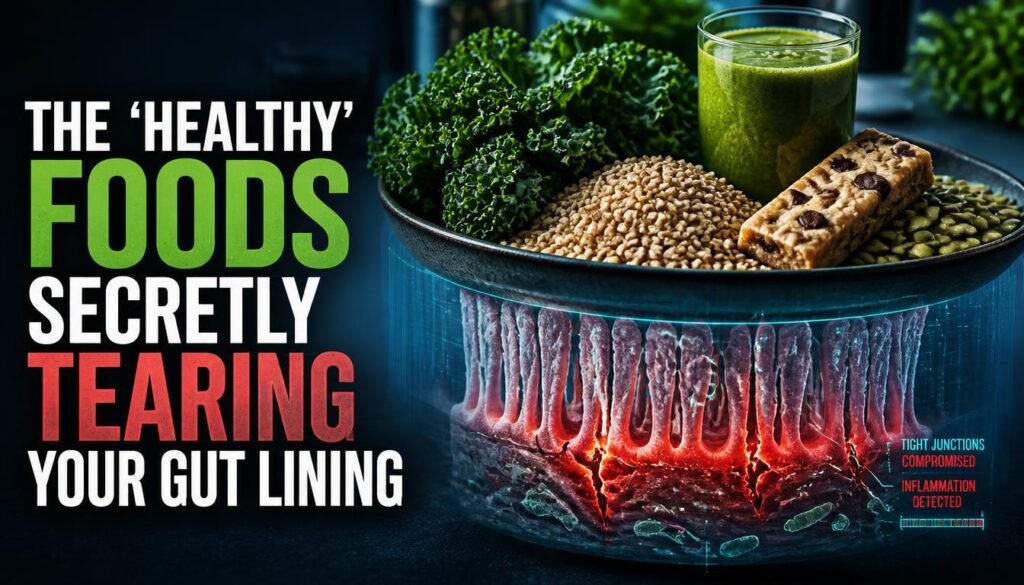
You eat clean. You meal-prep, you drink your green smoothies, you snack on protein bars, and you never touch processed junk. Yet you are still bloated by 2 PM, your brain feels wrapped in cotton, and your energy crashes every afternoon. If this sounds familiar, you are not alone, and you are not imagining it. The uncomfortable truth that the wellness industry rarely discusses is that several of the most celebrated “health foods” contain biochemical compounds—lectins, gluten fragments, emulsifiers, and sugar alcohols—that act as direct irritants to your intestinal barrier. Identifying the foods that damage your gut lining is the critical first step toward resolving chronic bloating, brain fog, and systemic inflammation that no amount of probiotics can fix.
As a clinician focused on intestinal permeability and metabolic longevity, I see patients every week who are unknowingly sabotaging their own healing. They are doing everything “right” according to mainstream nutrition headlines, yet their gut barrier remains compromised. In this guide, I will break down the exact architecture of your intestinal wall, expose the seven “healthy” foods that may be silently tearing it apart, and give you the precise 21-day protocol to seal your tight junctions and restore your metabolic vitality.
The Architecture of Your Gut Barrier: Tight Junctions, Zonulin, and Endotoxemia
To understand how certain foods cause damage, you must first understand the structure they are damaging. Your intestinal lining is only one cell layer thick—about the thickness of a piece of paper. These cells, called enterocytes, are bound together by protein structures known as tight junhttps://pmc.ncbi.nlm.nih.gov/articles/PMC6928914/ctions.
Think of your gut lining as a highly secure border checkpoint. Nutrients (amino acids, fatty acids, vitamins) are allowed through the official gates. Everything else—undigested food proteins, bacteria, and bacterial toxins—must stay inside the intestinal tube.
When certain compounds trigger the release of zonulin (a protein discovered by Dr. Alessio Fasano that regulates the opening of tight junctions), those gates are pried open. Once the junctions gape, bacterial endotoxins called lipopolysaccharides (LPS) leak into your bloodstream. This condition, known as metabolic endotoxemia, forces your immune system into a state of chronic, low-grade alert, driving insulin resistance, brain fog, and autoimmune reactivity. This is why understanding the foods that damage your gut lining is not just about digestion; it is about protecting your entire systemic health. For a deeper dive into the symptoms, read The “Leaky Gut” Symptom You’re Ignoring (And Why It’s Causing Your Brain Fog).
7 “Healthy” Foods That May Be Tearing Your Gut Lining
Not everyone reacts to these foods. A resilient gut with a thick mucus layer and a diverse microbiome can handle occasional exposure. But if your barrier is already compromised—due to chronic stress, NSAID use, or a history of antibiotics—these “health foods” can act like sandpaper on an open wound.
1. Whole Grains and “Ancient Grains” (Gluten and Wheat Germ Agglutinin)
Whole grains are universally marketed as heart-healthy fiber sources. But for a compromised gut, they present a double threat. First, gluten directly stimulates the release of zonulin, physically prying open your tight junctions. Second, grains contain Wheat Germ Agglutinin (WGA), a lectin that binds to the glycoproteins on your enterocytes, disrupting their function and triggering localized immune responses. Even “ancient grains” like spelt and einkorn contain these compounds. If you are actively healing, grains are among the most common foods that damage your gut lining.
2. Raw or Undercooked Legumes (The Lectin Bomb)
Beans, lentils, and peanuts are praised as plant-based protein powerhouses. However, they are also the most concentrated dietary sources of lectins—specifically Phytohaemagglutinin (PHA). Lectins are the plant’s defense mechanism; they are “sticky” proteins designed to survive digestion and bind to the gut walls of whatever eats them. While proper soaking and high-heat cooking destroy most lectins, raw or undercooked legumes (and raw peanut butter) can cause direct mucosal damage and severe inflammation.
3. “Sugar-Free” Snacks Sweetened with Sugar Alcohols
Protein bars and keto cookies are often sweetened with erythritol, xylitol, maltitol, and sorbitol to keep the sugar count low. The problem? Your body cannot fully absorb sugar alcohols. They travel to the colon, where they draw in water osmotically and are rapidly fermented by bacteria, causing explosive bloating and gas. Furthermore, emerging research suggests high doses of certain sugar alcohols can alter the composition of the gut microbiome, favoring opportunistic strains over beneficial ones.
4. Protein Bars Loaded with Emulsifiers
To give protein bars their soft, shelf-stable texture, manufacturers rely on emulsifiers like polysorbate 80, carboxymethylcellulose (CMC), and soy lecithin. Landmark research published in Nature demonstrated that these compounds do not just pass through your gut; they actively degrade the protective mucus layer that separates your enterocytes from the bacteria in the lumen. Once that mucus barrier thins, bacteria make direct contact with the gut wall, triggering inflammation and increased permeability.
5. Cold-Pressed Juices and Green Smoothies (Fructose and Oxalates)
Drinking your vegetables sounds ideal, but juicing strips away the fiber matrix and delivers a massive, unbuffered load of fructose directly to your liver and gut. As we covered in High Uric Acid Isn’t Just Gout — It’s a Metabolic Warning Sign, unbuffered fructose depletes cellular ATP and drives uric acid production, which damages the endothelial and mucosal linings. Additionally, raw spinach and beet smoothies are incredibly high in oxalates, which can irritate the gut lining and contribute to kidney stone formation in susceptible individuals.
6. Fermented Foods When You Have Histamine Intolerance
Kombucha, kimchi, and sauerkraut are fantastic for a healthy, diverse microbiome. But if you suffer from histamine intolerance or Small Intestinal Bacterial Overgrowth (SIBO), these foods can be disastrous. Fermented foods are loaded with histamine. If you lack the DAO enzyme required to break it down, histamine floods your system, causing vasodilation, gut inflammation, bloating, and brain fog. If fermented foods make you feel worse, read Histamine Intolerance: Why Certain Foods Make You Feel Terrible.
7. Raw Cruciferous Vegetables in Excess (Roughage and Raffinose)
Raw kale salads and broccoli are nutrient-dense, but they are also mechanically rough and loaded with raffinose, a complex sugar your body cannot digest. In a healthy gut, this is fine. In an inflamed, compromised gut, the physical roughage acts as mechanical abrasion on healing tissue, while the raffinose ferments in the lower bowel, producing painful gas and distension. When your gut is actively healing, vegetables should be cooked until soft, not eaten raw.
Who Is Most Vulnerable to These Foods?
You do not need to fear these foods forever. They become problematic primarily when your baseline resilience is low. You are at high risk if you have:
- A history of antibiotic use: As we detailed in Why Antibiotics Destroy Your Microbiome for Years, Not Weeks, antibiotics strip the protective bacterial layer that defends your mucosa.
- Chronic NSAID use: Ibuprofen and aspirin directly inhibit the prostaglandins required to maintain the gut’s mucus layer.
- SIBO or IBS: If bacterial overgrowth is present, fermentable fibers and sugar alcohols will cause severe distress. Learn how to identify it in SIBO: The Hidden Gut Infection Behind 78% of IBS Cases.
- High chronic stress: Cortisol physically reduces blood flow to the gut and degrades the mucosal lining.
The 21-Day Gut Lining Repair Protocol
Once you remove the foods that damage your gut lining, your body is remarkably good at healing itself. The enterocytes in your gut lining regenerate every 3 to 5 days. Give them the right raw materials and remove the irritants, and you can seal your barrier in about three weeks.
| Phase | Goal | Action & Targeted Nutrition |
|---|---|---|
| Days 1–7: Remove | Eliminate irritants and reduce mechanical stress. | Cut gluten, raw lectins, sugar alcohols, and emulsifiers. Eat all vegetables cooked and soft. |
| Days 8–14: Soothe & Fuel | Provide raw materials for enterocyte regeneration. | Consume collagen-rich bone broth daily. L-Glutamine (5g twice daily) is the primary fuel for gut cells. |
| Days 15–21: Reinoculate | Restore microbial diversity safely. | Introduce gentle, low-histamine fermented foods (like fresh kefir) only if tolerated. Prioritize soluble fibers. |
💡 Action Step: To give your gut the physical rest it needs to heal, you must activate the Migrating Motor Complex (MMC)—the cleansing wave that sweeps your small intestine clean between meals. Use our Intermittent Fasting Calculator to design a 14-to-16-hour fasting window, and ensure you are hitting your daily amino acid targets for tissue repair using our Protein Intake Calculator. For a structured reset, consider The 4-Day Bone Broth Fast: A Dangerous Fad or The Ultimate Gut Reset?.
Final Thoughts
The goal of this guide is not to make you afraid of your food; it is to give you the biochemical context the wellness industry leaves out. A food can be “healthy” for a resilient gut and deeply irritating to a compromised one. By temporarily removing the foods that damage your gut lining—the lectins, the emulsifiers, the sugar alcohols, and the unbuffered fructose—you give your enterocytes the quiet, well-fueled environment they need to rebuild your tight junctions.
Heal the barrier first. Then, reintroduce the rainbow of whole foods slowly, watching how your body responds. Your digestion, your energy, and your clarity will tell you exactly what your unique biology can tolerate.
Frequently Asked Questions (FAQ)
1. What are the most common foods that damage your gut lining?
The most common foods that damage your gut lining include gluten-containing grains (which trigger zonulin release), raw or undercooked legumes (high in lectins), processed foods with emulsifiers like polysorbate 80, sugar alcohols like maltitol and sorbitol, and unbuffered fruit juices high in fructose.
2. Can healthy foods like kale and beans cause bloating?
Yes. Raw kale is mechanically rough and high in raffinose, a sugar your body cannot digest, leading to fermentation and gas. Beans are high in lectins, which can irritate a compromised intestinal lining. Cooking these foods thoroughly significantly reduces their irritating potential.
3. How long does it take to heal a damaged gut lining?
The enterocytes (cells) that line your gut regenerate every 3 to 5 days. With the removal of dietary irritants and adequate intake of healing nutrients like L-glutamine and collagen, significant repair of the intestinal barrier typically occurs within 3 to 4 weeks.
4. Do emulsifiers in protein bars really harm the microbiome?
Yes. Research published in Nature has shown that common emulsifiers like polysorbate 80 and carboxymethylcellulose degrade the protective mucus layer of the gut, allowing bacteria to contact the intestinal wall directly, which triggers inflammation and increased permeability.
5. Is fermented food always good for gut health?
No. While fermented foods support a healthy, diverse microbiome, they are very high in histamine. For individuals with histamine intolerance, DAO enzyme deficiency, or SIBO, fermented foods like kombucha and kimchi can trigger severe bloating, inflammation, and brain fog.
⚕️ Medical Disclaimer
The content provided on RegenStep.com, including this guide authored by Dr. Julian Vance, is strictly for educational and informational purposes only. It is not intended to be a substitute for professional medical advice, diagnosis, or treatment.
Dietary triggers for intestinal permeability are highly individual. Elimination protocols should not be maintained long-term without professional supervision, as unnecessary restriction can lead to nutrient deficiencies and microbiome depletion. Always consult with your gastroenterologist or a registered dietitian before making significant dietary changes, particularly if you have a diagnosed condition such as Celiac disease, Inflammatory Bowel Disease (IBD), or SIBO.
Who Is Most Vulnerable to These Foods?
You do not need to fear these foods forever. They become problematic primarily when your baseline resilience is low. You are at high risk if you have:
What are the most common foods that damage your gut lining?
The most common foods that damage your gut lining include gluten-containing grains (which trigger zonulin release), raw or undercooked legumes (high in lectins), processed foods with emulsifiers like polysorbate 80, sugar alcohols like maltitol and sorbitol, and unbuffered fruit juices high in fructose.
Can healthy foods like kale and beans cause bloating?
Yes. Raw kale is mechanically rough and high in raffinose, a sugar your body cannot digest, leading to fermentation and gas. Beans are high in lectins, which can irritate a compromised intestinal lining. Cooking these foods thoroughly significantly reduces their irritating potential.
How long does it take to heal a damaged gut lining?
The enterocytes (cells) that line your gut regenerate every 3 to 5 days. With the removal of dietary irritants and adequate intake of healing nutrients like L-glutamine and collagen, significant repair of the intestinal barrier typically occurs within 3 to 4 weeks.
Do emulsifiers in protein bars really harm the microbiome?
Yes. Research published in Nature has shown that common emulsifiers like polysorbate 80 and carboxymethylcellulose degrade the protective mucus layer of the gut, allowing bacteria to contact the intestinal wall directly, which triggers inflammation and increased permeability.
Is fermented food always good for gut health?
No. While fermented foods support a healthy, diverse microbiome, they are very high in histamine. For individuals with histamine intolerance, DAO enzyme deficiency, or SIBO, fermented foods like kombucha and kimchi can trigger severe bloating, inflammation, and brain fog.

Julian Vance is the writer and editor behind RegenStep, translating peer-reviewed longevity, metabolic, and gut-health research into practical, actionable guides. Julian is not a licensed physician; content is reviewed against cited primary sources and is for informational purposes only. Always consult a qualified healthcare provider for personal medical advice.