
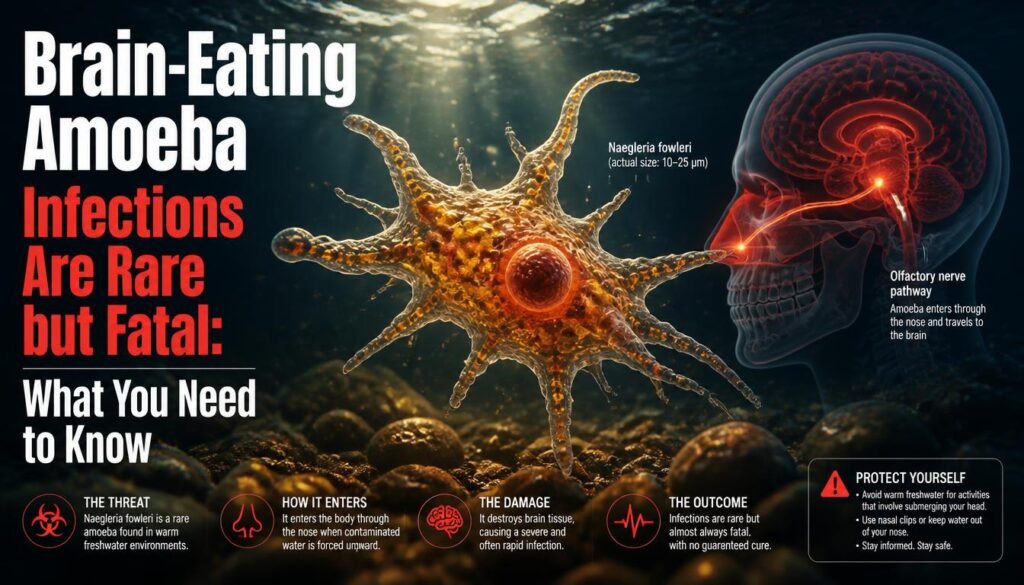
Every summer, a handful of tragic headlines resurface the same terrifying question: how can a microscopic organism in a lake kill a healthy person in a matter of days? The brain-eating amoeba, scientifically known as Naegleria fowleri, is responsible for one of the rarest and most lethal infections in modern medicine. While the odds of encountering it are astronomically low, the fatality rate exceeds 97%, making it a pathogen that demands respect, understanding, and precise prevention—not panic.
As a physician focused on disease defense and public health literacy, I believe fear is best replaced with accurate biological knowledge. Most people do not understand how this organism enters the body, why it is so difficult to treat, or which everyday habits (like nasal rinsing with tap water) carry hidden risk. In this guide, I will break down the exact biology of Naegleria fowleri, the timeline of the disease it causes, and the evidence-based protocols you need to protect your family during warm-water season.
What Exactly Is the Brain-Eating Amoeba?
Naegleria fowleri is a free-living, single-celled organism that thrives in warm freshwater. It grows best at temperatures up to 115°F (46°C) and is commonly found in:
- Lakes, rivers, and hot springs, particularly during late summer heat waves.
- Poorly maintained swimming pools and inflatable pools with inadequate chlorination.
- Geothermal water and natural hot springs.
- Household plumbing and water heaters, where warm, stagnant water allows it to colonize.
- Soil near discharge points of warm water.
Unlike bacteria or viruses, this amoeba does not need a human host to survive. Humans are accidental, dead-end hosts. The organism only causes disease when it is forcibly driven up the nasal passage, typically during swimming, diving, or nasal rinsing.
How Infection Actually Happens: The Nasal Route
The critical detail most people miss is that you cannot be infected by drinking contaminated water. Stomach acid destroys the organism. Infection requires water to enter the nose. When contaminated water is forced up the nasal cavity, the amoeba migrates to the roof of the nasal passage, penetrates the olfactory nerve tissue, and travels through the cribriform plate—a porous bone at the base of the skull—directly into the brain. Once inside, it multiplies rapidly and destroys brain tissue, causing catastrophic inflammation.
Primary Amebic Meningoencephalitis (PAM): Why It Is Almost Always Fatal
The disease caused by the brain-eating amoeba is called Primary Amebic Meningoencephalitis (PAM). According to the Centers for Disease Control and Prevention (CDC), there have been only a handful of documented survivors in North America out of more than 150 known cases since 1962. The fatality rate exceeds 97%.
There are three clinical reasons for this grim statistic:
- Explosive Progression: The amoeba destroys neural tissue faster than the immune system can mount a targeted response, causing massive cerebral edema (brain swelling) and herniation.
- Diagnostic Mimicry: Early symptoms are indistinguishable from bacterial meningitis. Standard cerebrospinal fluid (CSF) cultures do not detect amoebas, so the correct diagnosis is often made only after treatment has failed or post-mortem.
- Limited Drug Penetration: Very few antimicrobial agents effectively cross the blood-brain barrier at concentrations high enough to kill the organism, and by the time they are administered, irreversible damage has usually occurred.
The Symptom Timeline: From Headache to Crisis
PAM progresses with terrifying speed. The incubation period is typically 1 to 9 days (median of 5) after exposure, and death usually occurs within 1 to 18 days (median of 5) after symptoms begin. Recognizing the timeline is critical for anyone who has recently swum in warm freshwater.
| Stage | Timeframe | Clinical Presentation |
|---|---|---|
| Stage 1: Onset | Days 1–5 post-exposure | Severe frontal headache, high fever, nausea, vomiting. Often misdiagnosed as viral or bacterial meningitis. |
| Stage 2: Neurological Decline | Days 5–12 | Stiff neck, seizures, hallucinations, confusion, loss of balance, and altered mental status. |
| Stage 3: Terminal Phase | Days 12–18 | Rapid loss of consciousness, coma, cerebral herniation, and death. |
If you develop a sudden, severe headache and fever within two weeks of swimming in warm freshwater or using tap water for nasal rinsing, seek emergency care immediately and explicitly tell the medical team about your water exposure. That single sentence can change the diagnostic pathway. For more on how clinicians track hidden inflammatory crises, read Silent Inflammation Markers: The Blood Tests Your Doctor Isn’t Ordering.
Who Is Most at Risk?
While anyone can theoretically be infected, surveillance data reveals a consistent risk profile:
- Children and young adults, particularly males, who engage in vigorous water play (jumping, diving, underwater swimming) in warm freshwater.
- Residents of southern U.S. states (Texas, Florida, Georgia, Arizona), though cases are increasingly reported further north.
- Nasal irrigators who use unboiled tap water with neti pots or sinus rinse devices.
- Users of untreated private wells or households with aging, warm water heaters.
How to Protect Yourself: The Prevention Protocol
Because there is no vaccine and no reliably curative treatment, prevention is the only true defense against the brain-eating amoeba. Follow these evidence-based protocols during warm-water season:
- Avoid warm freshwater during heat waves. If water temperatures are high and levels are low (late summer), skip the swim.
- Keep your head above water. Avoid jumping or diving into warm lakes and rivers. Use nose clips when submersion is unavoidable.
- Do not stir up sediment. The organism concentrates in the bottom sediment of lakes and rivers. Avoid digging in the mud or shallow bottoms.
- Verify pool chlorination. Properly maintained, chlorinated pools are safe. Avoid poorly maintained inflatable pools and water slides using untreated water.
- Hold your head upright in hot springs. Natural geothermal pools are a documented source of infection.
| Risk Situation | Safety Protocol |
|---|---|
| Swimming in a warm lake | Keep head above water, wear nose clips, avoid sediment. |
| Hot springs / geothermal pools | Avoid submerging the head entirely. |
| Nasal rinsing (Neti pot) | Use ONLY distilled, sterile, or previously boiled water. |
| Inflatable kids’ pools | Use chlorinated tap water; drain and dry daily. |
Neti Pots and Tap Water: The Hidden Household Risk
One of the most preventable and tragic routes of infection involves nasal irrigation. CDC investigations have linked multiple fatal PAM cases to the use of tap water in neti pots and sinus rinse devices. Naegleria fowleri can colonize household plumbing and water heaters, surviving in the warm water that flows from your bathroom tap.
If you use nasal irrigation for allergies or sinus health, the water must be rendered safe. Use only:
- Distilled or sterile water (commercially labeled).
- Tap water boiled for 1 minute (3 minutes at elevations above 6,500 feet), then cooled.
- Water filtered through a filter with an absolute pore size of 1 micron or smaller.
Never use straight tap water, and always clean and air-dry your irrigation device after each use.
Diagnosis and Treatment: Is There Any Hope?
Diagnosis requires a lumbar puncture to analyze cerebrospinal fluid, ideally with PCR testing specifically targeting Naegleria fowleri. Because time is the enemy, treatment must begin on clinical suspicion alone.
The current aggressive cocktail, refined from the few documented survivors, includes:
- Amphotericin B (intravenous and intrathecal), the primary amebicidal agent.
- Miltefosine, an investigational drug originally developed for leishmaniasis, now available through emergency protocols.
- Azithromycin, fluconazole, and rifampin as adjunctive antimicrobials.
- Dexamethasone to manage cerebral edema.
- Therapeutic hypothermia (cooling the body to roughly 32–34°C) to reduce brain swelling, a strategy used in several successful survivor cases.
Survival remains the exception, not the rule. This is why aggressive antimicrobial stewardship and early immune resilience matter across all infectious diseases. Supporting your baseline immunity through adequate protein and metabolic health is foundational; assess your needs with our Protein Intake Calculator and learn how immune function changes with age in Immunosenescence: Can You Really Reverse Immune Aging?.
The Climate Connection: Why Cases Are Appearing Further North
Historically, U.S. cases clustered in the Gulf South. In recent years, however, confirmed infections have occurred in Minnesota, Iowa, and Nebraska. The mechanism is straightforward: as global freshwater temperatures rise and summer heat waves lengthen, the thermal habitat suitable for Naegleria fowleri expands northward.
It is vital to keep this in perspective. Even with geographic expansion, the United States sees only 0 to 8 cases per year. Tens of millions of people swim in freshwater annually without incident. The risk is real but vanishingly small—your risk is dramatically higher driving to the lake than swimming in it.
Final Thoughts
The brain-eating amoeba is a stark reminder that nature harbors organisms of immense destructive power, but it is also a reminder that knowledge neutralizes fear. You cannot catch PAM from drinking water, from another person, or from a properly chlorinated pool. By keeping your head above warm freshwater, avoiding sediment, and using only boiled or sterile water for nasal rinsing, you reduce an already microscopic risk to nearly zero. Respect the water, follow the protocol, and enjoy your summer safely.
Frequently Asked Questions (FAQ)
1. Can you get a brain-eating amoeba infection from drinking water?
No. You cannot be infected by drinking water contaminated with Naegleria fowleri. Stomach acid destroys the organism. Infection only occurs when contaminated water is forcibly driven up the nose, allowing the amoeba to travel through the olfactory nerve into the brain.
2. Is PAM contagious from person to person?
No. Primary amebic meningoencephalitis (PAM) cannot spread from person to person. Humans are accidental, dead-end hosts, and the amoeba does not transmit through coughing, touching, or any other form of human contact.
3. How common are Naegleria fowleri infections in the United States?
Infections are extremely rare. The United States typically sees 0 to 8 cases per year, despite tens of millions of freshwater swimming exposures annually. However, the disease is nearly always fatal, with a fatality rate exceeding 97%.
4. Is it safe to use a neti pot with tap water?
No. Tap water can harbor Naegleria fowleri and other pathogens. For nasal irrigation, use only distilled or sterile water, or tap water that has been boiled for 1 minute (3 minutes at elevations above 6,500 feet) and cooled.
5. What are the first symptoms of a brain-eating amoeba infection?
Early symptoms of PAM appear about 5 days after exposure and include severe frontal headache, fever, nausea, and vomiting. These rapidly progress to stiff neck, seizures, hallucinations, and coma. Anyone with these symptoms after warm freshwater exposure must seek emergency care immediately.
⚕️ Medical Disclaimer
The content provided on RegenStep.com, including this article authored by Dr. Julian Vance, is strictly for educational and informational purposes only. It is not intended to be a substitute for professional medical advice, diagnosis, or treatment.
Primary amebic meningoencephalitis (PAM) is a life-threatening medical emergency. If you or a family member develops a severe headache, fever, stiff neck, or altered mental status within two weeks of warm freshwater exposure or nasal rinsing, call emergency services or proceed to the nearest emergency department immediately. Never disregard professional medical advice or delay in seeking it because of something you have read on this website.
What Exactly Is the Brain-Eating Amoeba?
Naegleria fowleri is a free-living, single-celled organism that thrives in warm freshwater. It grows best at temperatures up to 115°F (46°C) and is commonly found in: Unlike bacteria or viruses, this amoeba does not need a human host to survive. Humans are accidental, dead-end hosts. The organism only causes disease when it is forcibly driven up the nasal passage, typically during swimming, diving, or nasal rinsing.
Who Is Most at Risk?
While anyone can theoretically be infected, surveillance data reveals a consistent risk profile:
Diagnosis and Treatment: Is There Any Hope?
Diagnosis requires a lumbar puncture to analyze cerebrospinal fluid, ideally with PCR testing specifically targeting Naegleria fowleri. Because time is the enemy, treatment must begin on clinical suspicion alone. The current aggressive cocktail, refined from the few documented survivors, includes: Survival remains the exception, not the rule. This is why aggressive antimicrobial stewardship and early immune resilience matter across all infectious diseases. Supporting your baseline immunity through adequate protein and metabolic health is foundational; assess your needs with our Protein Intake Calculator and learn how immune function changes with age in Immunosenescence: Can You Really Reverse Immune Aging?.
Can you get a brain-eating amoeba infection from drinking water?
No. You cannot be infected by drinking water contaminated with Naegleria fowleri. Stomach acid destroys the organism. Infection only occurs when contaminated water is forcibly driven up the nose, allowing the amoeba to travel through the olfactory nerve into the brain.
Is PAM contagious from person to person?
No. Primary amebic meningoencephalitis (PAM) cannot spread from person to person. Humans are accidental, dead-end hosts, and the amoeba does not transmit through coughing, touching, or any other form of human contact.
How common are Naegleria fowleri infections in the United States?
Infections are extremely rare. The United States typically sees 0 to 8 cases per year, despite tens of millions of freshwater swimming exposures annually. However, the disease is nearly always fatal, with a fatality rate exceeding 97%.
Is it safe to use a neti pot with tap water?
No. Tap water can harbor Naegleria fowleri and other pathogens. For nasal irrigation, use only distilled or sterile water, or tap water that has been boiled for 1 minute (3 minutes at elevations above 6,500 feet) and cooled.
What are the first symptoms of a brain-eating amoeba infection?
Early symptoms of PAM appear about 5 days after exposure and include severe frontal headache, fever, nausea, and vomiting. These rapidly progress to stiff neck, seizures, hallucinations, and coma. Anyone with these symptoms after warm freshwater exposure must seek emergency care immediately.

Julian Vance is the writer and editor behind RegenStep, translating peer-reviewed longevity, metabolic, and gut-health research into practical, actionable guides. Julian is not a licensed physician; content is reviewed against cited primary sources and is for informational purposes only. Always consult a qualified healthcare provider for personal medical advice.