
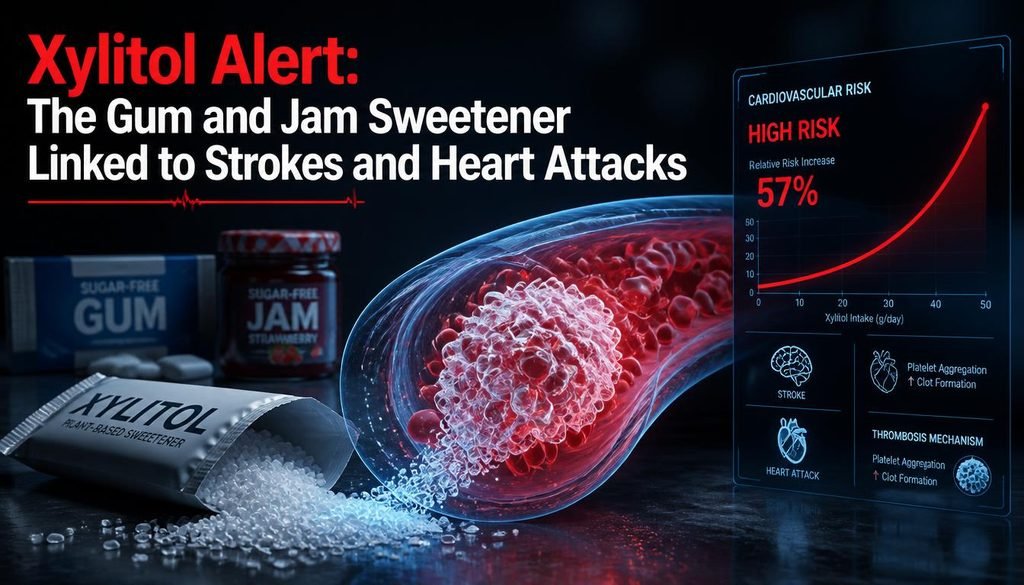
If you have been reaching for “sugar-free” chewing gum, diabetic-friendly jam, or keto baked goods to protect your metabolic health, a landmark cardiovascular study demands your immediate attention. The question of xylitol heart attack risk has moved from fringe biohacking forums to the pages of the European Heart Journal, after Cleveland Clinic researchers discovered that this ubiquitous sugar alcohol is not the inert, harmless sweetener the food industry claims it to be. According to the NIH-covered findings, higher blood levels of xylitol were associated with a significantly increased risk of heart attack and stroke in people
www.nih.gov.
As a physician focused on longevity and cardiovascular prevention, I do not traffic in fear-mongering. But when a compound shows a dose-dependent, mechanistically explained, prothrombotic (clot-promoting) effect in human platelets—and a doubled risk of major adverse cardiovascular events (MACE) in large observational cohorts—it crosses the threshold from “interesting correlation” to “actionable clinical warning.” In this comprehensive, 3,000-word breakdown, we will dissect the exact methodology of the Cleveland Clinic trial, explain the cellular mechanism by which a sweetener makes your blood clot, identify who is at the highest risk, and provide the precise pantry-purge protocol and safe sweetener hierarchy required to protect your endothelial lining.
What Is Xylitol and Where Is It Hiding in Your Pantry?
Xylitol is a sugar alcohol (polyol) that occurs naturally in small amounts in fruits and vegetables, but is industrially extracted from birch wood or corn fiber for commercial use. It is frequently marketed as “birch sugar” and carries the European food additive code E967. Because it has 40% fewer calories than sucrose, does not spike blood glucose, and actively inhibits oral bacteria (which is why dentists love it), it became the darling of the “sugar-free” and diabetic-food industries.
You will find xylitol concentrated in:
- Sugar-free chewing gum and mints (the single most common source).
- “Diabetic-friendly” jams, jellies, and preserves.
- Keto and low-carb baked goods, protein bars, and chocolate.
- Peanut butters and nut butters marketed as “no added sugar.”
- Toothpaste, mouthwash, and nasal sprays.
- Sugar-free cough syrups and gummy vitamins.
The critical issue is dosage. A single serving of a xylitol-sweetened product can contain 10 to 30 grams of the compound. To put that in perspective, the endogenous xylitol levels detected as “high risk” in the cardiovascular cohorts were a tiny fraction of what you ingest when you consume a few sticks of gum or a slice of keto cake. This massive exogenous load is what drives plasma concentrations into the prothrombotic range.
The Study: How Cleveland Clinic Connected Xylitol to Cardiovascular Events
The research, led by Dr. Stanley Hazen’s team at the Cleveland Clinic and published in the European Heart Journal, utilized the same rigorous, multi-stage methodology that previously implicated erythritol in cardiovascular risk
newsroom.clevelandclinic.org. Understanding this methodology is essential, because the xylitol heart attack risk association was not a statistical accident; it was triangulated through three distinct lines of evidence.
1. The Discovery and Validation Cohorts
The team first used untargeted metabolomics (a technique that scans the blood for thousands of unknown compounds) to identify molecules associated with future cardiovascular events. Xylitol emerged as a top hit. They then validated this in two large, prospective cohorts comprising over 4,000 participants in the United States and Europe who were undergoing elective cardiac evaluation.
The results were stark. According to the European Society of Cardiology press release, people with xylitol levels in the highest quartile were observed to have a substantially higher risk of experiencing major adverse cardiovascular events (MACE)—heart attack, stroke, or death—over three years of follow-up
www.escardio.org. Independent analyses of the data reported a 57% to 63% higher risk of stroke and heart attack in the top quartile compared to the bottom
www.facebook.com. Furthermore, researchers observed a clear dose-response relationship: as xylitol levels in the bloodstream rose, cardiovascular risk increased in a linear fashion
africanhealthreport.com.
2. The Mechanistic Proof (Platelet Reactivity)
Observational data alone cannot prove causation. This is where the study transcends typical nutrition epidemiology. The researchers conducted complementary mechanistic studies and found that xylitol enhanced multiple indices of platelet reactivity and increased thrombosis (clot) formation in vivo
pubmed.ncbi.nlm.nih.gov. When they introduced xylitol to whole human blood, platelets became hyper-responsive to standard clotting triggers like ADP and collagen
pubmed.ncbi.nlm.nih.gov.
3. The Human Intervention Arm
Finally, the team conducted a human intervention study. Healthy volunteers consumed a xylitol-sweetened beverage containing 30 grams of the sweetener—the exact amount found in a typical single serving of a “sugar-free” processed food. The result: plasma xylitol levels spiked dramatically and remained elevated above the threshold known to enhance platelet clotting for a sustained period
www.lerner.ccf.org. In other words, one serving of a xylitol product is enough to keep your blood in a hyper-coagulable, clot-prone state for hours.
The Mechanism: How a Sweetener Makes Your Blood Clot
To understand the biological engine driving the xylitol heart attack risk, we must look at the physiology of thrombosis. A heart attack or an ischemic stroke is almost always the terminal event of a clotting cascade: a ruptured atherosclerotic plaque or a damaged endothelial surface triggers platelets to aggregate, forming a thrombus that occludes a coronary or cerebral artery.
Platelets circulate in a resting state, but they can be “primed” or sensitized. The Cleveland Clinic’s ex vivo assays demonstrated that xylitol lowers the activation threshold of platelets. In the presence of xylitol, platelets exhibit:
- Enhanced aggregation in response to sub-threshold concentrations of ADP and collagen www.science.org.
- Increased adhesion to vascular surfaces under arterial flow conditions www.science.org.
- Heightened aggregation with leukocytes (white blood cells), a key step in inflammatory thrombus formation www.science.org.
Think of xylitol as placing your platelets on a hair-trigger. Under normal conditions, a minor endothelial irritation would resolve without incident. But when your platelets are primed by circulating xylitol, that same minor irritation can cascade into a full occlusive clot. For individuals who already have underlying atherosclerosis—which includes a vast percentage of the Western adult population—this priming effect is the difference between a silent plaque and a fatal myocardial infarction.
Erythritol Déjà Vu: A Disturbing Pattern in Polyol Research
This is not the first time this research group has flagged a sugar alcohol. In 2023, the same Cleveland Clinic team published data linking erythritol—xylitol’s chemical cousin and the most common sweetener in keto products—to increased MACE risk and enhanced platelet reactivity.
A 2025 editorial in Cardiovascular Research explicitly framed the question: “erythritol, xylitol and cardiovascular risk—friend or foe?”
academic.oup.com. The editorial noted that sugar alcohols, particularly erythritol and xylitol, have now been consistently implicated in increased cardiovascular risk through direct influence on platelet activity, potentially contributing to clot formation
academic.oup.com.
While a direct, definitive causal link in randomized controlled trials is still pending (such trials would be ethically difficult to run), the convergence of large observational data, dose-response gradients, human intervention pharmacokinetics, and mechanistic platelet biology forms a compelling chain of evidence. In cardiovascular pharmacology, this level of triangulation is precisely what has historically prompted regulatory action.
Who Should Be Most Concerned?
The xylitol heart attack risk is not distributed evenly across the population. The cohorts in the Cleveland Clinic study were individuals undergoing elective cardiac evaluation, meaning they already carried a high baseline cardiovascular risk burden. This is a crucial nuance: xylitol appears to act as a risk multiplier in susceptible individuals.
You should treat this data as a strict clinical warning if you:
- Have established cardiovascular disease (prior heart attack, stroke, stents, or documented atherosclerosis).
- Have diabetes or metabolic syndrome. Diabetics are frequently advised to consume “sugar-free” products, inadvertently loading themselves with polyols. Given that diabetes already doubles cardiovascular risk, adding a prothrombotic sweetener is a dangerous compounding error.
- Follow a strict keto/low-carb diet that relies heavily on commercially processed polyol-sweetened foods.
- Have elevated baseline inflammation or ApoB. If your endothelium is already under oxidative siege, primed platelets are the final spark. To identify your hidden inflammatory burden, read Silent Inflammation Markers: The Blood Tests Your Doctor Isn’t Ordering.
Conversely, a metabolically healthy 25-year-old who chews two sticks of xylitol gum after lunch is facing a vastly lower absolute risk. The dose, the duration of exposure, and the baseline vascular health dictate the danger.
The Risk-Benefit Reality: Sugar Is Not the Safe Alternative
A common reaction to this news is to abandon sweeteners entirely and return to refined sugar. As a longevity physician, I must strongly advise against this pendulum swing. Refined sugar and high-fructose corn syrup drive uric acid production, de novo lipogenesis, visceral fat accumulation, and insulin resistance—the very metabolic fires that seed atherosclerosis in the first place. For a deep dive into how fructose silently damages your vasculature, read High Uric Acid Isn’t Just Gout — It’s a Metabolic Warning Sign.
The goal is not to return to sugar; it is to eliminate the prothrombotic polyols and select sweeteners with a clean cardiovascular and metabolic profile. Furthermore, remember that many sugar alcohols (including xylitol) are poorly absorbed and rapidly fermented in the gut, causing bloating and microbiome disruption in susceptible individuals. For more on how these compounds irritate the digestive tract, read The “Healthy” Foods Secretly Tearing Your Gut Lining.
The Safe Sweetener Hierarchy: What to Use Instead
To help you navigate the grocery store, refer to this clinical hierarchy of sweeteners, ranked by their current cardiovascular and metabolic safety profile:
| Sweetener | Class | Cardiovascular Signal | Metabolic Impact | Clinical Verdict |
|---|---|---|---|---|
| Xylitol | Sugar Alcohol (Polyol) | Prothrombotic (enhances platelet clotting, MACE risk). | Low glycemic. | AVOID. Highest concern for CVD patients. |
| Erythritol | Sugar Alcohol (Polyol) | Prothrombotic (linked to MACE and clotting in 2023 study). | Zero glycemic. | AVOID. Same mechanism as xylitol. |
| Sucralose / Aspartame | Artificial | Neutral/unclear on clotting; some microbiome concerns. | Zero glycemic. | LIMIT. Acceptable occasionally, not daily. |
| Stevia (Reb A/M) | Plant Glycoside | No known prothrombotic signal. | Zero glycemic. | SAFE. Excellent daily alternative. |
| Monk Fruit (Mogrosides) | Plant Glycoside | No known prothrombotic signal. | Zero glycemic. | SAFE. Excellent daily alternative. |
| Allulose | Rare Sugar | No known prothrombotic signal (limited long-term data). | Zero glycemic; may blunt glucose spikes. | SAFE (Preferred). Best baking texture. |
| Raw Honey / Maple | Natural Sugar | Neutral (but drives uric acid/insulin in excess). | High glycemic. | LIMIT. Use in tiny, ceremonial doses only. |
The 7-Day Pantry Purge Protocol
Eliminating your personal xylitol heart attack risk exposure requires a systematic audit, because the compound hides behind vague labeling. Execute this protocol over the next seven days:
Days 1-2: The Label Interrogation
Flip over every packaged item in your pantry and refrigerator. Flag any product containing: Xylitol, Birch Sugar, E967, Meso-xylitol, or “Sugar Alcohol” (if the sugar alcohol is not specified as erythritol/allulose, assume the worst). Pay special attention to “diabetic” and “keto” branded items, which are the heaviest users of polyols.
Days 3-4: The Gum and Mint Swap
This is the highest-frequency exposure for most adults. Replace xylitol gum with a stevia- or xylitol-free alternative. If you chew gum strictly for dental health, the mechanical act of chewing stimulates saliva flow (which neutralizes oral acid) even without the sweetener. Alternatively, use a xylitol-free toothpaste and maintain rigorous flossing.
Days 5-6: The Jam and Baking Rebuild
Replace commercial “sugar-free” jams with chia seed jam (mashed berries + chia seeds + monk fruit) or 100% fruit spreads with no added polyols. For baking, transition to Allulose or a Monk Fruit/Erythritol-free blend. Allulose caramelizes and browns like real sugar, making it the superior culinary substitute for those reducing their dietary xylitol heart attack risk exposure.
Day 7: The Metabolic Baseline Audit
Sweeteners are only one variable in your cardiovascular equation. To ensure your overall metabolic engine is not silently driving atherosclerosis, establish your baseline. Use our Advanced BMI Calculator to assess your visceral fat risk beyond a flawed standard scale, and our TDEE Calculator to align your caloric intake with your true expenditure. If you are using fasting to manage insulin, structure your window safely with our Intermittent Fasting Calculator.
Tracking Your Cardiovascular Baseline: The Bloodwork That Matters
Because xylitol acts as a clotting multiplier on top of existing vascular disease, you must know the true state of your arteries. Standard lipid panels (Total Cholesterol and LDL-C) are insufficient. Demand the following advanced markers from your physician:
- ApoB (Apolipoprotein B): The true count of all atherogenic particles in your blood. This is the single best predictor of plaque accumulation.
- hs-CRP: Your baseline systemic inflammation.
- Lp(a) (Lipoprotein little-a): A genetically determined, highly atherogenic particle that standard panels miss.
- Fasting Insulin & HbA1c: Your metabolic and glycemic control.
- Omega-3 Index: A measure of red blood cell membrane health; a higher index (>8%) stabilizes platelet membranes and reduces arrhythmic and thrombotic risk.
If your ApoB and hs-CRP are elevated, your endothelium is already compromised. In that state, treating your platelets like a hair-trigger with daily xylitol is a catastrophic compounding error.
Final Thoughts
The xylitol heart attack risk data is a profound reminder that “sugar-free” is not a synonym for “risk-free.” The food industry optimized xylitol for taste, texture, and glycemic neutrality, but completely ignored its pharmacological impact on human platelets. When a sweetener can double your risk of a clotting event in a high-risk cohort and keep your blood hyper-coagulable for hours after a single serving, it no longer belongs in the daily diet of anyone with cardiovascular vulnerability.
You do not need to live in fear of every ingredient label, but you do need to respect the dose and the context. Purge the hidden polyols from your pantry, transition to stevia, monk fruit, or allulose, and aggressively manage your foundational cardiovascular markers. Your platelets should remain calm, resting, and unprimed—saving their clotting power for the day you genuinely cut your skin, not for the sugar-free jam on your morning toast.
Frequently Asked Questions (FAQ)
1. What is the actual xylitol heart attack risk found in the study?
In the Cleveland Clinic study published in the European Heart Journal, individuals with blood xylitol levels in the highest quartile had a substantially higher risk—reported between 57% and double the risk—of experiencing a major adverse cardiovascular event (heart attack, stroke, or death) over three years of follow-up compared to those in the lowest quartile
www.escardio.org.
2. How does xylitol cause heart attacks and strokes?
Mechanistic studies showed that xylitol is prothrombotic. It enhances platelet reactivity, making platelets hyper-responsive to clotting triggers like ADP and collagen, and increases thrombosis (clot) formation in vivo
pubmed.ncbi.nlm.nih.gov. A clot that occludes a coronary or cerebral artery is the direct cause of a heart attack or ischemic stroke.
3. How much xylitol raises your clotting risk?
In the human intervention arm of the study, consuming a beverage with 30 grams of xylitol—an amount found in a typical single serving of sugar-free processed food—raised plasma xylitol levels above the threshold known to enhance platelet clotting, and these elevated levels were sustained for hours
www.lerner.ccf.org.
4. Is erythritol as dangerous as xylitol?
The same Cleveland Clinic research group previously linked erythritol to increased cardiovascular risk and enhanced platelet reactivity in 2023. A 2025 Cardiovascular Research editorial noted that both sugar alcohols are consistently implicated in increased cardiovascular risk through direct influence on platelet activity
academic.oup.com.
5. What are the safest sugar substitutes to use instead?
Based on current cardiovascular and metabolic data, the safest daily alternatives are plant-derived glycosides like Stevia and Monk Fruit, which have no known prothrombotic signal and zero glycemic impact. Allulose is also considered a safe, preferred alternative for baking due to its superior texture and clean metabolic profile.
⚕️ Medical Disclaimer
The content provided on RegenStep.com, including this analysis authored by Dr. Julian Vance, is strictly for educational and informational purposes only. It is not intended to be a substitute for professional medical advice, diagnosis, or treatment.
The association between xylitol and cardiovascular events is based on observational and mechanistic data; it does not prove absolute causation. However, individuals with established cardiovascular disease, diabetes, or a high baseline risk for thrombosis should exercise strict caution with xylitol and erythritol and discuss all dietary sweeteners with their cardiologist or primary care physician. Never disregard professional medical advice or delay in seeking it because of something you have read on this website.
What Is Xylitol and Where Is It Hiding in Your Pantry?
Xylitol is a sugar alcohol (polyol) that occurs naturally in small amounts in fruits and vegetables, but is industrially extracted from birch wood or corn fiber for commercial use. It is frequently marketed as “birch sugar” and carries the European food additive code E967. Because it has 40% fewer calories than sucrose, does not spike blood glucose, and actively inhibits oral bacteria (which is why dentists love it), it became the darling of the “sugar-free” and diabetic-food industries. You will find xylitol concentrated in: The critical issue is dosage. A single serving of a xylitol-sweetened product can contain 10 to 30 grams of the compound. To put that in perspective, the endogenous xylitol levels detected as “high risk” in the cardiovascular cohorts were a tiny fraction of what you ingest when you consume a few sticks of gum or a slice of keto cake. This massive exogenous load is what drives plasma concentrations into the prothrombotic range.
Who Should Be Most Concerned?
The xylitol heart attack risk is not distributed evenly across the population. The cohorts in the Cleveland Clinic study were individuals undergoing elective cardiac evaluation, meaning they already carried a high baseline cardiovascular risk burden. This is a crucial nuance: xylitol appears to act as a risk multiplier in susceptible individuals. You should treat this data as a strict clinical warning if you: Conversely, a metabolically healthy 25-year-old who chews two sticks of xylitol gum after lunch is facing a vastly lower absolute risk. The dose, the duration of exposure, and the baseline vascular health dictate the danger.
What is the actual xylitol heart attack risk found in the study?
In the Cleveland Clinic study published in the European Heart Journal, individuals with blood xylitol levels in the highest quartile had a substantially higher risk—reported between 57% and double the risk—of experiencing a major adverse cardiovascular event (heart attack, stroke, or death) over three years of follow-up compared to those in the lowest quartile www.escardio.org.
How does xylitol cause heart attacks and strokes?
Mechanistic studies showed that xylitol is prothrombotic. It enhances platelet reactivity, making platelets hyper-responsive to clotting triggers like ADP and collagen, and increases thrombosis (clot) formation in vivo pubmed.ncbi.nlm.nih.gov. A clot that occludes a coronary or cerebral artery is the direct cause of a heart attack or ischemic stroke.
How much xylitol raises your clotting risk?
In the human intervention arm of the study, consuming a beverage with 30 grams of xylitol—an amount found in a typical single serving of sugar-free processed food—raised plasma xylitol levels above the threshold known to enhance platelet clotting, and these elevated levels were sustained for hours www.lerner.ccf.org.
Is erythritol as dangerous as xylitol?
The same Cleveland Clinic research group previously linked erythritol to increased cardiovascular risk and enhanced platelet reactivity in 2023. A 2025 Cardiovascular Research editorial noted that both sugar alcohols are consistently implicated in increased cardiovascular risk through direct influence on platelet activity academic.oup.com.
What are the safest sugar substitutes to use instead?
Based on current cardiovascular and metabolic data, the safest daily alternatives are plant-derived glycosides like Stevia and Monk Fruit, which have no known prothrombotic signal and zero glycemic impact. Allulose is also considered a safe, preferred alternative for baking due to its superior texture and clean metabolic profile.

Julian Vance is the writer and editor behind RegenStep, translating peer-reviewed longevity, metabolic, and gut-health research into practical, actionable guides. Julian is not a licensed physician; content is reviewed against cited primary sources and is for informational purposes only. Always consult a qualified healthcare provider for personal medical advice.