
We spend our entire lives obsessing over the chemical information we put into our bodies. We track macronutrients, we hunt for specific polyphenols, and we meticulously time our fasting windows. Yet, we largely ignore the most fundamental biological input of all: light. Just as the ellagitannins in berries or the sulforaphane in broccoli act as chemical triggers to mobilize your body’s core defense systems, specific wavelengths of light act as physical information. They are software updates for your mitochondria.
The wellness industry has heavily commercialized this concept, slapping glowing LEDs on everything from $40 face masks to $15,000 clinical beds. But strip away the marketing hype, and you are left with a rigorously validated branch of biophysics known as photobiomodulation (PBM). When delivered at the correct wavelengths, dosages, and beam angles, light penetrates the optical window of human tissue to directly interact with the electron transport chain. It doesn’t heat the tissue; it catalyzes it.
Let’s bypass the biohacking dogma and look strictly at the molecular reality. Here is the exact biochemical breakdown of how targeted light therapy alters cellular behavior, where the commercial market is lying to you, and how to build a clinical-grade protocol in your own home.
Red Light Therapy Benefits for Skin
The dermatological applications of photobiomodulation are the most heavily researched and visually verifiable. When you expose the dermis to red light (specifically in the 630nm to 670nm range), you are targeting the fibroblasts—the primary architects of your skin’s extracellular matrix.
The Fibroblast Proliferation Cascade
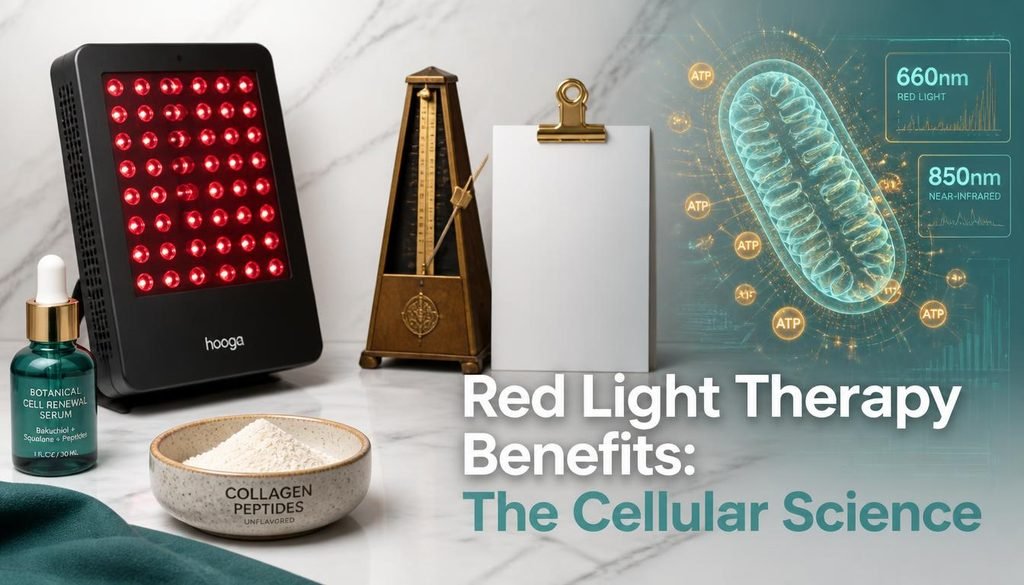
Fibroblasts are packed with mitochondria. When 660nm photons penetrate the epidermis and strike the dermal layer, they are absorbed by Cytochrome C Oxidase (Complex IV of the mitochondrial electron transport chain). This photodissociation event kicks inhibitory nitric oxide off the enzyme, allowing oxygen to rush back in. The immediate result is a massive surge in localized ATP production.
With this newfound energy, fibroblasts rapidly proliferate and upregulate the synthesis of Type I and Type III collagen, as well as elastin. Unlike topical retinoids, which force cellular turnover through chemical irritation, red light provides the raw energetic currency required for the cell to rebuild its structural scaffolding from the inside out.
Angiogenesis and Wound Healing
One of the five core health defense systems is angiogenesis—the creation of new blood vessels. Red light therapy is a potent angiogenic stimulus. The transient release of nitric oxide during the PBM process acts as a powerful local vasodilator. This increases microcirculation to the treated area, delivering oxygen and nutrients while sweeping away metabolic waste. This is why clinical PBM is heavily utilized in post-surgical wound healing, burn recovery, and the remodeling of hypertrophic scars. It accelerates the transition from the inflammatory phase of healing directly into the proliferative and remodeling phases.
Red Light Therapy Benefits for Hair
Hair loss, particularly androgenetic alopecia, is fundamentally a disease of follicular miniaturization and localized microvascular starvation. The hair follicle is one of the most metabolically demanding tissues in the human body; it requires immense ATP to sustain the anagen (growth) phase.
Shifting the Follicular Cycle
Hair follicles cycle through three phases: anagen (growth), catagen (transition), and telogen (resting). In pattern hair loss, the anagen phase progressively shortens, and the follicle shrinks. Near-infrared and red light therapy (typically utilizing 650nm to 810nm wavelengths) penetrates the scalp and reaches the follicular bulge, where the stem cells reside.
By upregulating ATP and stimulating the release of localized growth factors (like VEGF and HGF), PBM forces dormant telogen follicles back into the anagen phase. Furthermore, the light modulates local inflammatory cytokines. Micro-inflammation around the follicle is a primary driver of fibrosis and hair shedding; by calming this localized immune response, the follicular environment is preserved.
The Synergistic Stack
Light therapy alone will not overcome a severe genetic predisposition or a massive hormonal imbalance, but it is a phenomenal adjunct. When paired with topical vasodilators (like minoxidil) or natural DHT-blocking botanicals (like rosemary oil and saw palmetto), the increased microcirculation from the light therapy drives the topical compounds deeper into the dermal papilla. Ensure you are providing the raw amino acid building blocks for keratin synthesis by tracking your daily requirements with our Protein Intake Calculator.
Red Light Therapy Dangers
Because PBM is non-ionizing—meaning it lacks the energy to strip electrons from atoms and damage DNA like UV radiation does—the general public assumes it is entirely risk-free. This is a dangerous oversimplification. While it won’t cause skin cancer, improper use of red and near-infrared light carries specific, well-documented biological risks.
The Invisible Threat to the Retina
Visible red light (660nm) is intensely bright. Your natural biological defense is to squint or look away. Near-infrared light (810nm to 1064nm), however, is entirely invisible to the human eye. When you expose your eyes to high-irradiance NIR, your pupils do not constrict. The lens of the eye can actually focus this invisible energy directly onto the retina, potentially causing thermal accumulation and accelerating the formation of cataracts or inducing photochemical retinal damage over time. If you are using a high-powered panel with NIR diodes active, blackout goggles are not optional; they are mandatory.
The EMF and Flicker Problem
The danger often isn’t the light itself, but the cheap electrical engineering driving it. Low-quality, consumer-grade LED panels utilize cheap power drivers that emit massive electromagnetic fields (EMFs). Sitting two feet away from a panel that is projecting high levels of magnetic and electric radiation introduces a chronic neurological stressor that entirely counteracts the cellular benefits of the light.
Furthermore, cheap drivers use Pulse Width Modulation (PWM) at low frequencies to dim the lights. This creates an invisible, high-speed strobe effect. While your conscious brain doesn’t register the flicker, your visual cortex does. This can trigger severe neurological fatigue, eye strain, and migraines. A clinical-grade device must be verified as flicker-free and emit near-zero EMF at a distance of six inches.
Red Light Therapy at Home
If you decide to invest in an at-home setup, you must approach the purchase like a biophysicist, not a consumer. The market is flooded with devices that are biologically useless because they fail the basic laws of optics.
Irradiance vs. Total Wattage
Marketing teams love to boast about “300 Watts of Power.” Total wattage is a meaningless metric if the light is scattering in all directions. The only metric that matters is Irradiance, measured in milliwatts per square centimeter (mW/cm²). This tells you how many photons are actually striking your tissue. Clinical studies generally require an irradiance of at least 50 to 100 mW/cm² at the surface of the skin to achieve deep tissue penetration. Most cheap, flexible silicone masks deliver less than 10 mW/cm².
The Beam Angle and Optical Lenses
Light intensity drops off exponentially as you move away from the source, governed by the Inverse Square Law. Furthermore, bare LEDs emit light in a wide, 120-degree cone. Most of those photons scatter into the room, never reaching your cells. High-end panels place a secondary optical lens over every single LED chip, narrowing the beam angle to 30 or 60 degrees. This focuses the photons into a tight, penetrating beam. If a device lacks these lenses, you must press it directly against your bare skin to get any benefit, completely negating the convenience of a standing panel.
The Wavelength Matrix
Your device must offer specific, targeted wavelengths.
- 660nm (Red): Optimal for superficial tissue, skin health, collagen synthesis, and wound healing.
- 810nm to 850nm (Near-Infrared): Optimal for deep tissue penetration, targeting muscle recovery, joint inflammation, and transcranial brain stimulation. If a device offers “full spectrum” or vague “infrared” claims without specifying the exact nanometer peaks, it is a novelty item, not a medical tool.
💡 Action Step: True cellular regeneration requires a synergistic environment. Light therapy upregulates the demand for cellular repair, but your body needs the raw materials to execute it. Track your true metabolic baseline and visceral fat risk using our Advanced BMI Calculator and our Body Fat Calculator to ensure your systemic inflammation isn’t blunting your tissue’s response to the light.
Red Light Therapy Benefits and Risks
The most critical concept in photobiomodulation—and the one most frequently violated by overzealous biohackers—is the Biphasic Dose Response, governed by the Arndt-Schultz Law.
The Bell Curve of Light
In pharmacology, more of a drug usually yields a stronger effect, up to the point of toxicity. In light therapy, the dose-response curve is bell-shaped.
- Too little energy (Fluence): No biological effect.
- Optimal energy: Maximum cellular stimulation, ATP production, and tissue healing.
- Too much energy: The biological effect is completely inhibited. Cellular activity is suppressed, and tissue damage can occur.
If 10 Joules of energy heals a tendon, blasting that same tendon with 100 Joules will not heal it ten times faster; it will likely suppress cellular activity and increase inflammation. This is why sitting in front of a massive, high-powered panel for 45 minutes every single day is a biological error. You are overdosing your superficial tissues and blunting the hormetic signal.
Calculating the Dose
The therapeutic dose is measured in Fluence (Joules per square centimeter).
- Superficial Skin Issues: 3 to 10 J/cm².
- Deep Tissue (Muscles, Joints): 20 to 60 J/cm².
To calculate your session time, you need to know the irradiance of your specific device. Formula: Time (seconds) = (Target Fluence in J/cm² × 1000) / Irradiance in mW/cm². If your device delivers 100 mW/cm² at a 6-inch distance, and you want a 30 J/cm² dose for a deep muscle tear, you need to treat the area for exactly 5 minutes. More time is not better; precision is better.
Clinical Contraindications
While safe for the vast majority, PBM should be avoided or used with extreme caution in specific scenarios:
- Active Malignancy: Because PBM increases microcirculation, ATP, and angiogenesis, there is a theoretical risk that applying high-dose light directly over an active, untreated tumor could stimulate its growth. Never apply PBM over known cancers unless directed by an oncologist.
- The Thyroid Gland: The thyroid is highly vascular. High-dose, unmonitored NIR exposure over the anterior neck can potentially trigger autoimmune flares (like Hashimoto’s) or hyperthyroidism in susceptible individuals. Shield the neck when using full-body panels.
- Photosensitizing Medications: If you are taking medications that increase photosensitivity (like isotretinoin, certain antibiotics, or lithium), PBM can trigger severe skin reactions.
Blue Light Therapy Benefits
While red and near-infrared light are utilized for cellular regeneration and energy production, blue light (specifically in the 405nm to 420nm range) serves an entirely different biological function: targeted antimicrobial destruction.
The Porphyrim Mechanism in Acne
The primary bacterium responsible for acne vulgaris is Cutibacterium acnes (C. acnes). As part of its natural metabolic process, C. acnes produces molecules called porphyrins. When 415nm blue light strikes these porphyrins, it excites them, causing them to generate singlet oxygen—a highly reactive, localized free radical. This oxidative burst destroys the bacteria from the inside out, without harming the surrounding human tissue.
For individuals suffering from mild to moderate inflammatory acne, blue light therapy offers a non-antibiotic, non-irritating method to reduce bacterial load and calm sebaceous gland inflammation. It is frequently paired with red light therapy in clinical settings: the blue light kills the bacteria, and the red light heals the resulting tissue damage and reduces erythema (redness).
The Circadian Anchor
Beyond dermatology, blue light is the primary zeitgeber (time-giver) for the human circadian clock. When high-intensity blue light hits the melanopsin receptors in your eyes in the morning, it signals the suprachiasmatic nucleus to halt melatonin production and trigger the Cortisol Awakening Response. While we must ruthlessly block blue light after sunset to protect our sleep architecture, getting massive doses of it via outdoor sunlight (or specialized light boxes) first thing in the morning is non-negotiable for metabolic and neurological health. To align your light exposure with your feeding windows, utilize our Intermittent Fasting Calculator to map out a circadian-aligned protocol.
Red Light Therapy Benefits Weight Loss
The idea that shining a light on your body can cause fat loss sounds like the ultimate late-night infomercial scam. Yet, the mechanism behind photobiomodulation-induced lipolysis is heavily documented in clinical literature, provided you understand its strict limitations.
Transient Adipocyte Pores
Research utilizing specific wavelengths (often 635nm or 660nm) has demonstrated that red light can create transient, microscopic pores in the membranes of adipocytes (fat cells). This process, known as photobiomodulation-induced lipolysis, causes the fat cell to leak its intracellular triglycerides into the interstitial space.
Once the lipids are outside the cell, they are processed by the lymphatic system and either burned for energy by the mitochondria or excreted. The fat cell itself is not destroyed (as it is in surgical liposuction or cryolipolysis); it is simply deflated.
The Metabolic Caveat
Here is where the commercial wellness industry lies to you. If you undergo red light therapy to “deflate” your fat cells, but you do not create a caloric deficit to force your body to actually burn those leaked lipids, the triglycerides will simply be reabsorbed by the adipocytes within 48 hours. You will be right back where you started.
Red light therapy is not a standalone weight loss cure; it is a metabolic adjunct. It is a tool to help mobilize stubborn, localized fat stores (often referred to as “spot reduction,” which is otherwise impossible through diet alone) so that your systemic metabolic engine can process them.
To make this protocol work, you must pair the light therapy with a structured caloric deficit andZone 2 cardiovascular training to maximize lipid oxidation. Calculate your exact daily energy expenditure using our TDEE Calculator to ensure you are in a mild, sustainable deficit, and use our Body Fat Calculator to track the actual reduction in adipose tissue rather than relying on the deceptive fluctuations of a standard bathroom scale.
Is Red Light Therapy a Hoax?
So, is the entire industry a biohacking hoax? The answer requires separating the underlying biophysics from the commercial execution.
The Science is Bulletproof
The underlying science of photobiomodulation is not a hoax. It is a rigorously validated, NASA-born biological mechanism. Thousands of peer-reviewed, double-blind, placebo-controlled trials have proven that specific wavelengths of red and near-infrared light, delivered at precise irradiances, can accelerate wound healing, reduce joint inflammation, modulate neuroinflammation, and restore mitochondrial function. The interaction between photons and Cytochrome C Oxidase is a fundamental law of cellular biology.
The Execution is the Scam
The “hoax” lies in the consumer application. The wellness industry has taken this profound science and packaged it into underpowered, overpriced, electrically noisy gadgets that fail to deliver a therapeutic dose of photons to your cells.
If you buy a cheap, flexible silicone face mask from a drop-shipping website and expect it to heal your torn rotator cuff or reverse your biological age, you will rightfully conclude it is a scam. If you sit 10 feet away from a panel that lacks optical lenses, the Inverse Square Law dictates that your cells are receiving virtually zero therapeutic energy.
Red light therapy is an ultimate tissue healer, but only when treated with clinical respect. It requires the correct wavelengths, the correct beam angle, the correct distance, and the correct dosage. Stop treating it like a magic wand, start treating it like a precise medical instrument, and your mitochondria will reward you with the vitality to match.
Frequently Asked Questions (FAQ)
1. What are the main red light therapy benefits for skin?
Red light therapy (specifically 630-670nm) penetrates the dermis and stimulates fibroblasts to produce ATP. This cellular energy surge upregulates the synthesis of Type I and Type III collagen and elastin, accelerates wound healing via angiogenesis, and reduces localized inflammation without the chemical irritation associated with topical retinoids.
2. Can red light therapy actually regrow hair?
Yes, clinical studies show that red and near-infrared light therapy can improve hair density and thickness in individuals with androgenetic alopecia. The light penetrates the scalp to stimulate follicular stem cells, increases local microcirculation via nitric oxide release, and forces dormant hair follicles from the telogen (resting) phase back into the anagen (growth) phase.
3. What are the dangers of red light therapy at home?
While non-ionizing and safe for the skin, the primary danger is to the eyes. Near-infrared light (810-1064nm) is invisible, meaning your pupils will not constrict to protect your retinas, potentially causing thermal damage or cataracts. Additionally, cheap consumer devices often emit high levels of electromagnetic fields (EMFs) and invisible flicker, which can cause neurological stress and migraines.
4. Does red light therapy help with weight loss?
Red light therapy can induce “lipolysis” by creating transient microscopic pores in fat cell membranes, causing them to leak triglycerides into the interstitial space. However, it is not a standalone weight loss cure; if the leaked fat is not burned for energy through a caloric deficit and exercise, the fat cells will simply reabsorb the lipids within 48 hours.
5. Is red light therapy a hoax or scientifically proven?
The underlying science of photobiomodulation is heavily validated by decades of peer-reviewed clinical trials and was pioneered by NASA. However, the commercial application is often a “hoax,” as many cheap consumer devices lack the necessary irradiance (power density), optical lenses, and precise wavelengths required to deliver a therapeutic dose of photons to deep tissues.
⚕️ Editorial & Medical Disclaimer
Julian Vance is not a licensed physician or medical professional. All content published on RegenStep.com is thoroughly reviewed against cited primary sources and peer-reviewed literature for educational and informational purposes only. It does not constitute medical advice, diagnosis, or treatment. Always consult a qualified healthcare provider or doctor regarding any personal health condition or medical decisions.

Julian Vance is the writer and editor behind RegenStep, translating peer-reviewed longevity, metabolic, and gut-health research into practical, actionable guides. Julian is not a licensed physician; content is reviewed against cited primary sources and is for informational purposes only. Always consult a qualified healthcare provider for personal medical advice.