
You are spending $60 a month on a premium, refrigerated, 50-billion CFU probiotic. You take it religiously every single morning. And yet, your bloating hasn’t improved, your brain fog is still there, and your digestion is just as unpredictable as ever.
You might assume you bought a “bad batch” or need a brand with a higher strain count.
In reality, the problem isn’t the supplement. The problem is a fundamental misunderstanding of human gut ecology.
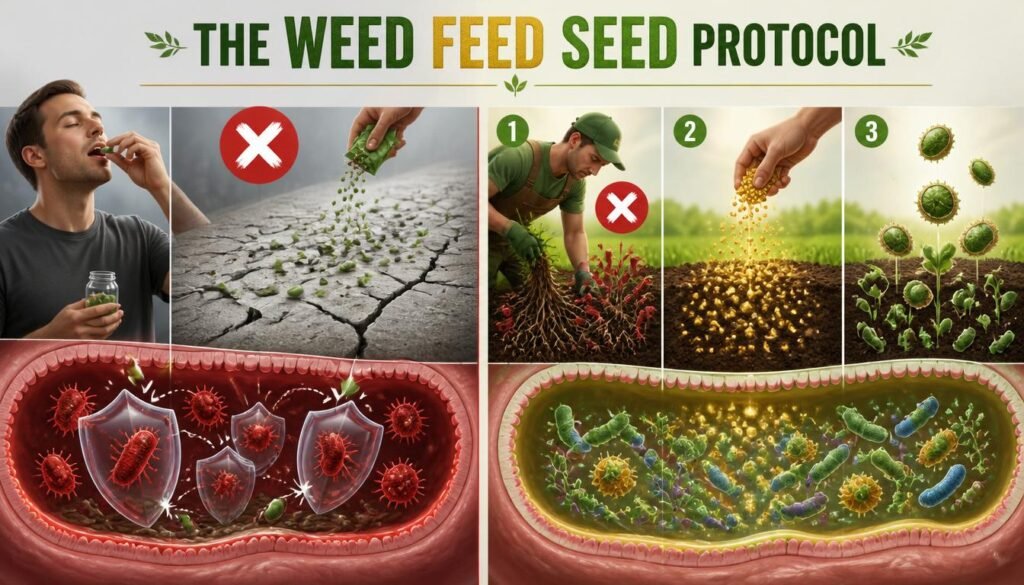
Taking a massive dose of probiotics without preparing your gastrointestinal tract first is the biological equivalent of throwing expensive grass seed onto toxic, dry concrete and expecting a lush lawn to grow. It is mathematically and biologically impossible.
Here is the exact cellular science behind the “Microbiome Mistake” that 90% of people make, why your probiotics are dying before they can help you, and the functional medicine protocol required to actually fix your gut.
Let me introduce you to Jennifer, a 41-year-old marketing director who had been taking high-dose probiotics for over two years. “I spent hundreds of dollars on different brands,” she told me. “I tried refrigerated ones, shelf-stable ones, and even the expensive multi-strain formulas. Nothing helped my bloating or brain fog.”
Jennifer’s problem wasn’t the probiotics—it was her gut environment. She had undiagnosed SIBO (Small Intestinal Bacterial Overgrowth) and was unknowingly feeding the wrong bacteria [3†L8-L11]. We shifted her focus to a Weed, Feed, Seed protocol: clearing out the overgrowth with targeted antimicrobials, prepping her gut with gentle prebiotics, and then introducing spore-based probiotics. Within eight weeks, her bloating resolved, her energy returned, and her digestion finally normalized. “I was throwing good bacteria into a war zone,” she says. “I had to fix the environment first.”
Jennifer’s story is not uncommon. Here is the exact cellular science behind why your probiotics are failing and how to actually fix your gut.
That first step makes far more sense once you understand the gut-brain-skin axis.
The “Seeds on Concrete” Fallacy
To understand why your probiotic is failing, you have to stop thinking of your gut as an empty tube and start thinking of it as a highly competitive, densely populated rainforest.
Trillions of bacteria, fungi, and archaea are already living there. They have claimed the territory. When you swallow a capsule containing 50 billion Lactobacillus bacteria, they are entering a hostile war zone.
If your gut is currently inflamed, highly acidic, or dominated by opportunistic bad bacteria (like a Candida or SIBO overgrowth), the new probiotic strains you just swallowed will be violently outcompeted and killed off within hours. The native microbiome consistently drives a more rapid and divergent genetic evolution of probiotic strains than host factors do [5†L10-L12]. In other words, your existing gut bacteria will outcompete and alter the newcomers before they can establish themselves.
They will pass straight through your digestive tract as expensive waste.
To make a probiotic actually “colonize” (survive and multiply), you must prepare the soil first. Research has shown that probiotic supplementation promotes the colonization of beneficial bacteria and improves microbial diversity [5†L33-L35]. However, this only happens when the gut environment is ready to receive them.
Internal Link: Understanding your baseline gut health is the first step. Use our Body Fat Calculator and TDEE Calculator to assess your metabolic health before starting any gut protocol.
The 2 Massive Mistakes You Are Making
Before you swallow another probiotic pill, you must fix the two biological bottlenecks that are sabotaging your gut health.
Mistake 1: You Skipped the “Weed” Phase
If your garden is completely choked with invasive weeds, planting new seeds won’t help. The weeds will steal all the water and sunlight.
If you suffer from chronic bloating, you likely have an overgrowth of opportunistic bacteria or yeast (like Candida albicans). These pathogens secrete toxins and create protective “biofilms” that act like biological shields [4†L6-L12]. You cannot just drop good bacteria into this environment.
You must actively “weed” the garden first by using targeted botanical antimicrobials (like Oil of Oregano or Berberine) or a temporary Low-FODMAP diet to starve the bad bacteria and clear the real estate.
SIBO is a disorder characterized by the excessive growth of bacteria in the small intestine, which can lead to abdominal pain, bloating, and malabsorption [3†L8-L11]. Taking a standard probiotic containing Lactobacillus or Bifidobacterium strains when you have SIBO can actually worsen symptoms by increasing fermentation in the small intestine, leading to more gas and bloating [3†L49-L53].
Mistake 2: You Are Starving Your Good Bacteria
This is the single biggest mistake in modern gut health. Probiotics are living organisms. If you do not feed them, they die.
The food that probiotics eat is called a Prebiotic. Prebiotics are specific types of soluble fiber (Microbiota-Accessible Carbohydrates, or MACs) that human beings cannot digest [7†L6-L8]. When you eat prebiotics, they travel intact to your large intestine, where your good bacteria ferment and eat them.
If you take a high-dose probiotic but eat a standard, highly processed, low-fiber diet, your new bacteria will literally starve to death upon arrival. Prebiotics appear more effective for comprehensive microbiome reconstitution by enhancing microbial diversity and metabolic function [2†L7-L10].
The Functional Protocol: Weed, Feed, Seed
To permanently fix your gut, you must follow the correct biological sequence.
Step 1: WEED (Clear the Pathogens)
Duration: 2 to 4 weeks
Focus on reducing gut inflammation and clearing out overgrowths.
- The Action: Temporarily remove refined sugars and highly fermentable carbohydrates that feed bad bacteria. Introduce natural, gentle anti-microbials or fasting protocols to activate your Migrating Motor Complex (your gut’s internal street sweeper) to flush out stagnant debris.
- Support Your Gut: During this phase, consider supporting your gut with a targeted approach. Our Protein Intake Calculator (internal link) can help ensure you’re getting enough protein to support tissue repair during the weeding phase.
Step 2: FEED (The Prebiotic Primer)
Before introducing new bacteria, you must lay down the soil and the fertilizer.
- The Action: Introduce targeted, gentle soluble fibers. PHGG (Partially Hydrolyzed Guar Gum) or Acacia fiber are excellent choices because they feed the good bacteria without causing the severe gas and bloating associated with rougher fibers like inulin.
- The Biology: You must create an environment rich in “bacterial food” so that when the probiotics arrive, they have the fuel they need to survive and multiply. Research shows that both probiotics and prebiotics positively affect gut microbiota, but they operate through different mechanisms [2†L6-L8]. Prebiotics are the substrate that promotes the growth and activity of commensal bacteria in the gut [2†L15-L16].
Step 3: SEED (The Right Type of Probiotic)
Most standard, refrigerated lactic-acid probiotics (Lactobacillus and Bifidobacterium) are highly sensitive. Up to 90% of them are destroyed by your stomach acid before they ever reach your intestines.
The Biohack: Switch to Spore-Based Probiotics (Bacillus strains). These act like microscopic seeds protected by a hard, biological armor. They are 100% immune to stomach acid. They pass through the stomach safely and only “hatch” once they reach the fertile, prebiotic-rich environment of your large intestine.
Bacillus coagulans CGI314 spores display resistance to high temperatures (40°C, 70°C, and 90°C), and gastric and bile acids [pH 3.0 and bile salt (0.3%)] [1†L7-L9]. Bacillus clausii spores survive transit through the human gastrointestinal tract and can undergo germination, outgrowth, and multiplication as vegetative forms [6†L44-L46]. Spore-based probiotics act as “microbial gardeners,” actively policing the gut and creating a highly oxygenated environment that allows your own native keystone bacteria to thrive.
The Gut Protocol Matrix
| Phase | Objective | Action | Duration |
|---|---|---|---|
| WEED | Clear pathogens and biofilms | Remove refined sugars; use targeted antimicrobials or Low-FODMAP diet | 2-4 weeks |
| FEED | Prepare the gut environment | Introduce gentle prebiotics (PHGG, Acacia fiber) | 2-4 weeks |
| SEED | Introduce beneficial bacteria | Use spore-based probiotics (Bacillus strains) | Ongoing |
The Bottom Line: Prepare the Soil First
Jennifer now follows a maintenance protocol: a spore-based probiotic, daily prebiotic fiber, and occasional “weed” cycles when she notices any bloating returning. “I wasted years and hundreds of dollars on probiotics that never had a chance,” she says. “Now I know—the environment matters more than the supplement.”
Your probiotic is not useless—but it is useless if you don’t prepare your gut first. The “Weed, Feed, Seed” protocol is the scientifically sound approach to actually fixing your microbiome. Stop throwing seeds on concrete. Start preparing the soil.
Frequently Asked Questions (FAQ)
Q: Do probiotics really need to be refrigerated?
A: Usually, no. The functional medicine community is moving away from refrigerated probiotics. If a strain of bacteria is so fragile that it cannot survive at room temperature on a store shelf, it is highly unlikely to survive the 98.6°F (37°C) highly acidic, churning environment of your stomach. Spore-based probiotics are completely shelf-stable and vastly superior for survivability. Research shows that spore-forming Bacillus strains demonstrate remarkable heat and acid resistance compared with conventional lactic acid bacteria [1†L35-L37].
Q: Should I take probiotics on an empty stomach or with food?
A: If you are taking a standard, non-spore probiotic, you should take it 15 to 30 minutes before a meal. This is when your stomach acid is at its lowest. If you take it in the middle of a heavy protein meal, your stomach will be flooded with hydrochloric acid, which will instantly incinerate the unprotected bacteria. Spore-based probiotics, however, can be taken at any time due to their protective armor.
Q: What are the best natural prebiotics?
A: If your gut is healthy enough to tolerate whole foods without severe bloating, the best natural prebiotics include cooked and cooled potatoes (Resistant Starch), slightly underripe green bananas, asparagus, garlic, and chicory root. Prebiotics are indigestible dietary components that improve host health by stimulating the growth and metabolic activity of beneficial intestinal microbes [7†L6-L8].
Q: Can taking probiotics make bloating worse?
A: Yes. If you have SIBO (Small Intestinal Bacterial Overgrowth) and you take a standard probiotic containing Lactobacillus, you are dropping millions of bacteria into a small intestine that is already dangerously overgrown. They will immediately begin fermenting your food in the wrong part of your digestive tract, causing severe, painful bloating [3†L49-L53]. You must “weed” the overgrowth before you “seed.” Long-term use and overuse of probiotics can actually cause SIBO [3†L43-L46].
Q: Why do cardiologists warn against probiotics?
A: Some cardiologists warn against certain probiotics in specific populations—particularly those with compromised immune systems or severe underlying conditions—due to the rare risk of translocation (bacteria crossing the gut barrier into the bloodstream). However, for healthy individuals, probiotics are generally safe. Always consult your healthcare provider before starting any new supplement regimen, especially if you have underlying health conditions.
Q: Should people with Hashimoto’s take probiotics?
A: Many functional medicine practitioners recommend probiotics for Hashimoto’s patients because gut health is closely linked to autoimmune function. However, strain selection matters. Some probiotics can support immune regulation and reduce inflammation, while others may exacerbate symptoms. Always work with a practitioner who understands your specific condition.
Q: Can berberine be taken with probiotics?
A: Yes, but timing matters. Berberine is a potent antimicrobial that can kill both bad and good bacteria. If you are taking berberine as part of a “weed” phase, separate it from your probiotic supplementation. Take berberine with meals and probiotics between meals or at a different time of day to maximize the benefits of both.

Julian Vance is the writer and editor behind RegenStep, translating peer-reviewed longevity, metabolic, and gut-health research into practical, actionable guides. Julian is not a licensed physician; content is reviewed against cited primary sources and is for informational purposes only. Always consult a qualified healthcare provider for personal medical advice.