
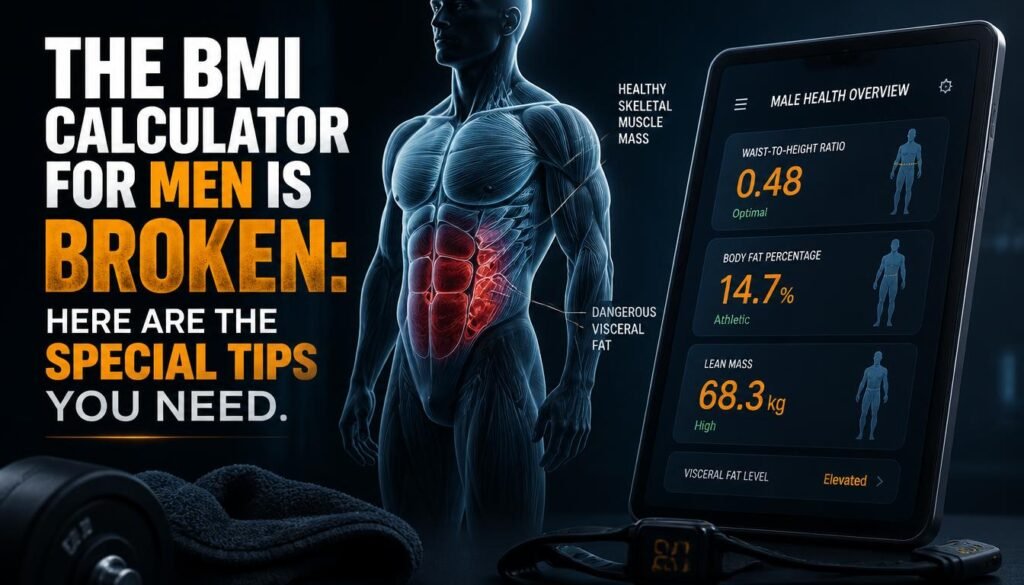
When men decide to take their health seriously, the first tool they usually reach for is a standard BMI calculator for men. You input your height and weight, and the screen categorizes you as underweight, normal, overweight, or obese. But here is the uncomfortable truth that mainstream medicine ignores: the standard BMI calculator for men is fundamentally flawed for the male physique. It was never designed to measure muscle mass, it ignores your hormonal reality, and it frequently misclassifies muscular, metabolically healthy men as “overweight,” while dangerously mislabeling others with high visceral fat as “healthy.”
As a clinician focused on longevity and metabolic optimization, I see the frustration this outdated metric causes daily. Men train hard, build dense muscle, and step on a scale only to be told they are in the same BMI category as someone who is sedentary and metabolically sick. To truly understand your metabolic health, we must abandon the generic BMI calculator for men and adopt a male-specific approach to body composition. This guide will provide the special tips you need to evaluate your health accurately across different stages of your life and optimize your biological age.
For the underlying math and its limits, see our step-by-step BMI guide.
The Historical Flaw: Why the Standard Formula Fails Men
To understand why the standard BMI calculator for men is so inaccurate, we have to look at its origins. The Body Mass Index (BMI) was created in the 1830s by Adolphe Quetelet, a Belgian mathematician—not a physician. He developed the formula to study population averages, not individual health. More importantly, his baseline data did not account for the massive variations in male skeletal muscle mass and bone density.
When this formula was later adopted by life insurance companies and eventually the medical community, a “universal” cutoff was applied to both sexes. This is a biological oversight. Men and women store fat in radically different ways due to sex hormones like testosterone and estrogen. Relying solely on a generic BMI calculator for men can misclassify up to 40% of athletic or heavily muscled men regarding their actual body fat percentage. Muscle is significantly denser than fat. A man with a 10% body fat percentage who lifts heavy weights will often register as “overweight” or even “obese” on the BMI scale, despite being in the top 1% of metabolic health.
The Hidden Danger: Visceral Fat and the “Dad Bod”
If you are using a basic BMI calculator for men, you are operating with only 10% of the data. The most critical variable it ignores is where your fat is stored.
Unlike women, who tend to store fat subcutaneously (under the skin) in the hips and thighs due to estrogen, men are biologically predisposed to store fat viscerally—deep inside the abdominal cavity, wrapping around the liver, pancreas, and intestines. This visceral fat is not just cosmetically undesirable; it is an active endocrine organ that pumps out inflammatory cytokines, drives insulin resistance, and exponentially increases your risk of heart disease and type 2 diabetes.
A man can have a “normal” BMI but carry a dangerous amount of visceral fat—a condition known as “normal weight obesity” or the classic “dad bod.” The BMI calculator for men looks at his total weight, sees it is within a normal range, and gives him a clean bill of health, completely missing the ticking metabolic time bomb in his abdomen. For a deeper dive into this, read our guide on Visceral Fat vs Subcutaneous Fat: Which One Is Actually Killing You?.
Special Tips for Men at Different Life Stages
A truly effective approach to male metabolic health must adapt to your hormonal landscape. The special tips you need in your 20s are vastly different from the protocols required in your 50s.
The 20s and 30s: Building Metabolic Armor
In your younger years, testosterone is high, and your body is primed to build and maintain lean muscle tissue.
- The Trap: Using a standard BMI calculator for men and attempting to drop your weight to match a generic chart, which often leads to sacrificing hard-earned muscle mass through extreme caloric restriction.
- Special Tip: Focus entirely on body recomposition—losing visceral fat while maximizing skeletal muscle. Muscle is your metabolic sink; it absorbs blood glucose and keeps you insulin sensitive. Prioritize heavy resistance training and ensure you are eating enough protein to support tissue growth by using our Protein Intake Calculator.
The 40s and 50s: The Testosterone Shift and Visceral Accumulation
As you enter your 40s, testosterone levels naturally begin to decline by about 1% per year. Simultaneously, life stress peaks, elevating cortisol.
- The Trap: Continuing to eat the exact same way you did in your 20s and wondering why your waistline is expanding, even if the BMI calculator for men only shows a slight increase.
- Special Tip: This is the decade where carbohydrate tolerance decreases and cortisol starts aggressively directing fat storage to your belly. You must shift your focus to managing stress and optimizing sleep. Managing stress is no longer just for mental health; it is a mandatory physical requirement to prevent Cortisol Belly Fat. Intermittent fasting becomes highly effective here to lower baseline insulin levels.
The 60s and Beyond: Fighting Sarcopenia
After age 60, the primary threat to male longevity is not necessarily fat gain, but muscle loss (sarcopenia) and declining bone density.
- The Trap: Believing that if your BMI remains “normal” or slightly “overweight,” you are safe from metabolic disease. In reality, that weight might be fat replacing lost muscle.
- Special Tip: Visceral fat migration and muscle wasting are the primary drivers of frailty and cardiovascular disease in older men. At this stage, tracking your functional strength (like grip strength and leg power) is infinitely more important than tracking your BMI. Muscle is the organ of longevity; losing it is a primary predictor of early mortality. Assess your functional strength and protein needs with our Protein Intake Calculator and read our deep dive into Grip Strength & Longevity: The Simple Test That Predicts How Long You’ll Live.
💡 Action Step: Stop letting a flawed algorithm dictate your health strategy. Use our advanced Body Fat Calculator to get a much more accurate estimate of your body composition, and our TDEE Calculator to understand your true daily energy expenditure based on your activity level and muscle mass.
Better Metrics to Use Instead of the BMI Calculator for Men
If you throw out the standard BMI calculator for men, what should you use instead? I recommend tracking these three functional metrics in your clinic or at home.
1. Waist-to-Height Ratio (WHtR)
This is arguably the most powerful predictor of cardiovascular risk in men. Simply measure your waist circumference (at the level of your belly button) and divide it by your height. The goal is to keep your waist circumference to less than half of your height (a ratio of < 0.5). This metric is vastly superior to the BMI calculator for men because it automatically scales to your frame size and directly targets dangerous abdominal fat, regardless of how muscular your chest or arms are.
2. Waist-to-Chest Ratio
For men focused on aesthetics and functional health, the waist-to-chest ratio is an excellent marker of hormonal balance. A high chest measurement combined with a low waist measurement indicates high muscle mass and low visceral fat—a sign of optimal testosterone-to-cortisol balance. A waist that is approaching or exceeding the chest measurement is a red flag for metabolic syndrome.
3. Fasting Insulin and Triglycerides
Weight and BMI are lagging indicators of metabolic dysfunction. Bloodwork is a leading indicator. Ask your doctor to test your fasting insulin and triglycerides. Optimal fasting insulin for a man should be between 2-5 μIU/mL, and triglycerides should be under 100 mg/dL. If your fasting insulin is high, you are experiencing insulin resistance, even if the BMI calculator for men says you are at a “healthy” weight.
Standard BMI Categories vs. Metabolic Reality
To visualize why the standard metric fails, consider how two men with the exact same BMI can have completely different health profiles:
| Metric | Man A (The “Skinny Fat” Phenotype) | Man B (The “Muscular” Phenotype) |
|---|---|---|
| Age | 45 | 45 |
| Height & Weight | 5’10”, 190 lbs | 5’10”, 190 lbs |
| Standard BMI Result | 27.3 (Categorized as “Overweight”) | 27.3 (Categorized as “Overweight”) |
| Body Fat % | 30% (High) | 14% (Optimal) |
| Muscle Mass | Low (Sarcopenic) | High |
| Fat Distribution | High Visceral Fat (Cortisol-driven belly) | Intramuscular and Subcutaneous |
| Metabolic Reality | High risk for insulin resistance, fatty liver, and cardiovascular disease. | Excellent metabolic flexibility, high insulin sensitivity, protected against aging. |
| Action Required | Resistance training, carbohydrate restriction, stress management. | Maintain current strength training and protein intake. |
Both men would be told they are “overweight” by a standard BMI calculator for men, yet only Man B is actually metabolically optimized. Man A requires urgent intervention, while Man A’s BMI falsely provides him with a sense of security, and Man B’s BMI falsely triggers health anxiety.

The Muscle Imperative: Why Men Must Lift Heavy
The most critical special tip for men regarding body composition is to recognize that muscle is your longevity armor. Men naturally possess a higher baseline of muscle mass than women, but this tissue is highly susceptible to atrophy as testosterone declines and physical activity decreases with age.
Muscle tissue is highly metabolically active. It acts as a disposal site for blood glucose. When you eat a carbohydrate, your muscles absorb that glucose, preventing it from circulating in the bloodstream and being stored as visceral fat. If you want to optimize your longevity, stop trying to shrink yourself to fit a broken BMI category. Instead, focus on recomposition: losing visceral fat while actively building and preserving skeletal muscle.
Final Thoughts
It is time to retire the generic BMI calculator for men from your health toolkit. It is a relic of a bygone era that fails to respect the complexity of male biology, muscle density, and visceral fat risks. True health is not a number on a chart developed in the 1830s. It is metabolic flexibility, robust muscle mass, low visceral fat, and a balanced nervous system.
By shifting your focus to functional metrics like your waist-to-height ratio, tracking your body fat percentage, and prioritizing muscle-building exercises, you take control of your biological age. Your body is a dynamic, hormone-driven engine. Treat it with the nuance and respect it deserves, and your healthspan will reflect that investment for decades to come.
Frequently Asked Questions (FAQ)
1. Is there a specific BMI calculator for men?
No, the standard BMI formula is exactly the same for men and women, which is why a standard BMI calculator for men is often inaccurate. It only uses height and weight, ignoring male-specific factors like high muscle density, bone mineral density, and the tendency to store dangerous visceral fat around the organs.
2. What is a healthy body fat percentage for men?
A healthy body fat percentage for men varies by age. For men in their 20s and 30s, 8-19% is generally considered healthy. For men in their 40s and 50s, 11-22% is considered normal. Dropping below 5% is unsustainable and can crash testosterone levels, while exceeding 25% significantly increases metabolic disease risk.
3. Why does the BMI calculator say I am overweight when I lift weights?
Muscle is significantly denser than fat. If you engage in heavy resistance training, you will weigh more due to increased muscle mass and intramuscular glycogen storage. A standard BMI calculator cannot differentiate between dense muscle and visceral fat, often misclassifying muscular men as overweight or obese.
4. What is a better metric than BMI for men?
The Waist-to-Height Ratio is vastly superior to BMI for men. Simply divide your waist circumference (measured at the belly button) by your height. Keeping your waist to less than half of your height (< 0.5 ratio) is a highly accurate way to ensure you do not carry dangerous visceral fat, regardless of your weight.
5. How does low testosterone affect a man’s BMI and body composition?
Low testosterone accelerates sarcopenia (muscle loss) and promotes the storage of visceral fat around the abdomen. A man’s total weight and BMI might remain stable as he ages, but his body composition shifts from metabolically protective muscle to metabolically dangerous fat, increasing his risk for heart disease and insulin resistance.
⚕️ Medical Disclaimer
The content provided on RegenStep.com, including this article authored by Dr. Julian Vance, is strictly for educational and informational purposes only. It is not intended to be a substitute for professional medical advice, diagnosis, or treatment.
Body composition metrics, including BMI, body fat percentage, and waist-to-height ratios, are screening tools and do not diagnose specific medical conditions. Always consult with your physician or a qualified healthcare provider before beginning any new weight management, diet, or exercise program, particularly if you have a history of cardiovascular disease, metabolic syndrome, or hormonal imbalances
Is there a specific BMI calculator for men?
No, the standard BMI formula is exactly the same for men and women, which is why a standard BMI calculator for men is often inaccurate. It only uses height and weight, ignoring male-specific factors like high muscle density, bone mineral density, and the tendency to store dangerous visceral fat around the organs.
What is a healthy body fat percentage for men?
A healthy body fat percentage for men varies by age. For men in their 20s and 30s, 8-19% is generally considered healthy. For men in their 40s and 50s, 11-22% is considered normal. Dropping below 5% is unsustainable and can crash testosterone levels, while exceeding 25% significantly increases metabolic disease risk.
Why does the BMI calculator say I am overweight when I lift weights?
Muscle is significantly denser than fat. If you engage in heavy resistance training, you will weigh more due to increased muscle mass and intramuscular glycogen storage. A standard BMI calculator cannot differentiate between dense muscle and visceral fat, often misclassifying muscular men as overweight or obese.
What is a better metric than BMI for men?
The Waist-to-Height Ratio is vastly superior to BMI for men. Simply divide your waist circumference (measured at the belly button) by your height. Keeping your waist to less than half of your height (< 0.5 ratio) is a highly accurate way to ensure you do not carry dangerous visceral fat, regardless of your weight.
How does low testosterone affect a man’s BMI and body composition?
Low testosterone accelerates sarcopenia (muscle loss) and promotes the storage of visceral fat around the abdomen. A man’s total weight and BMI might remain stable as he ages, but his body composition shifts from metabolically protective muscle to metabolically dangerous fat, increasing his risk for heart disease and insulin resistance.

Julian Vance is the writer and editor behind RegenStep, translating peer-reviewed longevity, metabolic, and gut-health research into practical, actionable guides. Julian is not a licensed physician; content is reviewed against cited primary sources and is for informational purposes only. Always consult a qualified healthcare provider for personal medical advice.