
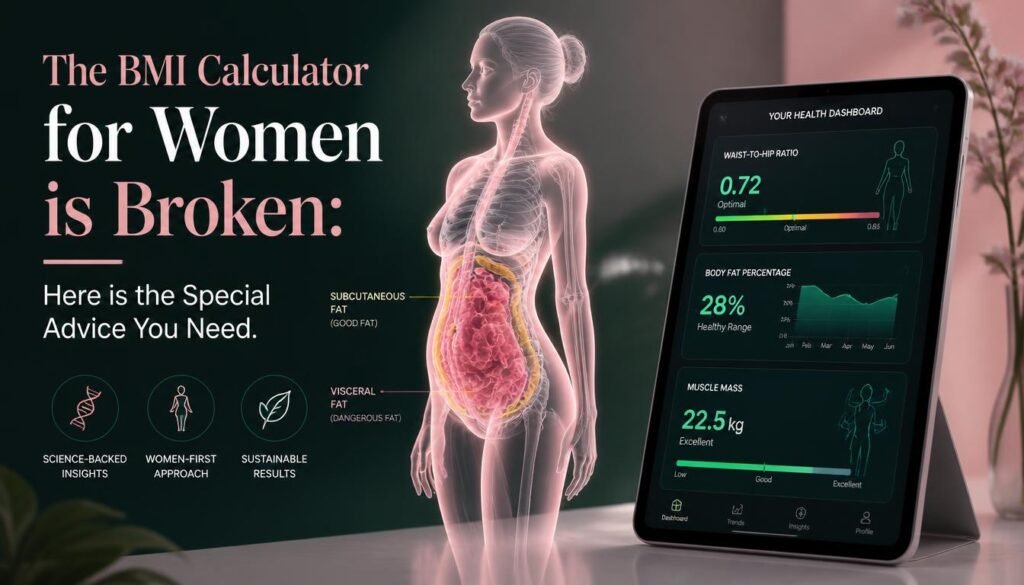
When women begin a health or weight loss journey, one of the first tools they reach for is a standard BMI calculator for women. You plug in your height and weight, and the algorithm spits out a number, categorizing you as underweight, normal, overweight, or obese. But here is the uncomfortable truth that the mainstream medical establishment rarely discusses: the standard BMI calculator for women is fundamentally flawed. It was never designed to measure female health, it ignores your hormonal reality, and it frequently misclassifies metabolically healthy women as “overweight” while dangerously mislabeling others as “healthy.”
As a clinician focused on longevity and metabolic optimization, I see the psychological damage this outdated metric causes every day. Women restrict calories to unhealthy extremes to achieve a “normal” BMI, only to lose vital muscle mass and crash their thyroid function. To truly understand your metabolic health, we must abandon the generic BMI calculator for women and adopt a hormone-aware, female-specific approach to body composition. This guide will provide the special advice you need to evaluate your health accurately across different stages of your life.
For the underlying math and its limits, see our step-by-step BMI guide.
The Historical Flaw: Why the Standard Formula Fails Women
To understand why the standard BMI calculator for women is so inaccurate, we have to look at its origins. The Body Mass Index (BMI) was created in the 1830s by Adolphe Quetelet, a Belgian mathematician—not a physician. He developed the formula to study population averages, not individual health. More importantly, his baseline data was drawn exclusively from white, European males.
When this male-centric formula was later adopted by life insurance companies and eventually the medical community, a “universal” cutoff was applied to both sexes. This is a biological travesty. According to research published in the Journal of Clinical Endocrinology & Metabolism, men and women store fat in radically different ways due to sex hormones like estrogen and testosterone.
Relying solely on a generic BMI calculator for women can misclassify up to 40% of patients regarding their actual body fat percentage and metabolic risk. Women naturally require a higher essential body fat percentage (typically 10-13% just for basic reproductive and hormonal function, compared to 2-5% for men) to maintain healthy estrogen levels, bone density, and thyroid function. Punishing a woman’s biology with a male-centric mathematical formula is not just inaccurate; it is actively harmful.
4 Hidden Variables Standard BMI Ignores in Women
If you are using a basic BMI calculator for women, you are operating with only 10% of the data. Here are the critical variables that standard BMI completely ignores:
1. Fat Distribution: The Pear vs. The Apple
Estrogen dictates that premenopausal women tend to store fat in the gluteofemoral region (hips, thighs, and buttocks). This subcutaneous fat is not just cosmetically benign; it is actually metabolically protective and serves as a sink for circulating fatty acids. Conversely, men (and postmenopausal women) tend to store fat viscerally, wrapping around internal organs. The problem with any standard BMI calculator for women that only uses height and weight is that it cannot distinguish between a woman with healthy, estrogen-driven hip fat and a woman with dangerous, cortisol-driven visceral fat. For a deeper dive into this, read our guide on Visceral Fat vs Subcutaneous Fat: Which One Is Actually Killing You?.
2. Muscle Mass vs. Fat Mass
Muscle is denser than fat. A female athlete with high muscle mass and low body fat might step on a scale, use a basic BMI calculator for women, and be told she is “overweight.” Meanwhile, a sedentary woman with low muscle mass and high visceral fat (a condition known as “normal weight obesity” or “skinny fat”) might fall into the “normal” BMI category, completely unaware that she is at high risk for insulin resistance and cardiovascular disease.
3. Bone Density Changes
Women are at a significantly higher risk for osteopenia and osteoporosis, particularly as estrogen declines during perimenopause and menopause. Standard BMI provides zero insight into your skeletal integrity. A woman could maintain her “ideal” BMI while silently losing critical bone mineral density, setting herself up for frailty in her later years.
4. Fluid Retention and Hormonal Cycles
A woman’s body weight can fluctuate by 3 to 7 pounds throughout her menstrual cycle due to progesterone-induced water retention. If you weigh yourself during the luteal phase (the week before your period) and plug that number into a BMI calculator for women, you might falsely conclude you are gaining fat, leading to unnecessary dietary restriction and elevated cortisol.
💡 Action Step: Stop letting a flawed algorithm dictate your self-worth. Use our advanced Body Fat Calculator to get a much more accurate estimate of your body composition, and our TDEE Calculator to understand your true daily energy expenditure based on your activity level.
Special Advice for Women at Different Life Stages
A truly effective approach to female metabolic health must adapt to your hormonal landscape. The advice you need in your 20s is vastly different from the advice you need in your 50s.
The 20s and 30s: Building the Metabolic Foundation
In your reproductive years, estrogen is your primary metabolic driver. Your body is primed to store fat in the lower body.
- The Trap: Using a generic BMI calculator for women and attempting to drop your body fat below 20%.
- The Special Advice: Do not fear healthy body fat. Falling below 20% body fat can trigger hypothalamic amenorrhea, shutting down your reproductive hormones, crashing your thyroid, and weakening your bones. Focus on building lean muscle mass through heavy resistance training. Muscle is your metabolic sink; the more you build now, the more insulin sensitive you will be later. Ensure you are eating enough protein to support this tissue growth by using our Protein Intake Calculator.
The 40s (Perimenopause): The Cortisol and Insulin Shift
As you enter perimenopause, progesterone drops first, leaving you in a state of “estrogen dominance” relative to progesterone. Simultaneously, your body becomes more sensitive to stress.
- The Trap: Continuing to eat the exact same way you did in your 20s and wondering why a standard BMI calculator for women is suddenly creeping up into the “overweight” category.
- The Special Advice: This is the decade where carbohydrate tolerance decreases. Insulin resistance begins to creep in, and cortisol starts redirecting fat storage from your hips to your belly. You must shift your focus from chronic, exhausting cardio (which spikes cortisol) to heavy strength training and strategic walking. Managing stress is no longer just for mental health; it is a mandatory physical requirement to prevent Cortisol Belly Fat.
The 50s and Beyond (Post-Menopause): The Visceral Migration
After menopause, the protective umbrella of estrogen is gone. Fat distribution shifts dramatically to the visceral cavity (around the organs), mirroring male fat storage patterns.
- The Trap: Believing that if your BMI remains “normal,” you are safe from metabolic disease.
- The Special Advice: Visceral fat migration is the primary driver of post-menopausal cardiovascular disease and type 2 diabetes. At this stage, tracking your waist circumference is infinitely more important than tracking your BMI.

Better Metrics: What to Measure Instead
If you throw out the standard BMI calculator for women, what should you use instead? I recommend tracking these three functional metrics in your clinic or at home.
1. Waist-to-Hip Ratio (WHR)
This is a powerful predictor of cardiovascular risk in women. Take a tape measure and measure your natural waist (the narrowest part of your torso, usually just above the belly button) and your hips (the widest part of your buttocks). Divide the waist by the hips. According to the World Health Organization, a WHR above 0.85 in women indicates central adiposity (visceral fat accumulation) and elevated metabolic risk, regardless of what the BMI scale says.
2. Waist-to-Height Ratio
Simply measure your waist circumference and divide it by your height. The goal is to keep your waist circumference to less than half of your height. This metric is vastly superior to the standard BMI calculator for women because it automatically scales to your frame size and directly targets dangerous abdominal fat.
3. Fasting Insulin and HOMA-IR
Weight and BMI are lagging indicators of metabolic dysfunction. Bloodwork is a leading indicator. Ask your doctor to test your fasting insulin (not just fasting glucose). Optimal fasting insulin for a woman should be between 2-5 μIU/mL. If your fasting insulin is 10 μIU/mL or higher, you are experiencing insulin resistance, even if your BMI is “normal.”
Standard BMI Categories vs. Metabolic Reality
To visualize why the standard metric fails, consider how two women with the exact same BMI can have completely different health profiles:
| Metric | Woman A (The “Skinny Fat” Phenotype) | Woman B (The “Muscular” Phenotype) |
|---|---|---|
| Age | 45 | 45 |
| Height & Weight | 5’6″, 150 lbs | 5’6″, 150 lbs |
| Standard BMI Result | 24.2 (Categorized as “Normal”) | 24.2 (Categorized as “Normal”) |
| Body Fat % | 38% (High) | 22% (Optimal) |
| Muscle Mass | Low (Sarcopenic) | High |
| Fat Distribution | High Visceral Fat (Cortisol-driven belly) | Subcutaneous and Intramuscular |
| Metabolic Reality | High risk for insulin resistance, fatty liver, and cardiovascular disease. | Excellent metabolic flexibility, high insulin sensitivity, protected against aging. |
| Action Required | Resistance training, carbohydrate restriction, stress management. | Maintain current strength training and protein intake. |
Both women would be told they are perfectly healthy by a standard BMI calculator for women, yet only Woman B is actually metabolically optimized.
The Muscle Imperative: Why Women Must Lift Heavy
The most critical piece of special advice for women regarding body composition is to abandon the fear of “getting bulky.” Women do not have the testosterone profile to build massive, bodybuilder-style muscles naturally. What resistance training gives women is metabolic armor.
Muscle tissue is highly metabolically active. It acts as a disposal site for blood glucose. When you eat a carbohydrate, your muscles absorb that glucose, preventing it from circulating in the bloodstream and being stored as visceral fat. As you age, you naturally lose 3% to 8% of your muscle mass per decade after age 30. This condition, sarcopenia, is the primary reason why older women experience frailty and metabolic decline.
If you want to optimize your longevity, stop trying to shrink yourself to fit a broken BMI category. Instead, focus on recomposition: losing visceral fat while actively building skeletal muscle.
Final Thoughts
It is time to retire the generic BMI calculator for women from your health toolkit. It is a relic of a bygone era that fails to respect the complexity of female biology, hormonal shifts, and body composition. True health is not a number on a chart developed in the 1830s. It is metabolic flexibility, robust muscle mass, healthy bone density, and a balanced nervous system.
By shifting your focus to functional metrics like your waist-to-hip ratio, tracking your body fat percentage, and prioritizing muscle-building exercises, you take control of your biological age. Your body is a dynamic, hormone-driven ecosystem. Treat it with the nuance and respect it deserves, and your healthspan will reflect that investment for decades to come.
Frequently Asked Questions (FAQ)
1. Is there a specific BMI calculator for women?
No, the standard BMI formula is exactly the same for men and women, which is why a standard BMI calculator for women is often inaccurate. It only uses height and weight, ignoring female-specific factors like body fat distribution, hormonal cycles, and essential fat requirements for reproductive and thyroid health.
2. What is a healthy body fat percentage for women?
A healthy body fat percentage for women varies by age. For women in their 20s and 30s, 21-32% is generally considered healthy. For women in their 40s and 50s, 23-34% is considered normal. Dropping below 17-20% can disrupt estrogen production, halt menstruation, and negatively impact bone density.
3. Why is my BMI normal but I still look and feel overweight?
This is a condition known as “normal weight obesity” or being “skinny fat.” It means you have a “normal” BMI but a high body fat percentage and low muscle mass. This often results in poor metabolic health, fatigue, and visceral fat accumulation, despite the scale reading as healthy.
4. What is a better metric than BMI for women?
The Waist-to-Hip Ratio (WHR) and Waist-to-Height Ratio are vastly superior to BMI for women. These metrics account for fat distribution, specifically identifying dangerous visceral fat around the organs, which is a primary driver of metabolic disease and cardiovascular risk.
5. How does menopause affect a woman’s BMI and body composition?
During menopause, the drop in estrogen causes a shift in fat storage from the hips and thighs (subcutaneous fat) to the abdomen (visceral fat). A woman’s weight and BMI might stay exactly the same, but her metabolic risk increases significantly due to this internal fat redistribution.
⚕️ Medical Disclaimer
The content provided on RegenStep.com, including this article authored by Dr. Julian Vance, is strictly for educational and informational purposes only. It is not intended to be a substitute for professional medical advice, diagnosis, or treatment.
Body composition metrics, including BMI, body fat percentage, and waist-to-hip ratios, are screening tools and do not diagnose specific medical conditions. Always consult with your physician or a registered dietitian before beginning any new weight management, diet, or exercise program, particularly if you have a history of eating disorders, hormonal imbalances, or metabolic disease.
Is there a specific BMI calculator for women?
No, the standard BMI formula is exactly the same for men and women, which is why a standard BMI calculator for women is often inaccurate. It only uses height and weight, ignoring female-specific factors like body fat distribution, hormonal cycles, and essential fat requirements for reproductive and thyroid health.
What is a healthy body fat percentage for women?
A healthy body fat percentage for women varies by age. For women in their 20s and 30s, 21-32% is generally considered healthy. For women in their 40s and 50s, 23-34% is considered normal. Dropping below 17-20% can disrupt estrogen production, halt menstruation, and negatively impact bone density.
Why is my BMI normal but I still look and feel overweight?
This is a condition known as “normal weight obesity” or being “skinny fat.” It means you have a “normal” BMI but a high body fat percentage and low muscle mass. This often results in poor metabolic health, fatigue, and visceral fat accumulation, despite the scale reading as healthy.
What is a better metric than BMI for women?
The Waist-to-Hip Ratio (WHR) and Waist-to-Height Ratio are vastly superior to BMI for women. These metrics account for fat distribution, specifically identifying dangerous visceral fat around the organs, which is a primary driver of metabolic disease and cardiovascular risk.
How does menopause affect a woman’s BMI and body composition?
During menopause, the drop in estrogen causes a shift in fat storage from the hips and thighs (subcutaneous fat) to the abdomen (visceral fat). A woman’s weight and BMI might stay exactly the same, but her metabolic risk increases significantly due to this internal fat redistribution.

Julian Vance is the writer and editor behind RegenStep, translating peer-reviewed longevity, metabolic, and gut-health research into practical, actionable guides. Julian is not a licensed physician; content is reviewed against cited primary sources and is for informational purposes only. Always consult a qualified healthcare provider for personal medical advice.