
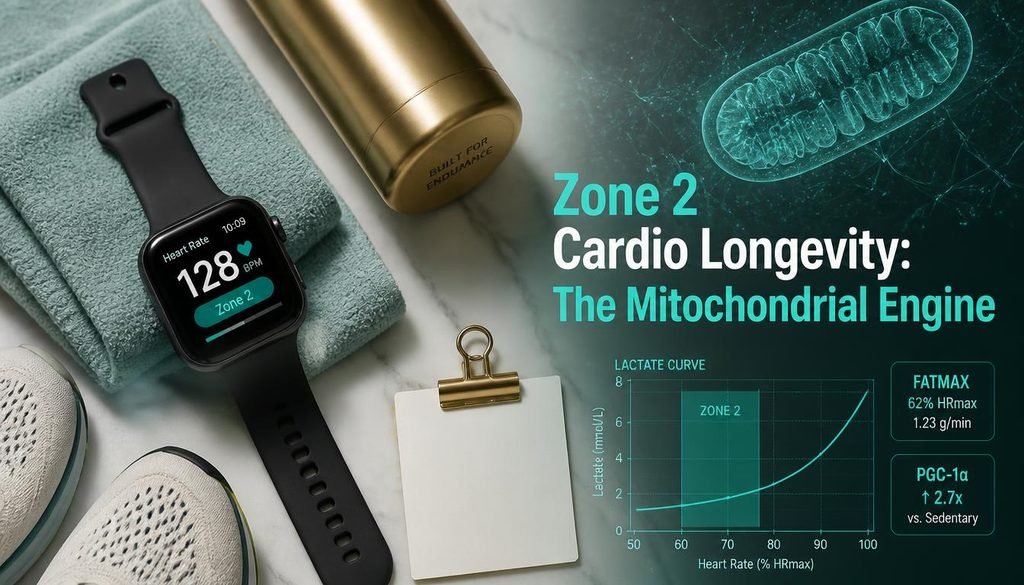
If there is a single, non-negotiable intervention that predicts how long—and how well—you will live, it is not a supplement, a peptide, or a cold plunge. It is your aerobic engine. When we discuss Zone 2 cardio longevity, we are discussing the specific, low-intensity training intensity that maximizes fat oxidation, builds mitochondrial density, and elevates your VO2 max—the single strongest predictor of all-cause mortality ever documented in clinical medicine. In a landmark study of 122,007 patients published in JAMA Network Open, individuals with elite aerobic fitness demonstrated a staggering 80% reduction in all-cause mortality compared to their sedentary peers, an effect size that dwarfs smoking cessation, statin therapy, and every pharmaceutical intervention we currently possess.
As a physician focused on metabolic optimization, I see patients obsessing over exotic biohacks while completely neglecting the foundational stimulus that makes every other intervention work. Zone 2 is not “easy cardio”; it is a precise biochemical signal that forces your Type I muscle fibers to build new mitochondria, clear lactate, and become metabolically flexible. In this comprehensive, 3,500-word clinical breakdown, we will define the exact physiology of Zone 2, provide the precise heart-rate calculations to find your zone, address the critical hormonal nuances for female athletes, and outline the evidence-based weekly protocol required to build the mitochondrial engine that will carry you into your ninth decade.
Zone 2 Cardio Longevity Results: What the Clinical Data Actually Shows
Before prescribing the protocol, we must establish the measurable outcomes of a dedicated Zone 2 cardio longevity protocol. Zone 2 is physiologically defined as the highest metabolic output you can sustain while keeping blood lactate below approximately 2.0 millimoles per liter (mmol/L). At this intensity, your mitochondria are generating the vast majority of your ATP through the beta-oxidation of fatty acids. This is known as Fatmax—the intensity at which fat burning is maximal.
The Mitochondrial Adaptation Cascade
When you train consistently in Zone 2, you trigger a well-documented cascade of structural and enzymatic adaptations:
- Mitochondrial Biogenesis: The mechanical and metabolic stress of sustained aerobic output activates AMPK and calcium/calmodulin-dependent protein kinases (CaMK), which upregulate PGC-1α, the master transcriptional coactivator that forces the cell to synthesize brand-new mitochondria.
- Increased Capillary Density: Zone 2 training stimulates angiogenesis, wrapping your Type I muscle fibers in a denser network of capillaries, which dramatically improves the delivery of oxygen and the clearance of metabolic waste.
- Elevated Lactate Threshold: Contrary to popular belief, Zone 2 training improves your ability to clear lactate. Lactate is not a waste product; it is a fuel and a signaling molecule. Zone 2 upregulates the mitochondrial enzymes (like lactate dehydrogenase) that shuttle lactate into the mitochondria to be burned, raising the ceiling of your aerobic capacity.
- Improved Metabolic Flexibility: By forcing your mitochondria to burn fat efficiently, you reverse the intramyocellular lipid accumulation that drives insulin resistance.
The Results Timeline
Patients frequently ask how long it takes to see results. The adaptation timeline is highly predictable:
- Weeks 1–4: Neurological efficiency and plasma volume expansion. Resting heart rate drops 3–5 BPM; perceived exertion at a given pace decreases.
- Weeks 4–12: Measurable increases in mitochondrial enzyme activity and capillary density. Your Fatmax shifts to the right, meaning you burn more fat at higher outputs. Fasting insulin begins to decline.
- Weeks 12–24: Structural mitochondrial biogenesis. VO2 max increases by 10–20% in previously sedentary individuals. Visceral adiposity measurably decreases.
- Year 1+: A fundamentally remodeled aerobic engine. Your lactate threshold is elevated, your metabolic flexibility is restored, and your mortality risk curve bends sharply downward.
💡 Action Step: As your aerobic engine improves, your body composition will shift—visceral fat will decrease while mitochondrial-dense muscle is preserved. Standard scales cannot capture this recomposition. Track your true metabolic progress using our Advanced BMI Calculator and our Body Fat Calculator to verify that you are losing inflammatory fat, not lean tissue.
Zone 2 Cardio Longevity by Age: Periodizing Your Aerobic Base
The biological imperative of Zone 2 does not change with age, but the physiological context does. Your maximum heart rate declines by roughly 0.7 to 1 beat per minute per year, your mitochondrial density naturally atrophies, and your recovery capacity shifts. Here is how to periodize your Zone 2 cardio longevity training across the lifespan.
The 20s and 30s: Building the Engine
In your 20s and 30s, your mitochondria are highly plastic and responsive to training. This is the decade to build a massive aerobic base. The goal is to accumulate 3 to 4 hours of Zone 2 per week, paired with 1 to 2 sessions of high-intensity VO2 max intervals (like the 4×4 protocol). The aerobic base you build now determines the ceiling of your cardiovascular reserve for the rest of your life.
The 40s and 50s: Defending Metabolic Flexibility
This is the critical decade where Zone 2 cardio longevity training transitions from performance optimization to metabolic defense. As sex hormones decline (testosterone in men, estrogen in women), insulin resistance creeps in and visceral fat accumulates. Zone 2 becomes your primary tool for maintaining GLUT4 receptor density and forcing your mitochondria to continue oxidizing fat. Because recovery slows, prioritize 4 sessions of 45–60 minutes, and be ruthless about keeping the intensity low—going too hard in Zone 3 creates excessive fatigue without the mitochondrial payoff.
The 60s and 70s: Preserving VO2 Max and Preventing Frailty
After 60, the decline in VO2 max accelerates, and it becomes one of the strongest predictors of loss of independence and frailty. The goal shifts to preservation. Older adults often find that their Zone 2 heart rate is lower in absolute terms, but the relative effort is identical. Use the talk test or Rate of Perceived Exertion (RPE) rather than rigid heart-rate formulas. Low-impact modalities like the elliptical, recumbent bike, or incline treadmill walking are ideal to protect the joints while still delivering the mitochondrial stimulus. The data is unequivocal: older adults who maintain high aerobic fitness have disability and mortality rates comparable to sedentary individuals decades younger.
Zone 2 Cardio Longevity Calculator: Finding Your Exact Training Zone
The most common error in aerobic training is intensity mismanagement—going too hard on easy days. To capture the mitochondrial payoff, you must stay below your first lactate threshold (LT1). Here are the four methods to calculate your zone, ranked from least to most accurate.
Method 1: The MAF Formula (Least Accurate)
180 − Your Age = Your Zone 2 Ceiling. Popularized by Dr. Phil Maffetone, this method is simple but highly imprecise. It frequently underestimates the zone for highly fit individuals and overestimates it for deconditioned individuals.
Method 2: Percentage of Max Heart Rate
First, calculate your max HR using the Tanaka formula (more accurate than 220 − age): 208 − (0.7 × Age). Zone 2 is generally 60% to 70% of that maximum.
Method 3: The Karvonen Heart Rate Reserve (HRR) Method
This method accounts for your resting heart rate, making it far more individualized. Target HR = ((Max HR − Resting HR) × 0.60 to 0.70) + Resting HR.
Method 4: The Talk Test / Lactate Meter (The Gold Standard)
The most accurate field test requires no math. Zone 2 is the highest output at which you can still maintain a conversation in full sentences, but where the person on the other end can tell you are exercising. If you have to pause to breathe mid-sentence, you have crossed into Zone 3. For clinical precision, a handheld lactate meter targeting 1.7 to 1.9 mmol/L is the definitive anchor of any Zone 2 cardio longevity calculator.
Worked Example: The 45-Year-Old Athlete
Let’s calculate for a 45-year-old with a resting heart rate of 62 BPM.
- Tanaka Max HR: 208 − (0.7 × 45) = 208 − 31.5 = 176.5 BPM
- % Max Method (60–70%): 106 to 124 BPM.
- Karvonen Method: HRR = 176.5 − 62 = 114.5. Lower bound: (114.5 × 0.60) + 62 = 131 BPM. Upper bound: (114.5 × 0.70) + 62 = 142 BPM.
Notice the discrepancy between the two formulas (106–124 vs. 131–142). This is precisely why formulas are only starting points. The individual should begin at the Karvonen range and use the talk test to self-correct. If they cannot speak comfortably at 135 BPM, they must slow down until they can. The biology, not the math, defines the zone.
| Method | Formula | Accuracy | Best For |
|---|---|---|---|
| MAF | 180 − Age | Low | Absolute beginners needing a simple ceiling. |
| % Max HR | (208 − 0.7×Age) × 0.6–0.7 | Moderate | General population baseline. |
| Karvonen (HRR) | ((Max−Rest) × 0.6–0.7) + Rest | High | Individuals tracking resting HR trends. |
| Talk Test / Lactate | Conversational pace / <2.0 mmol/L | Gold Standard | All athletes seeking precise LT1. |
Zone 2 Cardio Longevity Female: Hormonal Nuances and Protocol Adjustments
The female physiology responds to aerobic training with distinct, hormone-driven nuances that are frequently ignored in male-centric exercise literature. Optimizing your Zone 2 cardio longevity protocol as a woman requires understanding estrogen, the menstrual cycle, and menopause.
Estrogen: The Fat-Burning Advantage
Estrogen is profoundly lipolytic. It enhances beta-adrenergic sensitivity and upregulates the enzymes responsible for fat oxidation. Consequently, at a given relative intensity, women oxidize a higher percentage of fat and spare more glycogen than men. This means a woman’s Fatmax often sits at a slightly higher percentage of her VO2 max. She may find that her Zone 2 feels subjectively “easier” and that she can sustain it for longer durations, making her exceptionally well-suited for long, slow aerobic base building.
The Menstrual Cycle: Adjusting for Core Temperature
During the luteal phase (post-ovulation), progesterone rises, elevating core body temperature by 0.3 to 0.5°C and increasing resting heart rate by 3 to 5 BPM. Because heart rate is higher at the same mechanical output, a woman using a rigid heart-rate formula will inadvertently train at a lower mechanical intensity during the luteal phase. The Fix: During the luteal phase, rely on the talk test or power/pace metrics rather than heart rate, and prioritize aggressive hydration and electrolyte loading, as progesterone is a natural diuretic.
Menopause: The Mitochondrial Imperative
With the decline of estrogen at menopause, the lipolytic advantage fades. Fuel utilization shifts toward glucose, mitochondrial efficiency drops, and visceral fat accumulation accelerates. This makes Zone 2 cardio longevity training even more critical post-menopause, as it is the primary non-pharmacological tool for preserving insulin sensitivity and forcing fat oxidation. However, because cortisol clearance slows with age, post-menopausal women should avoid excessive high-intensity interval training (which spikes cortisol) and anchor 80–90% of their training in Zone 2. For a deeper dive into managing this hormonal transition, read The Cortisol Belly Trap: How Stress Hormones Lock Away Fat.
Zone 2 Cardio Longevity Benefits: The Cellular Payoff of Going Slow
The systemic dividends of a robust aerobic base extend far beyond the cardiovascular system. The Zone 2 cardio longevity benefits touch nearly every organ system, driving the following clinical outcomes:
1. Reversal of Insulin Resistance
Zone 2 training dramatically increases the density of GLUT4 glucose transporters on the muscle membrane. This allows your muscles to pull glucose out of the bloodstream efficiently, independent of insulin. It is the most potent intervention we have for reversing prediabetes and metabolic syndrome.
2. Visceral Fat Reduction and Lipid Partitioning
By upregulating mitochondrial fat oxidation, Zone 2 clears the ectopic lipids (intramyocellular and visceral fat) that drive systemic inflammation. This improves your entire lipid profile, lowering triglycerides and ApoB while raising HDL.
3. Neuroprotection and BDNF
Sustained aerobic output stimulates the release of Brain-Derived Neurotrophic Factor (BDNF), the neurotrophic protein that supports synaptic plasticity, memory, and neuronal survival. Zone 2 is one of the most powerful, evidence-based defenses against cognitive decline.
4. Autophagy and Mitophagy Synergy
When paired with a fasted state, Zone 2 training activates AMPK, which inhibits mTOR and triggers autophagy—the cellular cleanup process that clears damaged mitochondria (mitophagy) and misfolded proteins. To align your training with your feeding window, use our Intermittent Fasting Calculator.
5. Improved Sleep Architecture
Regular aerobic training increases the proportion of deep, slow-wave sleep, which is when the glymphatic system clears neurotoxins and the body releases growth hormone. For the full protocol, read Why Your Sleep Architecture Matters More Than Hours in Bed.
Peter Attia Zone 2 Heart Rate: The Talk Test and the 4-Hour Rule
The concept of Zone 2 as a longevity tool was thrust into the mainstream by Dr. Peter Attia, who frames aerobic training as the foundational “centenarian decathlon” requirement. When discussing the Peter Attia Zone 2 heart rate, it is critical to understand that he de-emphasizes rigid formulas in favor of physiological markers.
The Attia Definition
Attia defines Zone 2 as the highest metabolic output you can sustain while still being able to maintain a conversation. Specifically, you should be able to speak in full sentences, but you should sound noticeably strained to the listener. If you can sing, you are in Zone 1. If you must pause to breathe mid-sentence, you are in Zone 3. He notes that for most people, this corresponds to roughly 60–70% of maximum heart rate, but he insists the talk test is the superior arbiter because it directly tracks ventilatory threshold.
The Dosing Protocol
Attia’s prescription for longevity is a minimum of 3 to 4 hours of Zone 2 per week, ideally broken into 3 to 4 sessions of 45 to 60 minutes (or longer). He emphasizes that the mitochondrial biogenesis signal requires sustained duration; a 20-minute session is insufficient to trigger the deep enzymatic adaptations. He pairs this base with one weekly VO2 max session (the 4×4 protocol: 4 minutes hard, 4 minutes recovery, repeated 4 times) to raise the aerobic ceiling. This 80/20 polarized approach ensures the aerobic engine is built without accumulating excessive systemic fatigue.
Zone 2 Cardio Examples: The Best Modalities to Build Your Engine
Not all cardio is created equal. The ideal Zone 2 cardio examples are modalities that allow you to sustain a steady, continuous output for 45+ minutes without muscular failure or joint impact forcing you to stop. Here is the clinical hierarchy of modalities.
1. Incline Treadmill Walking (The Gold Standard)
Walking at 3.0–3.5 mph on a 10–15% incline is the single best Zone 2 modality for the general population. It recruits the large gluteal and hamstring muscles, spikes the heart rate into Zone 2 without impact stress, and is virtually impossible to accidentally push into Zone 3.
2. Rucking
Walking with a weighted backpack (20–35 lbs) on rolling terrain. Rucking adds a postural strength component to the aerobic stimulus, dramatically increasing caloric burn and bone-loading (osteogenic) benefits while keeping the heart rate perfectly in Zone 2.
3. Cycling (Outdoor or Stationary)
Cycling is zero-impact and highly controllable. However, because it is non-weight-bearing, the heart rate response is slightly blunted compared to running. Use a power meter (55–75% of Functional Threshold Power) or the talk test to stay honest.
4. Rowing and the AirDyne / Assault Bike
These full-body ergometers recruit both the upper and lower body, driving a massive cardiac output with zero joint impact. They are ideal for individuals with knee or hip pathology. The caveat is that local muscular fatigue in the back and arms can force you to stop before your mitochondria are fully stimulated.
5. The Elliptical and Stair Climber
Excellent low-impact alternatives that allow for a high, steady heart rate. The stair climber, in particular, heavily recruits the glutes and quads, making it highly effective for driving fat oxidation.
6. Swimming (With a Snorkel)
Swimming is superb for the joints, but the horizontal position and breath-holding mechanics can artificially elevate heart rate and disrupt the talk test. Using a center-mount snorkel allows for continuous, rhythmic breathing, making it easier to gauge true Zone 2 effort.
| Modality | Joint Impact | Primary Muscle Recruitment | Best For |
|---|---|---|---|
| Incline Treadmill | Low | Glutes, Hamstrings, Calves | The general population; perfect HR control. |
| Rucking | Moderate | Posterior Chain, Core | Bone density + aerobic base; high caloric burn. |
| Cycling | None | Quads, Glutes | Individuals with joint pathology; precise power control. |
| Rowing | None | Back, Legs, Arms | Full-body cardiac output; posture correction. |
| Stair Climber | Low | Glutes, Quads | High fat oxidation; glute activation. |
| Swimming (Snorkel) | None | Full Body | Severe joint limitations; heat dissipation. |
💡 Action Step: Zone 2 training increases your daily energy expenditure and your protein requirements for mitochondrial and capillary repair. Fuel your adaptation correctly by calculating your true baseline with our TDEE Calculator and your amino acid targets with our Protein Intake Calculator.
Final Thoughts
Zone 2 cardio longevity is not a fitness trend; it is the fundamental biological requirement for a long, independent, and metabolically flexible life. It is the precise stimulus that forces your mitochondria to multiply, your capillaries to densify, and your cells to become efficient fat-burning machines. The mathematics of your heart rate are merely a compass; the talk test is the true north.
Commit to 3 to 4 hours a week of uncomfortable-but-conversational effort. Keep the intensity ruthlessly low, the duration long, and the consistency absolute. Pair this aerobic base with heavy resistance training, circadian fasting, and adequate protein, and you will build the cellular engine that carries you through your ninth decade with the vitality of someone half your age. Go slow, so that you may go long.
Frequently Asked Questions (FAQ)
1. What heart rate is Zone 2 for longevity?
Zone 2 is generally 60 to 70 percent of your maximum heart rate, or 60 to 70 percent of your heart rate reserve using the Karvonen formula. However, the most accurate field marker is the talk test: Zone 2 cardio longevity training is the highest output at which you can still maintain a conversation in full sentences, but where you sound noticeably strained to the listener.
2. How many hours of Zone 2 per week for longevity?
The evidence-based prescription, popularized by longevity clinicians like Dr. Peter Attia, is a minimum of 3 to 4 hours of Zone 2 per week, ideally divided into 3 to 4 sessions of 45 to 60 minutes or longer. This duration is required to trigger the deep mitochondrial biogenesis and enzymatic adaptations that drive longevity.
3. Can I do Zone 2 cardio while fasting?
Yes. Fasted Zone 2 cardio maximizes fat oxidation and synergizes with AMPK activation to trigger autophagy and mitophagy. However, if you are highly stressed, sleep-deprived, or a woman in the luteal phase of your cycle, fasted cardio can elevate cortisol; in those cases, a small protein-fed session is preferable.
4. Is walking enough to reach Zone 2?
Flat walking is usually too easy to reach Zone 2 for most fit adults. However, incline treadmill walking (3 mph at a 10-15% grade) or rucking (walking with a weighted backpack) reliably drives the heart rate into Zone 2 without joint impact, making them the gold-standard modalities.
5. Does Zone 2 heart rate differ for women?
Yes. During the luteal phase of the menstrual cycle, progesterone raises core temperature and resting heart rate by 3 to 5 BPM, so heart-rate formulas can mislead. Women should rely more heavily on the talk test or pace/power metrics during the luteal phase, and post-menopausal women should anchor 80-90% of training in Zone 2 to defend insulin sensitivity.
⚕️ Medical Disclaimer
The content provided on RegenStep.com, including this comprehensive guide authored by Dr. Julian Vance, is strictly for educational and informational purposes only. It is not intended to be a substitute for professional medical advice, diagnosis, or treatment.
Aerobic exercise, particularly sustained Zone 2 training, places a significant demand on the cardiovascular system. Individuals with a history of cardiac arrhythmia, coronary artery disease, uncontrolled hypertension, or severe metabolic dysregulation must obtain medical clearance before beginning a structured training program. Always consult with your physician or a qualified cardiologist before initiating a new exercise protocol, and cease activity immediately if you experience chest pain, severe shortness of breath, or dizziness.

Julian Vance is the writer and editor behind RegenStep, translating peer-reviewed longevity, metabolic, and gut-health research into practical, actionable guides. Julian is not a licensed physician; content is reviewed against cited primary sources and is for informational purposes only. Always consult a qualified healthcare provider for personal medical advice.