
We are living through the most profound shift in metabolic medicine since the discovery of insulin. GLP-1 and dual GIP/GLP-1 receptor agonists—molecules like semaglutide and tirzepatide—are fundamentally rewriting the clinical approach to obesity, type 2 diabetes, and cardiovascular risk. By mimicking incretin hormones, these compounds delay gastric emptying, signal profound satiety to the hypothalamus, and resolve systemic insulin resistance. The results are nothing short of miraculous for visceral fat reduction.
But as a strategist focused on longevity and cellular health, I look past the dramatic drops on the bathroom scale and look directly at the DEXA scans. And what the data reveals is a massive, largely unaddressed biological crisis. When you slash caloric intake by 30% to 40% and rapidly drop body weight, the body does not exclusively burn adipose tissue. It actively cannibalizes its own structural and metabolic engine. Up to 40% of the weight lost on high-dose GLP-1 therapy is lean tissue—skeletal muscle and bone mineral density.
This is not a cosmetic issue. This is GLP-1 muscle preservation becoming the single most critical variable in your long-term healthspan. If you strip away your muscle mass, you destroy your primary glucose sink, crash your basal metabolic rate, and guarantee a severe metabolic rebound the moment you stop the medication. Let’s dismantle the guesswork and build a rigorous, evidence-based protocol to defend your lean mass while utilizing these powerful metabolic tools.
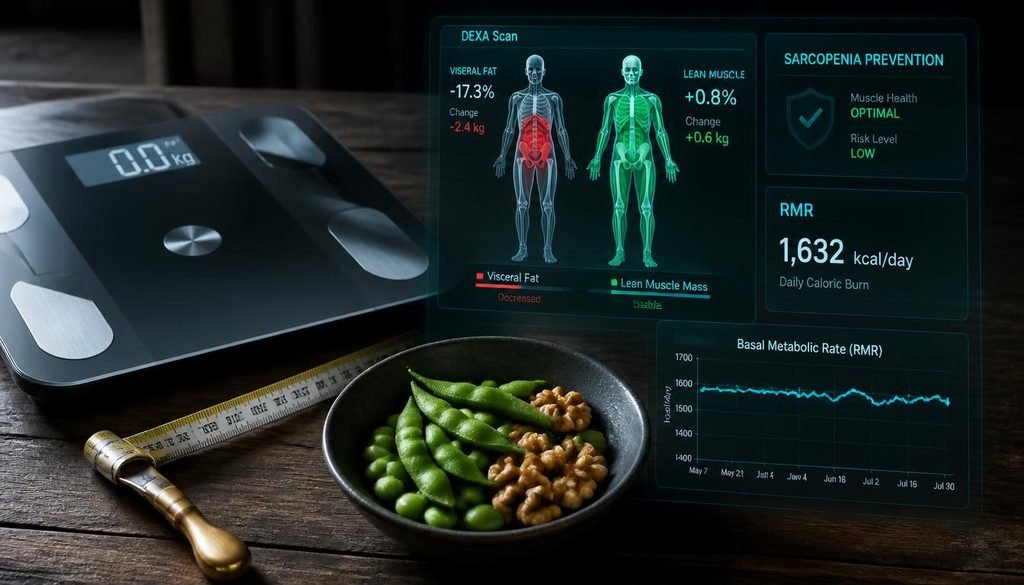
GLP-1 Muscle Loss Prevention: Defending Your Metabolic Armor
To understand why GLP-1 muscle loss prevention must be your primary focus, we have to reframe how we view skeletal muscle. Mainstream culture treats muscle as an aesthetic luxury—a byproduct of vanity and heavy lifting. In longevity biology, skeletal muscle is the largest endocrine and metabolic organ in the human body.
The Organ of Longevity
Muscle is your primary metabolic sink. It is responsible for clearing up to 80% of post-prandial glucose from your bloodstream via insulin-independent GLUT4 translocation. When you contract a muscle, it releases myokines—signaling proteins like IL-6 and irisin—that reduce systemic inflammation, promote neurogenesis in the brain, and stimulate the browning of white adipose tissue.
When you lose muscle mass rapidly, you are not just losing “tone.” You are losing your metabolic armor. You are shrinking the very tissue that protects you from hyperglycemia, frailty, and cognitive decline. If a patient loses 40 pounds on a GLP-1 agonist, and 15 of those pounds are skeletal muscle, their basal metabolic rate (BMR) plummets. They have essentially engineered a body that requires significantly fewer calories to maintain, setting the stage for rapid, aggressive weight regain (the rebound effect) once the pharmacological appetite suppression is removed. True GLP-1 muscle loss prevention is about protecting your metabolic ceiling.
GLP-1 Muscle Loss: The Hidden Cost of Rapid Weight Reduction
The sheer scale of GLP-1 muscle loss in the general population is staggering, primarily because patients and even prescribing clinicians are fixated on total body weight rather than body composition.
When you enter a massive caloric deficit—which is virtually unavoidable on high-dose incretin mimetics due to the profound early satiety and food aversion—the body perceives a famine state. From an evolutionary perspective, maintaining highly metabolically expensive tissue like skeletal muscle during a famine is a biological liability. The body’s survival mechanism is to shed the “expensive” muscle to lower its daily caloric requirements, while fiercely guarding fat stores for long-term energy survival.
Without a massive, deliberate intervention to signal that the muscle is required for immediate physical survival, the body will strip it away. This phenomenon, known as sarcopenic obesity (or in this case, sarcopenic weight loss), results in a patient who is technically “thinner” but metabolically frailer, with a higher body fat percentage relative to their new, lower lean mass.
The GLP-1 Muscle Loss Mechanism: Why Your Body Cannibalizes Its Own Engine
To intervene effectively, we must map the exact GLP-1 muscle loss mechanism. It is not simply a matter of “eating less.” It is a complex interplay of hormonal shifts, mechanical unloading, and protein malabsorption.
1. The Caloric and Protein Deficit
The primary driver is the sheer magnitude of the caloric deficit. When patients on GLP-1s report eating 800 to 1,200 calories a day, they are almost universally failing to hit the minimum threshold of protein required to maintain a positive net muscle protein balance. Muscle Protein Synthesis (MPS) and Muscle Protein Breakdown (MPB) are in a constant tug-of-war. If dietary amino acids (specifically leucine) drop below the leucine trigger threshold, MPB outpaces MPS, and the tissue degrades.
2. Slowed Gastric Emptying and Amino Acid Kinetics
GLP-1 agonists work by drastically slowing gastric emptying. While this blunts glucose spikes and induces satiety, it also alters the pharmacokinetics of protein digestion. The delayed transit time can blunt the rapid spike in blood amino acids required to maximally stimulate the mTOR pathway (the master regulator of muscle protein synthesis). The amino acids trickle in slowly, failing to hit the acute anabolic threshold.
3. Mechanical Unloading
As patients lose weight, the physical load they carry during daily activities decreases. Walking up a flight of stairs with 40 fewer pounds on your frame requires significantly less muscular force. This subtle reduction in daily mechanical tension signals the nervous system that the current muscle mass is “over-engineered” for the new, lighter body, accelerating the catabolic breakdown of the tissue.
GLP-1 Muscle Loss Symptoms: Spotting the Sarcopenic Slide
Because the scale is moving down, patients often ignore the early warning signs of tissue degradation. Recognizing GLP-1 muscle loss symptoms requires looking past the mirror and paying attention to functional and metabolic biomarkers.
- The “Ozempic Face” and Sagging Skin: While fat loss in the face is expected, a gaunt, hollowed appearance accompanied by severe skin laxity often indicates a loss of the underlying structural matrix (muscle and collagen) that keeps the skin tethered and full.
- Profound Physical Fatigue: A distinct lack of physical energy, feeling “heavy” or weak when performing basic tasks like carrying groceries or standing up from a low chair. This is a direct result of Type II (fast-twitch) muscle fiber atrophy.
- Plummeting Grip Strength: Grip strength is one of the most robust biomarkers for overall biological age and mortality risk. If your handshake feels weaker, or you struggle to open jars that were previously easy, your systemic lean mass is degrading.
- Cold Intolerance: Muscle is a primary generator of basal body heat. A sudden, persistent sensitivity to cold, particularly in the extremities, often signals a drop in basal metabolic rate driven by muscle loss.
- Stalled Weight Loss (The Metabolic Adaptation): If your weight loss completely stalls despite eating very few calories, your BMR has likely downregulated to match your intake, largely due to the loss of metabolically active lean tissue.
💡 Action Step: You cannot manage what you do not measure. The bathroom scale is a useless metric during GLP-1 therapy because it cannot differentiate between fat loss and muscle catabolism. You must track your true body composition using our Advanced BMI Calculator and our Body Fat Calculator. These tools utilize circumference and demographic data to estimate your lean mass retention, ensuring your weight loss is actually improving your metabolic health, not degrading it.
The Landmark GLP-1 Muscle Loss Study: What the DEXA Scans Reveal
To ground this in clinical reality, we have to look at the data from the landmark GLP-1 muscle loss study trials—specifically the STEP (Semaglutide Treatment Effect in People with obesity) and SURMOUNT (Tirzepatide) clinical trials.
When researchers utilized Dual-Energy X-ray Absorptiometry (DEXA) scans to analyze the composition of the weight lost, the results were a wake-up call for the longevity community. In the STEP 1 trial, patients lost an average of 15% of their total body weight. However, DEXA analysis revealed that roughly 30% to 40% of that lost weight was lean mass (muscle and bone mineral density).
To put this in perspective, a 40% lean mass loss is comparable to, and in some cases worse than, the muscle loss seen in bariatric surgery patients or elderly individuals suffering from acute cachexia (muscle wasting due to chronic disease).
Furthermore, sub-analyses of these trials showed that the patients who experienced the most profound lean mass loss were those who lost weight the fastest and did not engage in structured resistance training. The data is unequivocal: the medication drives the weight loss, but without a targeted mechanical and nutritional intervention, a massive portion of that weight will be your vital metabolic engine.
GLP-1 Muscle Loss Supplements: The Anabolic Rescue Stack
You cannot out-supplement a severe caloric and protein deficit, but when your appetite is pharmacologically suppressed, targeted compounds can help tip the scales back toward Muscle Protein Synthesis (MPS). When formulating a GLP-1 muscle loss supplements protocol, we focus on maximizing the anabolic signal per calorie consumed.
1. Essential Amino Acids (EAAs)
When you cannot stomach a whole food protein source, EAAs are your lifeline. Unlike whey or casein, which require gastric breakdown, free-form EAAs bypass the slowed gastric emptying caused by the GLP-1 and are rapidly absorbed into the bloodstream. A 10g dose of EAAs (with a high leucine content of at least 3g) provides the exact molecular trigger required to activate the mTOR pathway and halt muscle breakdown, with virtually zero caloric load and no gastrointestinal distress.
2. Creatine Monohydrate
Creatine is non-negotiable during rapid weight loss. By saturating the muscles with phosphocreatine, you maintain cellular hydration and ATP recycling capacity. This not only preserves strength and power output during your training sessions (providing the necessary mechanical tension to signal muscle retention) but also draws water into the muscle cell, creating an anabolic, anti-catabolic environment. Dose: 5g daily.
3. HMB (Beta-Hydroxy Beta-Methylbutyrate)
HMB is a metabolite of the amino acid leucine. While leucine stimulates muscle protein synthesis, HMB is exceptionally potent at inhibiting muscle protein breakdown (MPB). During severe caloric restriction, MPB accelerates. Supplementing with 3g of HMB daily acts as a biochemical brake on the catabolic pathways, protecting your lean mass while in a steep deficit.
4. Vitamin D3 + K2 and Calcium
Bone mineral density is intrinsically tied to muscle mass. Rapid weight loss accelerates bone resorption. Ensuring optimal levels of Vitamin D3 (5,000 IU) paired with K2 (MK-7) ensures that calcium is directed into the bone matrix rather than the arterial walls, protecting the structural scaffolding that your muscles anchor to.
💡 Action Step: To ensure you are providing the raw building blocks for your defense systems and preventing the catabolic slide, calculate your exact daily protein requirements with our Protein Intake Calculator. Even on a GLP-1, you must aim for a minimum of 0.8g to 1g of protein per pound of ideal body weight. Establish your baseline energy expenditure with our TDEE Calculator to ensure your deficit is aggressive enough for fat loss, but not so severe that it triggers catastrophic muscle wasting.
GLP-1 Muscle Building: The Mechanical Imperative
Let’s be brutally honest: you are not going to build massive amounts of new muscle while in a 1,000-calorie deficit on a GLP-1 agonist. The biological environment is primarily catabolic. Therefore, the goal of GLP-1 muscle building during the active weight-loss phase is actually muscle preservation through mechanical overload. You must send a signal so loud that the body is forced to retain the tissue.
The Myth of “Toning” with Light Weights
The most disastrous advice given to patients on weight-loss medications is to “do light cardio and use light dumbbells to tone.” Light resistance does not recruit the high-threshold motor units (Type II muscle fibers) that are most susceptible to atrophy during caloric restriction.
The Heavy Loading Protocol
To preserve lean mass, you must engage in heavy, progressive resistance training 3 to 4 days a week.
- Compound Movements: Focus on squats, deadlifts, presses, and rows. These multi-joint movements recruit the maximum amount of muscle mass and trigger a systemic hormonal response (endogenous growth hormone and testosterone release) that protects the entire body.
- Proximity to Failure: You must train close to muscular failure (leaving 1 or 2 reps in the tank). The mechanical tension and metabolic stress generated near failure are the primary drivers of the mTOR signaling pathway.
- Eccentric Overload: The lowering (eccentric) phase of a lift causes the most micro-tearing in the muscle fiber, which is a potent stimulus for repair and retention. Control the weight on the way down for a full 3 seconds.
If you are lifting the same weight today that you lifted three months ago, but you weigh 30 pounds less, your relative strength has skyrocketed, and you have successfully signaled your body to retain the muscle.
Building Muscle on GLP-1: The Nutritional and Training Protocol
Successfully building muscle on GLP-1 (or more accurately, defending it while stripping fat) requires a highly strategic approach to nutrient timing and training recovery. The early satiety and nausea associated with these medications make hitting protein targets a daily battle.
1. Protein Prioritization (The “Protein First” Rule)
Because your gastric capacity is severely limited, you must prioritize protein above all else. When you sit down to eat, consume your protein source first, before touching any vegetables, fats, or carbohydrates. If you fill up on fiber or fat first, you will not reach the leucine threshold required for MPS.
2. Liquid Nutrition and Hydrolyzed Proteins
When whole food is unpalatable, leverage liquid nutrition. Hydrolyzed whey protein or high-quality plant isolates are pre-digested, meaning they require minimal gastric breakdown and can pass through the slowed stomach environment more efficiently. A liquid protein shake sipped slowly over an hour can help you hit your macro targets without triggering the severe nausea associated solid meals.
3. Strategic Carbohydrate Placement
While GLP-1s excel at blunting glucose spikes, you still need carbohydrates to fuel intense resistance training and replenish muscle glycogen. Place the majority of your daily complex carbohydrates in the meal immediately following your heavy lifting session. This utilizes the insulin spike (which is still present, even if blunted by the GLP-1) to drive amino acids and glucose into the depleted muscle cells, shifting the body from a catabolic to an anabolic state.
4. Circadian Fasting and Autophagy
To maximize the cellular cleanup benefits of the GLP-1 without exacerbating muscle loss, pair the medication with a gentle, circadian-aligned fasting window. Use our Intermittent Fasting Calculator to design a 12-to-14-hour overnight fast. This allows the Migrating Motor Complex (MMC) to sweep the gut and initiates mild autophagy, without pushing the fast so long that the body begins breaking down muscle tissue for gluconeogenesis.
The Post-GLP-1 Transition: Avoiding the Rebound
The ultimate test of your GLP-1 muscle preservation protocol occurs when you stop the medication. Whether you are tapering off due to reaching your goal weight, experiencing intolerable side effects, or facing supply shortages, the cessation of the drug is a highly vulnerable period.
When the pharmacological appetite suppression lifts, your hunger will return with a vengeance. If you have lost 15 pounds of muscle during your treatment, your Basal Metabolic Rate (BMR) is now significantly lower than it was before you started the drug. If you return to your pre-GLP-1 eating habits, you will rapidly regain the weight—and because the body preferentially stores fat over muscle during rapid weight regain, you will likely end up with a worse body composition (higher body fat percentage, lower muscle mass) than when you started. This is the dreaded “Ozempic Rebound.”
The only defense against this is the metabolic armor you built during the treatment phase. If you successfully defended your lean mass through heavy resistance training and aggressive protein intake, your BMR remains high. Your muscle tissue acts as a massive sink for the incoming calories, partitioning them into glycogen storage and tissue repair rather than visceral fat accumulation.
Final Thoughts
The advent of GLP-1 and GIP receptor agonists is a triumph of modern pharmacology, offering a lifeline to millions suffering from the metabolic devastation of obesity and insulin resistance. But a pharmaceutical tool is only as effective as the biological strategy surrounding it.
Allowing the medication to blindly strip away your skeletal muscle is a profound strategic error. It trades short-term scale validation for long-term metabolic frailty. By treating GLP-1 muscle preservation as your primary clinical objective—utilizing heavy mechanical loading, prioritizing bioavailable amino acids, and leveraging targeted anabolic supplements—you can harness the fat-burning power of these compounds while protecting the vital, metabolic engine that will sustain your healthspan for decades to come. Stop obsessing over the total weight lost, and start engineering the body composition you are left with.
Frequently Asked Questions (FAQ)
1. How much muscle do you lose on GLP-1 medications?
Clinical DEXA scan data from landmark trials indicates that roughly 30% to 40% of the total weight lost on high-dose GLP-1 agonists (like semaglutide and tirzepatide) is lean mass, which includes skeletal muscle and bone mineral density. Without targeted resistance training and high protein intake, this muscle loss can be severe.
2. What are the best supplements to prevent GLP-1 muscle loss?
The most effective GLP-1 muscle loss supplements include Essential Amino Acids (EAAs) to trigger muscle protein synthesis without adding caloric bulk, Creatine Monohydrate (5g daily) to maintain cellular hydration and strength, and HMB to inhibit muscle protein breakdown during severe caloric deficits.
3. Can you build muscle while taking GLP-1 agonists?
Building significant new muscle mass is difficult while in the steep caloric deficit required by GLP-1 medications. However, you can absolutely preserve existing muscle and improve muscle density and strength by engaging in heavy, progressive resistance training and consuming at least 0.8g to 1g of protein per pound of ideal body weight.
4. Why do GLP-1 medications cause muscle loss?
The GLP-1 muscle loss mechanism is driven by three factors: a massive caloric deficit that forces the body to catabolize expensive tissue for energy, slowed gastric emptying that blunts the rapid absorption of amino acids needed for muscle protein synthesis, and a reduction in daily mechanical load as the body becomes lighter.
5. How do I stop the ‘Ozempic rebound’ weight gain?
The “rebound” occurs when the medication is stopped and appetite returns, but the patient’s basal metabolic rate has dropped due to muscle loss. To prevent this, you must aggressively defend your lean mass via heavy resistance training and high protein intake while on the drug, ensuring your metabolic rate remains high enough to handle normal caloric intake once the medication is discontinued.
⚕️ Editorial & Medical Disclaimer
Julian Vance is not a licensed physician or medical professional. All content published on RegenStep.com is thoroughly reviewed against cited primary sources and peer-reviewed literature for educational and informational purposes only. It does not constitute medical advice, diagnosis, or treatment. Always consult a qualified healthcare provider or doctor regarding any personal health condition or medical decisions, particularly before initiating heavy resistance training, altering your macronutrient intake, or adding new supplements while taking prescription GLP-1 or GIP receptor agonists.

Julian Vance is the writer and editor behind RegenStep, translating peer-reviewed longevity, metabolic, and gut-health research into practical, actionable guides. Julian is not a licensed physician; content is reviewed against cited primary sources and is for informational purposes only. Always consult a qualified healthcare provider for personal medical advice.