
We spend our lives obsessing over the chemical inputs of our biology. We track macronutrients, we hunt for specific polyphenols, and we meticulously time our fasting windows. Yet, we largely ignore the most fundamental, non-negotiable biological input of all: time. Your body is not a static machine that operates the exact same way at 8:00 AM as it does at 8:00 PM. It is a highly orchestrated, dynamic symphony of gene expression that rises and falls in strict accordance with the rotation of the Earth.
Welcome to the world of circadian biology. This is not merely the “science of sleep.” It is the master operating system of human physiology. It dictates when your liver detoxifies, when your gut microbiome expands, when your immune system patrols for pathogens, and when your DNA repairs itself. When you align your lifestyle with this biological rhythm, you achieve a state of profound metabolic and cognitive resilience. When you fight it—staring at LED screens at midnight and eating heavy meals in the dark—you trigger a systemic cascade of cellular chaos that accelerates aging and drives chronic disease.
Let’s strip away the superficial sleep hygiene tips and look strictly at the molecular reality. We are going to dissect the hardware of the master clock, decode the 24-hour genetic feedback loop, and map out the precise protocols required to re-entrain your biology to the natural world.
Circadian Etymology and Pronunciation: The Linguistic Anchor
Before we map the molecular machinery, we have to understand the language. The circadian etymology is rooted in the Latin phrase circa diem, which translates literally to “around a day.” It was coined in the 1950s by pioneering chronobiologists to describe the endogenous, roughly 24-hour rhythms observed in living organisms, distinguishing them from simple, passive responses to the environment.
If you are discussing this in clinical or academic circles, the correct circadian rhythm pronunciation is ser-KAY-dee-uhn. It is a biological term that encompasses everything from the blooming of a morning glory to the nocturnal release of human growth hormone. It is the fundamental metronome of life on a rotating planet.
Circadian Rhythm is Controlled by Which Part of the Brain: The Hardware
To understand how the body keeps time, we must locate the conductor of the orchestra. The circadian rhythm is controlled by which part of the brain? The answer lies deep within the hypothalamus, in a tiny, densely packed cluster of roughly 20,000 neurons known as the Suprachiasmatic Nucleus (SCN).
The SCN is the undisputed master clock of the human body. But a clock is useless if it cannot read the environment. It requires a mechanism to synchronize (or “entrain”) to the external 24-hour light-dark cycle. This synchronization is achieved through a highly specialized, evolutionary masterpiece called the retinohypothalamic tract.
The Melanopsin Pathway
For decades, scientists believed that the rods and cones in our retinas were the only photoreceptors in the human eye. But in the early 2000s, researchers discovered a third class of photoreceptors: the intrinsically photosensitive retinal ganglion cells (ipRGCs).
These cells do not process visual images; they process light intensity. They contain a unique photopigment called melanopsin, which is exquisitely sensitive to short-wavelength, blue-enriched light (the exact spectrum of a clear morning sky). When morning sunlight hits your eyes, melanopsin absorbs the photons and fires an electrical signal directly down the optic nerve, bypassing the visual cortex entirely, and slamming directly into the SCN.
This photon-to-electricity conversion is the ultimate biological “start” button. It tells the SCN that the sun has risen, initiating a massive, systemic cascade of hormonal and neurological shifts that prepare the body for the metabolic demands of the day. According to foundational overviews by the National Institute of General Medical Sciences (NIH), this light-entrainment mechanism is so powerful that it can physically alter the transcription of thousands of genes across the entire body within minutes.
Circadian Cycle: The Molecular Feedback Loop
The SCN is the hardware, but what is the software? How does a cluster of neurons actually “keep time” without a watch? The circadian cycle is driven by a breathtakingly elegant molecular mechanism known as the Transcription-Translation Feedback Loop (TTFL). This is the actual ticking of the cellular clock.
Inside the nucleus of your cells, specific “clock genes” are constantly interacting in a 24-hour loop of creation and destruction.
The Morning Phase: Activation
As the day begins, two primary transcription factor proteins—CLOCK and BMAL1—bind together. This heterodimer enters the nucleus and attaches to specific DNA sequences called E-boxes. This binding acts as a genetic starter pistol, initiating the transcription of a family of genes known as Period (PER) and Cryptochrome (CRY).
The Evening Phase: Accumulation and Inhibition
As the day progresses, the PER and CRY proteins are synthesized in the cytoplasm. They slowly accumulate, eventually binding to one another to form a PER/CRY complex. As night falls, this complex becomes large enough to re-enter the nucleus. Once inside, the PER/CRY complex physically binds to the CLOCK/BMAL1 duo, inhibiting their ability to trigger further transcription.
The production of new PER and CRY stops.
The Night Phase: Degradation and Reset
With production halted, the existing PER and CRY proteins are slowly tagged with ubiquitin and degraded by the cell’s proteasomes. As the night wears on and the PER/CRY complex dissolves, the inhibition on CLOCK and BMAL1 is lifted. The sun rises, the E-boxes are freed, and the cycle begins anew.
This entire loop—from activation to accumulation, to inhibition, to degradation—takes exactly 24 hours. It is a self-sustaining, autonomous molecular metronome that exists in nearly every cell in your body.
Circadian Rhythm in Humans: The Master and the Periphery
For a long time, the biological dogma was that the SCN was the only clock in the body, sending out hormonal signals to dictate the behavior of passive tissues. We now know this is fundamentally false. The circadian rhythm in humans is a decentralized, multi-tiered network.
The SCN is the CEO, but nearly every organ in your body—the liver, the pancreas, the heart, the gut, and skeletal muscle—contains its own “peripheral clocks.” These peripheral organs possess the exact same CLOCK/BMAL1/PER/CRY molecular machinery.
The Danger of Internal Desynchrony
While the SCN is entrained almost exclusively by light, your peripheral clocks are entrained by food and temperature.
When you eat a meal, the sudden influx of glucose, amino acids, and insulin acts as a massive Zeitgeber (time-giver) for your liver and pancreas. If you eat in alignment with the sun, the master clock and the peripheral clocks are perfectly synchronized. Your liver is primed to process the calories, and your pancreas is highly sensitive to insulin.
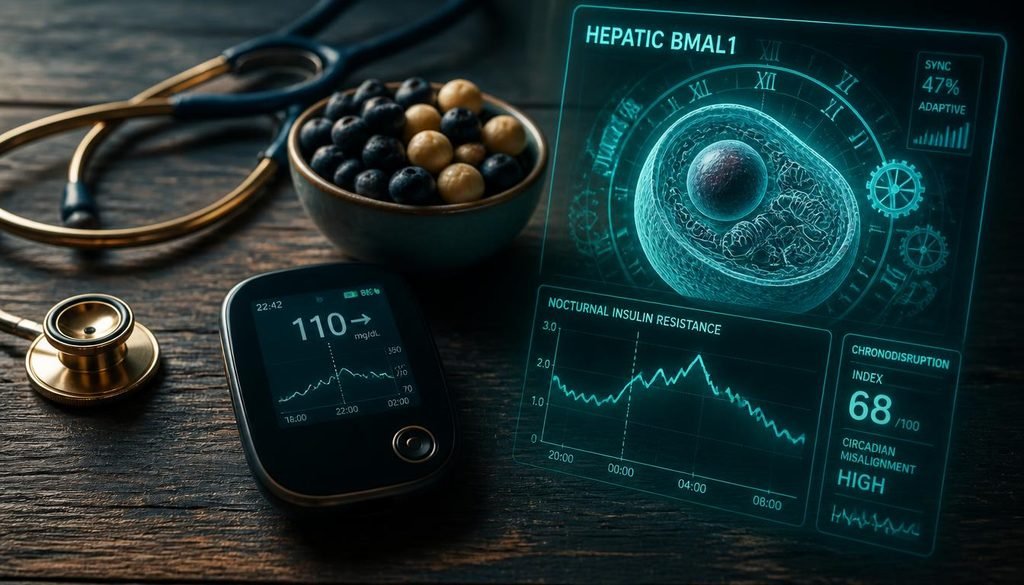
But if you eat a heavy meal at 11:00 PM, you create a state of internal desynchrony. The SCN is in the dark, signaling that it is time for cellular repair and fasting. But the sudden influx of calories tells the liver’s peripheral clock that it is daytime. The liver is forced to process glucose at a time when the body is naturally insulin resistant. This chronic misalignment is the biochemical root of metabolic syndrome in shift workers and late-night eaters.
💡 Action Step: To keep your master clock and peripheral clocks perfectly aligned, you must restrict your feeding window to the daylight hours. Use our Intermittent Fasting Calculator to design a circadian-aligned eating schedule that ensures your last meal is consumed at least three hours before sleep, allowing your liver to transition from digestion to nocturnal detoxification.
Circadian Rhythm Examples: The 24-Hour Symphony
To truly grasp the power of circadian biology, we have to look at how this molecular metronome dictates your daily physiology. Here are the most critical circadian rhythm examples that govern your performance, mood, and recovery.
1. The Cortisol Awakening Response (CAR)
Roughly 30 to 45 minutes after you wake up, your adrenal glands release a massive, acute spike of cortisol. This is not the “stress” cortisol; this is the Cortisol Awakening Response. It is a vital, healthy surge that increases blood pressure, mobilizes glucose, and sharpens cognitive focus, effectively shaking off sleep inertia and preparing you to hunt, gather, and engage with the world.
2. Core Body Temperature Fluctuations
Your core body temperature is not a static 98.6°F. It drops by roughly 2°F to 3°F during the night to facilitate deep, slow-wave sleep, and begins to rise in the early morning hours to promote wakefulness. This thermal rhythm is so rigid that it is used in clinical settings to map a patient’s internal biological phase.
3. The Nocturnal Glymphatic Flush
When you enter deep sleep, the brain’s glymphatic system opens its floodgates. Cerebrospinal fluid washes through the neural tissue, clearing out neurotoxic waste products like beta-amyloid and tau proteins that accumulate during waking hours. This cleanup process is strictly gated by the circadian clock; if you are awake at 2:00 AM, the glymphatic system remains largely dormant, allowing toxic proteins to accumulate and drive neuroinflammation.
4. The Diurnal Microbiome
Your gut microbiome is not a static entity; it physically and functionally shifts throughout the day. Pioneering microbial ecologists have shown that up to 60% of your gut bacteria exhibit diurnal fluctuations. Certain species expand during the day to help you extract energy from food, while others expand at night to repair the mucosal lining and produce short-chain fatty acids. When you eat late at night, or consume artificial sweeteners, you induce “jet lag” in your microbiome, leading to dysbiosis and systemic inflammation.
5. Melatonin Onset and the Dark Pulse
As the sun sets and the blue-light spectrum fades, the SCN signals the pineal gland to begin synthesizing melatonin. This “Dark Pulse” is not just a sleep aid; it is a profound, systemic antioxidant and an oncostatic (anti-cancer) agent. It signals the body to lower its core temperature, drop blood pressure, and initiate the nocturnal repair of DNA.
💡 Action Step: The morning Cortisol Awakening Response requires adequate cellular hydration to support blood volume and neurotransmitter synthesis. After 8 hours of respiratory water loss during sleep, your brain is highly vulnerable to circadian fatigue. Calculate your exact daily hydration baseline with our Water Intake Calculator and ensure you are consuming mineralized water immediately upon waking to support your morning physiological surge.
What Happens When Circadian Rhythms Are Disrupted: The Pathology
When you live in alignment with the sun, your biology hums. When you force your body to operate out of phase with its evolutionary programming, you trigger chronodisruption. The consequences of ignoring your circadian biology are not limited to feeling groggy the next day; they manifest as severe, systemic pathology.
1. Metabolic Chaos and Insulin Resistance
Your pancreas and skeletal muscle are highly circadian. Insulin sensitivity peaks in the morning and early afternoon, and plummets in the evening. If you consume 50 grams of carbohydrates at 8:00 AM, your muscles efficiently pull the glucose out of the blood. If you consume the exact same 50 grams at 10:00 PM, your pancreas must secrete two to three times as much insulin to force the glucose into the cells. Over time, this nocturnal hyperinsulinemia drives visceral fat accumulation, leptin resistance, and type 2 diabetes. Track your metabolic baseline and ensure your caloric intake matches your daytime expenditure using our TDEE Calculator.
2. The Oncological Threat (Shift Work)
The disruption of the circadian clock is so profoundly damaging to cellular DNA repair that the World Health Organization’s International Agency for Research on Cancer (IARC) has classified night-shift work as a Group 2A probable carcinogen. Melatonin is a potent suppressor of tumor growth. When artificial light at night suppresses melatonin production, the body loses its primary nocturnal defense against cellular mutation. Epidemiological data consistently shows higher rates of breast, prostate, and colorectal cancers in populations with chronic circadian disruption.
3. Neurodegeneration and Mood Disorders
The circadian clock heavily regulates neurotransmitter synthesis and receptor sensitivity. Chronic misalignment is a primary driver of treatment-resistant depression, bipolar cycling, and anxiety. Furthermore, the failure to achieve deep, glymphatic sleep due to circadian fragmentation accelerates the accumulation of amyloid plaques, drastically increasing the risk of early-onset Alzheimer’s disease.
4. Cardiovascular Strain
Blood pressure naturally dips at night (nocturnal dipping). When the circadian rhythm is disrupted by stress, late-night eating, or light exposure, this dipping mechanism fails. The vascular system remains under 24/7 sympathetic assault, leading to endothelial dysfunction, arterial stiffness, and a massively elevated risk of myocardial infarction and stroke.
Circadian Rhythm Disorder: When the Clock Breaks
Sometimes, chronodisruption is not a lifestyle choice, but a clinical pathology. A circadian rhythm disorder occurs when the internal master clock is fundamentally misaligned with the external environment, or when the clock itself loses its ability to maintain a 24-hour cycle.
Delayed Sleep-Wake Phase Disorder (DSWPD)
Often misdiagnosed as simple “insomnia” or labeled as “night owl” behavior, DSWPD is a neurological condition where the master clock is shifted several hours later than the societal norm. These individuals cannot fall asleep until 3:00 AM or 4:00 AM, and if forced to wake at 7:00 AM for work, they suffer from severe, chronic sleep deprivation and social jet lag. Treatment requires aggressive morning light therapy and precisely timed, low-dose melatonin administration in the early evening to pull the clock backward.
Advanced Sleep-Wake Phase Disorder (ASWPD)
The opposite of DSWPD, this condition is more common in the aging population. The circadian clock shifts drastically earlier. Individuals fall asleep at 7:00 PM and wake up at 3:00 AM, unable to return to sleep. This is often driven by a weakening of the SCN’s signaling power and a lack of late-afternoon light exposure.
Non-24-Hour Sleep-Wake Rhythm Disorder
Most devastatingly common in individuals who are totally blind (lacking the melanopsin photoreceptors required to entrain to the sun), the internal clock runs on its natural, slightly longer cycle (roughly 24.2 hours). Every day, their sleep time shifts forward by 12 to 30 minutes. Over the course of a month, they cycle entirely around the clock, experiencing periods of perfect alignment followed by weeks of agonizing, total circadian desynchrony.
The Circadian Reset Protocol: Re-Entraining the Master Clock
You cannot out-supplement a broken circadian rhythm. Fixing your biology requires sending the correct environmental signals to the SCN and the peripheral clocks at the exact right times. This is the clinical blueprint for circadian re-entrainment.
1. The Morning Photon Anchor
Within 30 to 60 minutes of waking, you must get outside and expose your eyes to natural sunlight. Glass windows filter out the specific blue-light wavelengths required to trigger melanopsin. You need 10 to 15 minutes of direct outdoor light on a clear day, or up to 30 minutes on an overcast day. This single action sets the timer for melatonin release 14 hours later and triggers the healthy Cortisol Awakening Response.
2. Thermal Manipulation
Your core body temperature must drop to initiate sleep. Keep your bedroom aggressively cool (65°F to 68°F). To accelerate this drop, take a hot shower or sauna session 90 minutes before bed. The heat draws blood to the surface of your skin; when you step into the cool air, your core rapidly dumps heat, signaling to the SCN that it is time to initiate the sleep cascade.
3. The Sunset Light Curfew
As the sun sets, you must mimic the fading of the solar spectrum. Overhead LEDs and screens blast the retina with the exact blue wavelengths that signal “noon” to the SCN, instantly halting melatonin production. After sunset, switch to dim, floor-level lamps with amber or red bulbs. If you must use screens, utilize high-quality blue-light-blocking glasses that filter 100% of short-wavelength light.
4. Circadian Fasting
Stop feeding your peripheral clocks when the master clock is asleep. Close the kitchen a minimum of three hours before bed. This allows your liver to complete the digestive process and transition into the nocturnal phase of cellular cleanup and glycogen regulation.
Final Thoughts
Circadian biology is the ultimate reminder that we are not separate from our environment; we are deeply, molecularly tethered to the rotation of the planet. The modern world, with its perpetual illumination, climate-controlled boxes, and 24-hour food availability, is an evolutionary mismatch that is quietly degrading our cellular infrastructure.
By respecting the master clock in the SCN, feeding your peripheral organs in alignment with the sun, and ruthlessly protecting your nocturnal dark pulse, you do more than just “sleep better.” You optimize your DNA repair, you stabilize your metabolic hormones, and you build a biological fortress capable of withstanding the entropy of time. Stop fighting the sun. Align your biology, and let the ancient rhythm of the Earth carry you toward a longer, more resilient healthspan.
Frequently Asked Questions (FAQ)
1. What part of the brain controls the circadian rhythm?
The circadian rhythm is controlled by which part of the brain? It is governed by the Suprachiasmatic Nucleus (SCN), a tiny cluster of roughly 20,000 neurons located deep within the hypothalamus. The SCN acts as the body’s master clock, receiving direct light signals from specialized photoreceptors in the eyes (melanopsin) to synchronize the body’s internal 24-hour cycle with the external environment.
2. What happens when circadian rhythms are disrupted?
Circadian disruption (chronodisruption) leads to severe metabolic and cellular dysfunction. It causes nocturnal insulin resistance, suppresses the release of protective melatonin, impairs the brain’s glymphatic waste-clearance system, and drives chronic systemic inflammation. Long-term disruption is heavily linked to obesity, type 2 diabetes, neurodegeneration, and an increased risk of certain cancers.
3. What is the molecular mechanism of the circadian cycle?
The circadian cycle is driven by a Transcription-Translation Feedback Loop (TTFL). Proteins called CLOCK and BMAL1 activate the transcription of PER and CRY genes. As PER and CRY proteins accumulate throughout the day, they eventually bind together, enter the nucleus, and inhibit their own production. The degradation of these proteins overnight resets the loop, taking exactly 24 hours.
4. What are common examples of circadian rhythms in humans?
Key circadian rhythm examples include the Cortisol Awakening Response (a morning spike in alertness), the nocturnal drop in core body temperature, the evening onset of melatonin secretion, and the diurnal fluctuation of the gut microbiome, which physically expands and shifts its bacterial composition based on the time of day.
5. What is the etymology of the word circadian?
The circadian etymology is derived from the Latin phrase circa diem, which translates literally to “around a day.” It was coined in the 1950s by chronobiologists to describe the endogenous, roughly 24-hour biological rhythms observed in living organisms.
⚕️ Editorial & Medical Disclaimer
Julian Vance is not a licensed physician or medical professional. All content published on RegenStep.com is thoroughly reviewed against cited primary sources and peer-reviewed literature for educational and informational purposes only. It does not constitute medical advice, diagnosis, or treatment. Always consult a qualified healthcare provider or doctor regarding any personal health condition or medical decisions, particularly if you suspect you have a clinical circadian rhythm disorder, severe insomnia, or are taking medications that affect the central nervous system.

Julian Vance is the writer and editor behind RegenStep, translating peer-reviewed longevity, metabolic, and gut-health research into practical, actionable guides. Julian is not a licensed physician; content is reviewed against cited primary sources and is for informational purposes only. Always consult a qualified healthcare provider for personal medical advice.