
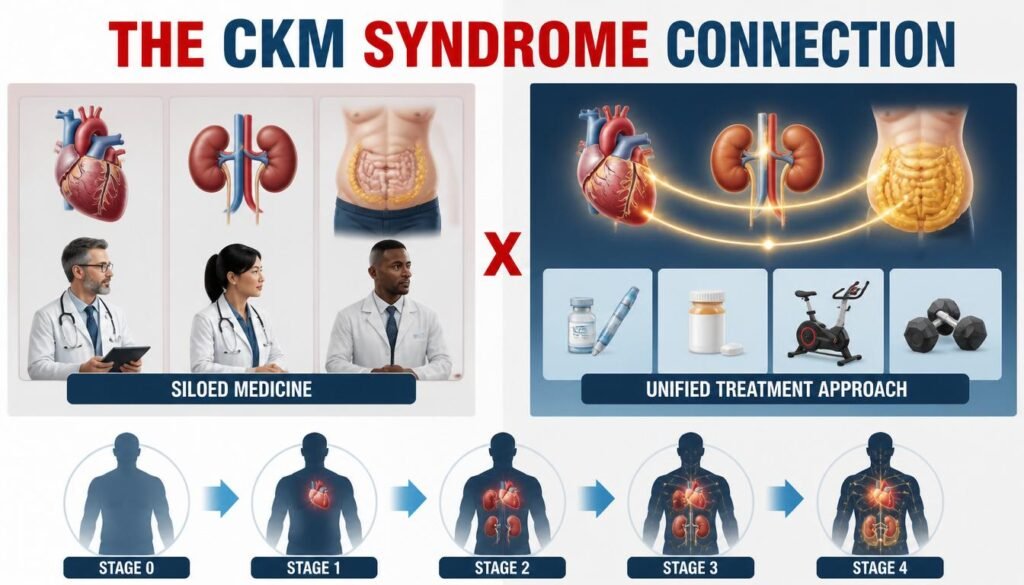
For decades, modern medicine treated the body like a collection of isolated parts. If you had high blood sugar, you saw an endocrinologist. If you had high blood pressure, you saw a cardiologist. If your kidneys were struggling, you were sent to a nephrologist.
But biology doesn’t work in silos.
Recently, the American Heart Association (AHA) and the American College of Cardiology (ACC) issued the first‑ever clinical guideline on Cardiovascular-Kidney-Metabolic (CKM) Syndrome. This landmark “super‑diagnosis” acknowledges a terrifying biological reality: obesity, Type 2 diabetes, chronic kidney disease (CKD), and cardiovascular disease are not separate conditions. They are the exact same disease process, just manifesting in different organs at different times.
Let me introduce you to Robert, a 58‑year‑old construction foreman who thought he was just getting older. “I had high blood pressure, my blood sugar was creeping up, and I was always tired,” he told me. “My cardiologist treated my heart, my endocrinologist treated my blood sugar, and my primary care doctor treated my weight. None of them talked to each other.”
Robert had CKM syndrome—and he didn’t even know it. When his doctors finally started treating him as a whole person rather than a collection of organs, everything changed. “Once we treated the root cause, not just the symptoms, my numbers improved across the board,” he says.
Nearly 9 in 10 adults in the U.S. have at least one CKM syndrome risk factor. Here is the exact cellular science of how CKM syndrome develops, the progressive stages of the disease, and the modern clinical protocols used to halt and reverse it.
External Link: The 2026 AHA/ACC/ADA/ASN Guideline for Cardiovascular-Kidney-Metabolic Syndrome provides the first comprehensive framework for managing this interconnected condition.here
Metabolic, kidney and heart decline share an immune-aging backdrop. See how immunosenescence drives chronic disease.
The Biological Web: How the Organs Communicate
To understand CKM syndrome, you have to look at how your fat tissue, kidneys, and heart constantly talk to one another.
The cascade almost always begins with visceral fat and insulin resistance (the “Metabolic” part of CKM).
- The Metabolic Spark: As visceral belly fat expands, it becomes highly inflamed, secreting toxic cytokines and causing cellular insulin resistance. Blood sugar and triglycerides begin to rise. CKM syndrome describes a complex, interconnected disease state in which metabolic risk factors, such as obesity and type 2 diabetes, intersect with the development and progression of chronic kidney disease and cardiovascular disease.
- The Kidney Damage: Your kidneys are composed of millions of microscopic blood vessels called glomeruli, which filter waste from your blood. Chronic high blood sugar and high blood pressure act like microscopic sandpaper, physically destroying these delicate filters.
- The Cardiovascular Collapse: As the kidneys fail, they trigger a massive release of the hormone renin, which aggressively drives up blood pressure. The combination of high blood pressure, high blood sugar, and systemic inflammation rapidly accelerates atherosclerosis (plaque buildup in the arteries), leading directly to heart attacks and strokes.
If you have a problem in one of these systems, you mathematically have a problem in all three.
Internal Link: Visceral fat is the metabolic spark that drives CKM syndrome. Read Visceral Fat vs Subcutaneous Fat: Which One Is Actually Killing You?.
The 4 Stages of CKM Syndrome
The medical community now categorizes CKM into distinct, progressive stages. The goal is to identify patients in Stages 1 or 2 before irreversible organ damage occurs.
Internal Link: Chronic inflammation drives progression through CKM stages. Read Inflammaging: How Chronic Low‑Grade Inflammation Drives Disease.
How Do I Know If I Have CKM Syndrome?
CKM syndrome is not a disease by itself. You cannot be “diagnosed” with it in the traditional sense. Instead, it is a framework for understanding how problems with the heart, kidneys, metabolism, and weight are connected.
To assess your CKM stage, your doctor will look at:
- Waist circumference (excess visceral fat)
- Fasting glucose and A1C (blood sugar control)
- Blood pressure
- Lipid panel (triglycerides and ApoB)
- Urine albumin-to-creatinine ratio (UACR) —to see if your kidneys are leaking protein
The new guideline also recommends using the PREVENT equations to estimate 10‑ and 30‑year risk for atherosclerotic cardiovascular disease, heart failure, and total CVD.
The Reversal Protocol: Treating the Root Cause
Because CKM is an interconnected web, the most effective treatments in 2026 are “pleiotropic” —meaning one intervention simultaneously fixes the heart, the kidneys, and the metabolism.
1. The GLP‑1 and SGLT2 Inhibitor Revolution
Modern pharmaceuticals have completely shifted the CKM landscape.
- GLP‑1 Receptor Agonists (like Semaglutide/Tirzepatide): For the first time, GLP‑1 receptor agonists are recommended for selected high‑risk patients to reduce cardiovascular events. By rapidly clearing visceral fat and lowering systemic inflammation, they remove the metabolic “spark” that drives CKM.
- SGLT2 Inhibitors (like Jardiance/Farxiga): These drugs force the kidneys to excrete excess glucose and sodium through the urine. They are clinically proven to drastically slow the progression of kidney failure while simultaneously protecting the heart from failure.
The guideline recommends that patients with CKM syndrome and type 2 diabetes prioritize GLP‑1 receptor agonists and/or SGLT2 inhibitors due to their proven heart and kidney benefits.
2. Aggressive ApoB Management
As we covered in our Cholesterol Breakthrough guide, clearing atherogenic particles from the blood is non‑negotiable for Stage 2 and Stage 3 CKM patients. Driving ApoB levels to absolute biological minimums (under 60 mg/dL or even lower) is critical to halting the cardiovascular damage driven by metabolic inflammation.
3. Zone 2 Cardio and Muscle Preservation
From a biohacking and lifestyle perspective, skeletal muscle is the ultimate sink for excess glucose. Heavy resistance training combined with daily Zone 2 Cardio (which forces the mitochondria to become highly efficient fat‑burners) restores cellular insulin sensitivity, taking the metabolic pressure off the kidneys and the heart.
The guideline emphasizes that lifestyle modification, obesity pharmacotherapy, and weight reduction strategies are foundational interventions for reducing long‑term cardiometabolic risk.
Internal Link: Zone 2 cardio is essential for metabolic health. Read Zone 2 Cardio vs. HIIT for Longevity.
The CKM Syndrome Treatment Protocol Matrix
| CKM Stage | Primary Interventions | Goal |
|---|---|---|
| Stage 1 | Lifestyle modification, weight loss, increased physical activity | Prevent progression to metabolic disease |
| Stage 2 | GLP‑1 RAs and/or SGLT2 inhibitors, blood pressure control, lipid management | Treat metabolic disease and kidney stress |
| Stage 3 | All of the above + aggressive ApoB lowering, PREVENT risk assessment | Halt subclinical cardiovascular disease |
| Stage 4 | Multidisciplinary care, cardioprotective therapies, kidney protective strategies | Manage clinical cardiovascular and kidney disease |
The Bottom Line: Treat the Whole Person
Robert now follows a comprehensive CKM protocol: a GLP‑1 medication for weight loss and blood sugar control, an SGLT2 inhibitor for kidney protection, daily Zone 2 cardio, and resistance training. “I used to see three different doctors for three different problems,” he says. “Now I see one team that treats me as one person.”
CKM syndrome is not just a new diagnosis—it is a new way of thinking about health. By recognizing that obesity, diabetes, kidney disease, and heart disease are all interconnected, you can take a proactive approach to prevention and reversal.
FAQ: CKM Syndrome
Q: How many stages are in CKM syndrome?
A: There are five stages (0‑4) of CKM syndrome. Stage 0 represents no risk factors. Stages 1‑3 represent progressively worsening metabolic and subclinical cardiovascular risk. Stage 4 represents clinical cardiovascular disease, with Stage 4a presenting without kidney failure and Stage 4b presenting with kidney failure.
Q: What are the symptoms of CKM syndrome?
A: CKM syndrome itself does not have specific symptoms—it is a framework for understanding interconnected conditions. Symptoms depend on which organ systems are affected: fatigue, shortness of breath, swelling in the legs (kidney/heart involvement), increased thirst and urination (diabetes), or chest pain (cardiovascular disease). Many people have no symptoms until later stages.
Q: What is the prognosis for CKM syndrome?
A: The prognosis worsens with each advancing stage. Studies show that the risk of all‑cause mortality increases progressively with higher CKM syndrome stages. Stage 4a is independently associated with increased in‑hospital mortality. However, CKM syndrome staging can promote regression through lifestyle changes and weight loss.
Q: What is Stage 4 CKM syndrome?
A: Stage 4 CKM syndrome represents clinical cardiovascular disease (heart attack, stroke, heart failure, or peripheral artery disease) alongside kidney and metabolic dysfunction. Stage 4a presents without kidney failure; Stage 4b presents with kidney failure (eGFR <15 mL/min/1.73m² or needing chronic kidney replacement therapy).
Q: Can CKM syndrome be reversed?
A: Stages 1 and 2 are highly reversible. By aggressively targeting visceral fat loss, controlling insulin resistance, and lowering systemic inflammation through diet, exercise, and targeted medications, you can completely halt the progression before structural organ damage occurs. Stages 3 and 4 are focused on aggressive disease management to prevent fatal cardiovascular events.
Q: What is the difference between CKM syndrome and metabolic syndrome?
A: Metabolic syndrome is a cluster of conditions (high blood pressure, high blood sugar, excess body fat around the waist, and abnormal cholesterol) that occur together. CKM syndrome expands on this by explicitly incorporating chronic kidney disease and cardiovascular disease into a unified framework, recognizing the bidirectional relationships between all three systems.
Q: Why was CKM syndrome only recently defined?
A: For decades, medical specialties were highly siloed. Cardiologists treated the heart, nephrologists treated the kidneys, and endocrinologists treated diabetes. The creation of the CKM diagnosis by the American Heart Association and American College of Cardiology in 2026 was a necessary paradigm shift to force doctors to treat the entire patient comprehensively. The AHA first defined CKM syndrome in 2023, but the 2026 guideline is the first clinical practice guideline for its management.

Julian Vance is the writer and editor behind RegenStep, translating peer-reviewed longevity, metabolic, and gut-health research into practical, actionable guides. Julian is not a licensed physician; content is reviewed against cited primary sources and is for informational purposes only. Always consult a qualified healthcare provider for personal medical advice.