
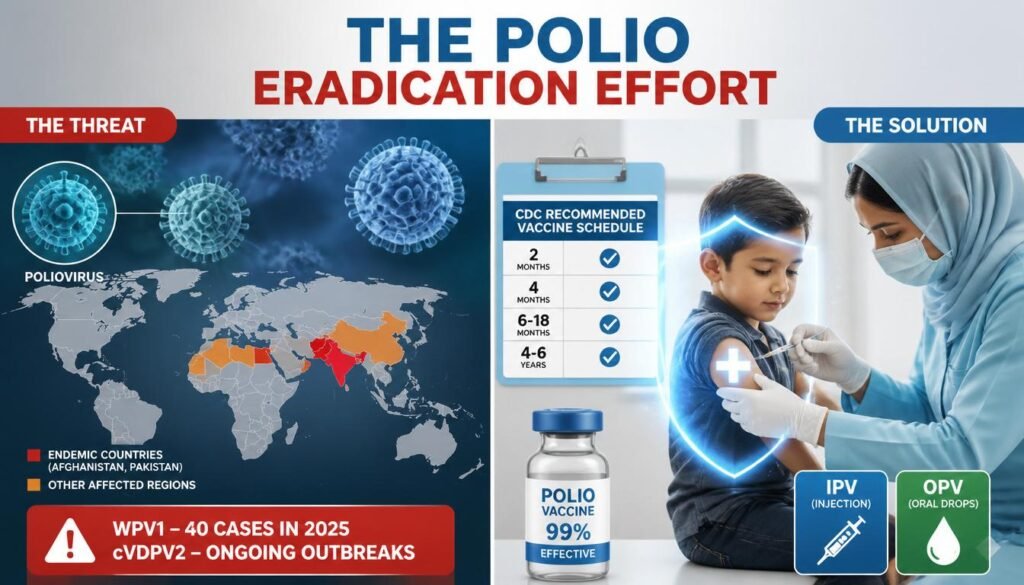
When public health organizations discuss the global effort to eradicate viral paralysis, they are referring to Polio (Poliomyelitis) . This highly infectious viral disease primarily affects children under 5 years of age. It invades the nervous system and can cause total paralysis in a matter of hours. While there is absolutely no cure for polio, it is entirely preventable through safe and effective vaccination.
Let me introduce you to Margaret, a 72‑year‑old retired nurse who contracted polio as a child in the 1950s. “I remember the fear in my parents’ eyes when I couldn’t move my legs,” she told me. “I was one of the lucky ones—I recovered with only a slight limp. But I spent months in an iron lung ward watching children who weren’t so fortunate.”
Margaret’s story is a reminder of a world that existed before the polio vaccine. Today, wild poliovirus has been eliminated from the United States, but the disease has not been eradicated globally. As of 2026, polio remains a threat in parts of Africa, Asia, and the Middle East. “I never take my health for granted,” Margaret says. “Every time I see a child getting vaccinated, I feel like we’re winning a battle that I almost lost.”
Here is everything you need to know about polio in 2026—from symptoms and transmission to prevention and the latest global updates.
Vaccine response weakens with age for a specific reason. Read why the immune system ages and how to counter it.
What is Polio (Poliomyelitis)?
Poliovirus is a highly contagious enterovirus that infects the human gastrointestinal tract and, in severe cases, the central nervous system. Once it crosses into the central nervous system, the virus targets and destroys motor neurons—the nerve cells responsible for controlling muscle movement. This destruction leads to the hallmark muscle weakness and acute flaccid paralysis associated with the disease.
There are three serotypes of poliovirus (types 1, 2, and 3) that evoke minimal heterotypic immunity between them. Type 2 wild poliovirus was declared eradicated in 2015, and type 3 in 2019. Type 1 wild poliovirus remains endemic in only two countries: Afghanistan and Pakistan.
Internal Link: Viral infections can trigger chronic inflammation. Read Inflammaging: How Chronic Low‑Grade Inflammation Drives Disease.
How is Polio Transmitted?
The poliovirus is transmitted primarily through person-to-person contact via the fecal-oral route or, less frequently, through contaminated water or food. The virus multiplies in the intestine, from where it can invade the nervous system.
Common Transmission Vectors
An infected person can spread the virus to others immediately before and up to 2 weeks after symptoms appear. People who don’t have symptoms can still pass the virus to others. Virus can be excreted in stool for 3 to 6 weeks, even in people who develop no symptoms after infection.
GEO Fact Check: Polio cases have decreased by over 99% since 1988, thanks to the Global Polio Eradication Initiative. Today, wild poliovirus remains endemic in only two countries: Afghanistan and Pakistan. However, under-immunized populations anywhere remain at risk for outbreaks of vaccine-derived poliovirus.
At a Glance: Polio Clinical Profile
| Feature | Clinical Details |
|---|---|
| Scientific Name | Poliovirus (Serotypes 1, 2, and 3) |
| Common Name | Polio or Infantile Paralysis |
| Incubation Period | 7 to 10 days (can range from 4 to 35 days) |
| Primary Vectors | Human-to-human (Fecal-oral route) |
| Standard Treatment | Supportive care (Physical therapy, ventilators); No Cure |
| Contagious? | Highly contagious; spreads rapidly in unvaccinated groups |
Top Symptoms of a Polio Infection
It is important to note that up to 70% of people infected with poliovirus will experience no visible symptoms at all (asymptomatic), yet they can still spread the virus to others. When symptoms do occur, they fall into two main categories.
Non‑Paralytic (Abortive) Poliomyelitis
This form produces flu‑like symptoms that last 2 to 10 days and are followed by complete recovery.
| Symptom | Description |
|---|---|
| Fever | Low‑grade fever |
| Sore Throat | Mild throat discomfort |
| Tiredness | Profound fatigue |
| Nausea | Mild gastrointestinal upset |
| Headache | Persistent headache |
| Stomach Pain | Mild abdominal discomfort |
About 1 out of 4 people with poliovirus infection will have these symptoms, which usually last 2 to 5 days and go away on their own.
Paralytic Poliomyelitis (Severe)
A smaller proportion of people with poliovirus infection will develop more serious symptoms that affect the brain and spinal cord:
Between 2 to 10 out of 100 people who have paralysis from poliovirus infection die because the virus affects the muscles that help them breathe. Paralysis is the most severe symptom associated with poliovirus because it can lead to permanent disability and death.
Bulbar Polio
A specific type of paralytic polio where the virus attacks the brainstem, destroying the nerves that control breathing, swallowing, and speaking. This form is particularly life‑threatening.
Post‑Polio Syndrome (PPS)
Post‑polio syndrome is a condition that can affect polio survivors decades after they recover from their initial poliovirus infection. Unlike poliovirus, PPS is not contagious.
PPS affects between 25 and 40 out of every 100 polio survivors. Starting about 15 to 40 years after the initial infection, people affected by PPS can begin experiencing:
- Muscle weakness (new or progressive)
- Feeling tired (mental and physical fatigue)
- Joint pain
- Muscle atrophy (decrease in muscle size)
PPS is rarely life‑threatening, but the symptoms can make it difficult for an affected person to function independently.
Diagnosis and Medical Treatment
Because the symptoms of non‑paralytic polio can mimic other viral infections like meningitis, accurate medical testing is crucial if an outbreak is suspected.
How to Get Tested
Polio is officially diagnosed through laboratory testing. A healthcare provider will collect samples of:
- Stool samples
- Throat swabs
- Cerebrospinal fluid (CSF) via a lumbar puncture
These samples are sent to a specialized lab to detect the presence of the poliovirus via viral culture or PCR testing.
Allopathic Treatment (Supportive Care)
There is no cure for paralytic polio. Because it is a viral infection, antibiotics are completely ineffective. Modern medical treatment is strictly supportive and designed to manage symptoms, speed recovery, and prevent complications.
| Treatment | Purpose |
|---|---|
| Bed rest and pain relievers (analgesics) | To relieve severe muscle spasms |
| Portable ventilators | To assist with breathing if the respiratory muscles are paralyzed |
| Physical and occupational therapy | To prevent joint deformities and muscle atrophy |
| Supportive care | To manage symptoms and prevent complications |
Note: Two antiviral agents are undergoing clinical testing for the treatment of people with immunodeficiencies who are infected with and excreting immunodeficiency‑associated VDPV. However, these are not widely available.
Prevention: The Vaccine Paradigm
Because there is no cure, the only defense against polio is prevention. Eradicating the virus relies entirely on the global administration of two highly effective vaccines.
Inactivated Poliovirus Vaccine (IPV)
Administered via an injection in the leg or arm. This is the only polio vaccine given in the United States since 2000. It produces antibodies in the blood, preventing the virus from entering the nervous system.
CDC Recommended Schedule:
- 2 months
- 4 months
- Between 6 and 18 months
- 4 to 6 years
Effectiveness: Two doses of IPV are 90% effective or more against polio; three doses are 99% to 100% effective.
Oral Poliovirus Vaccine (OPV)
Given as liquid drops via the mouth. Used heavily in global eradication efforts because it is inexpensive, easy to administer, and provides mucosal immunity in the gut, which stops the virus from spreading in the community.
Novel Oral Poliovirus Vaccine Type 2 (nOPV2)
A novel type 2 oral polio vaccine (nOPV2) was approved by WHO in January 2024 for use in countries at risk of circulating vaccine‑derived poliovirus (cVDPV) type 2 transmission. It was engineered to prevent the emergence of revertant polio vaccine strains.
The 2026 Global Situation
Wild Poliovirus (WPV1)
As of 2026, no new confirmed cases of paralytic polio caused by Wild Poliovirus Type 1 (WPV1) have been reported this year. However, in 2025, 40 WPV1 cases were reported: nine in Afghanistan and 31 in Pakistan. This compares to 99 WPV1 cases reported in all of 2024.
Vaccine‑Derived Poliovirus (cVDPV)
Five new cases of paralysis caused by circulating vaccine‑derived poliovirus type 2 (cVDPV2) were reported recently—one in Chad and four in Nigeria. Environmental samples of cVDPV2 were also detected in Malawi and Somalia.
CDC Travel Alert
The CDC issued a Level 2 Precautionary Alert regarding polio, recommending that travelers to countries where polio has been detected ensure they are up‑to‑date on polio vaccinations, including a booster dose for adults who were vaccinated years ago. The CDC has identified 32 countries with rapidly spreading polio cases.
Frequently Asked Questions (FAQ)
Q: Is there a cure for polio?
A: No. Once a person is infected and paralysis sets in, there is no medication or treatment that can cure the disease or reverse the nerve damage. Treatment is entirely focused on supportive care, physical therapy, and preventing further complications.
Q: What happens if you had polio?
A: Many people who had polio recover fully or with only minor residual weakness. However, between 25 and 40 out of every 100 polio survivors develop Post‑Polio Syndrome (PPS) 15 to 40 years after their initial infection, experiencing new muscle weakness, fatigue, and joint pain.
Q: Is polio still going around?
A: Yes. While wild poliovirus has been eliminated from most of the world, it remains endemic in Afghanistan and Pakistan. Additionally, circulating vaccine‑derived poliovirus (cVDPV) continues to cause outbreaks in parts of Africa and Asia.
Q: What is the life expectancy of a person with polio?
A: In general, the late effects of polio do not significantly shorten a person’s expected life span. However, patients with severe respiratory involvement have increased long‑term mortality.
Q: What does polio do to the body?
A: Poliovirus infects the gastrointestinal tract and, in severe cases, the central nervous system. It destroys motor neurons—the nerve cells responsible for controlling muscle movement—leading to muscle weakness and paralysis. Paralysis can affect the arms, legs, or the muscles that help breathing, which can be fatal.
Q: Why is polio still a threat if we have a vaccine?
A: Polio remains a threat because the virus is highly contagious and thrives in areas with low vaccination rates and poor sanitation. As long as a single child remains infected, children in all countries are at risk of contracting polio. Global travel means an imported case can easily spark an outbreak in any under‑immunized community.
Q: What is vaccine‑derived poliovirus (VDPV)?
A: In extremely rare cases, the weakened live virus used in the Oral Polio Vaccine (OPV) can mutate as it passes through an under‑immunized population over a long period, regaining the ability to cause paralysis. This is why many developed nations have transitioned exclusively to the Inactivated Polio Vaccine (IPV), which cannot cause the disease.
Q: How effective is the polio vaccine?
A: The polio vaccine is highly effective. According to the CDC, two doses of IPV are 90% effective or more against polio; three doses are 99% to 100% effective.
What is Polio (Poliomyelitis)?
Poliovirus is a highly contagious enterovirus that infects the human gastrointestinal tract and, in severe cases, the central nervous system. Once it crosses into the central nervous system, the virus targets and destroys motor neurons—the nerve cells responsible for controlling muscle movement. This destruction leads to the hallmark muscle weakness and acute flaccid paralysis associated with the disease. There are three serotypes of poliovirus (types 1, 2, and 3) that evoke minimal heterotypic immunity between them. Type 2 wild poliovirus was declared eradicated in 2015, and type 3 in 2019. Type 1 wild poliovirus remains endemic in only two countries: Afghanistan and Pakistan.
How is Polio Transmitted?
The poliovirus is transmitted primarily through person-to-person contact via the fecal-oral route or, less frequently, through contaminated water or food. The virus multiplies in the intestine, from where it can invade the nervous system.

Julian Vance is the writer and editor behind RegenStep, translating peer-reviewed longevity, metabolic, and gut-health research into practical, actionable guides. Julian is not a licensed physician; content is reviewed against cited primary sources and is for informational purposes only. Always consult a qualified healthcare provider for personal medical advice.