
If you’ve been told your bloating, undigested food in your stool, or brittle nails might be caused by low stomach acid rather than too much, your next question is obvious: how do you actually know? In our guide to the signs, causes, and fixes for low stomach acid, we covered the symptom picture. This article goes one step further and walks through the three ways hypochlorhydria is actually tested — the one you can try tonight in your own kitchen, the one functional-medicine practitioners use, and the one gastroenterologists rely on when it matters clinically.
None of these tests are diagnostic on their own, and none of them replace a conversation with your doctor — especially if you’re also dealing with unexplained weight loss, persistent reflux, or anemia. But they’re a reasonable, low-risk starting point for figuring out whether “low stomach acid” is a plausible explanation for what you’re feeling.
Why stomach acid strength is worth testing in the first place
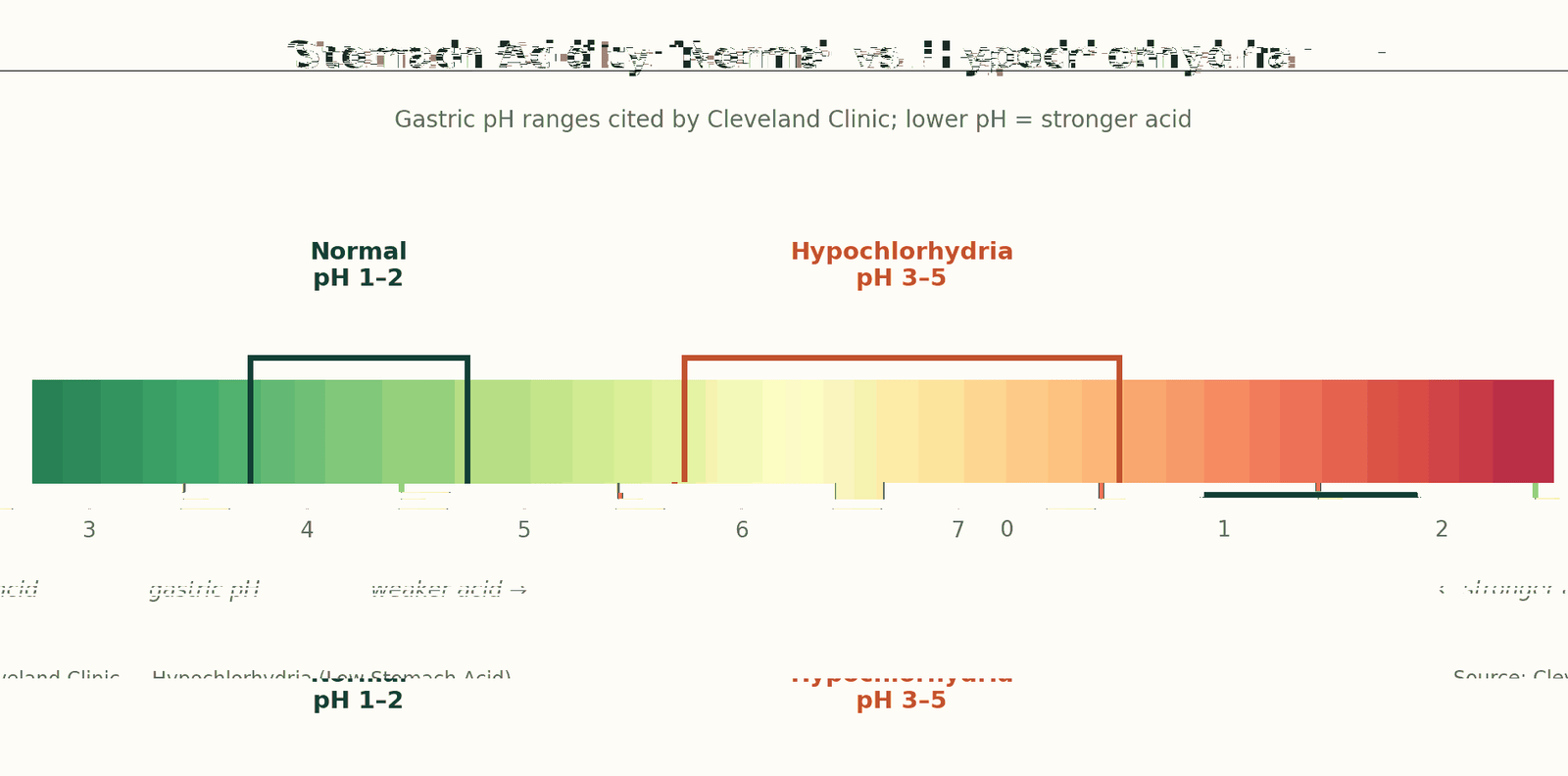
Your stomach is supposed to be aggressively acidic — a healthy fasting gastric pH sits around 1 to 2, roughly the acidity of battery acid. That’s not an accident. According to the Cleveland Clinic, this level of acidity exists to activate pepsin for protein digestion, trigger the release of digestive enzymes further down the tract, and kill the bacteria and pathogens you swallow with food and water. When gastric pH drifts up into the 3–5 range — hypochlorhydria — all three jobs get harder.
The Cleveland Clinic also notes that the most common underlying causes are atrophic gastritis (chronic inflammation that damages acid-secreting cells), H. pylori infection — which affects roughly half of people in the U.S. — and long-term use of acid-suppressing medication such as proton pump inhibitors. Age and chronic stress play a role too, which is one reason hypochlorhydria becomes more common later in life.
Test 1: The baking soda test (do this at home, interpret it loosely)
This is the test most people try first because it requires nothing but a box of baking soda. The logic: when sodium bicarbonate meets stomach acid, it produces carbon dioxide gas — and that gas has to come out as a burp. The faster and stronger the burp, the more acid was available to react with.
- First thing in the morning, before eating or drinking anything, mix ¼ teaspoon of baking soda into 4–6 oz of cold water.
- Drink it and start a timer immediately.
- Time how long it takes until you burp.
The commonly cited (and unvalidated) interpretation is that a burp within 2–3 minutes suggests adequate acid, while no burp — or a very small one — after 5 minutes is taken as a signal of low acid production. Treat this as a curiosity, not a lab result: swallowed air, how much water you drank, and how deeply you breathe while waiting can all skew the timing. It’s a reasonable first filter, not a diagnosis.
Test 2: The betaine HCl challenge (more informative, needs more caution)
This self-test is popular in functional-medicine circles because it tests the digestive system under an actual protein-containing meal, which is closer to a real-world scenario than an empty-stomach burp test.
- With a high-protein meal (not a light snack), take one capsule of betaine hydrochloride with pepsin (typically 650 mg).
- If you feel no warmth, burning, or digestive discomfort, add one more capsule with your next protein meal.
- Continue increasing by one capsule per meal, up to a commonly cited ceiling of around 5–6 capsules, until you feel a mild warming or burning sensation in your stomach.
- Once you feel that warmth at a given dose, drop back down one capsule — that’s roughly your working dose.
The idea is that if your stomach is already acidic enough, adding more acid causes noticeable burning almost immediately, even at a low dose. If you can tolerate several capsules with no sensation at all, it’s read as indirect evidence that your baseline acid output is low. This test is not appropriate if you have gastritis, ulcers, are taking NSAIDs regularly, or have any history of stomach lining damage — supplemental HCl can aggravate an already irritated stomach lining. If you feel burning that doesn’t resolve, drink a glass of water with a teaspoon of baking soda to neutralize it.
Test 3: What your doctor actually uses
If self-testing points toward low acid and symptoms are significant, these are the clinical-grade options the Cleveland Clinic lists:
- Heidelberg pH test — you swallow a small wireless capsule that transmits real-time pH readings from inside your stomach, both at baseline and after a bicarbonate challenge. This is considered the gold standard.
- SmartPill test — a similar wireless capsule that measures pH, pressure, and transit time as it moves through the entire digestive tract, giving a broader picture of gut motility alongside acidity.
- Gastric string test — you swallow a capsule attached to a thin string; after it dissolves, the string is pulled back out and tested with pH paper. A reading of 1–2 is normal, while 3–5 indicates hypochlorhydria.
These tests exist precisely because home methods are unreliable at the margins. If your symptoms are significant — unexplained anemia, vitamin B12 deficiency, chronic diarrhea, or weight loss — ask your doctor about one of these rather than relying on the baking soda test alone.
What a positive result actually means for your gut
Low stomach acid isn’t just a digestive inconvenience. Because gastric acid is one of your body’s first-line defenses against ingested pathogens, chronically low acid has been linked to a higher susceptibility to gut infections — including parasitic ones. If you’ve dealt with a stubborn stomach bug, it’s worth reading our breakdown of how outbreaks like cyclospora take hold and how to protect your gut. Poor protein breakdown from low acid has also been connected to histamine-related symptoms — see our guide on histamine intolerance and brain fog if bloating comes with food reactions.
What to do next if your results point to low acid
Confirming low acid is only useful if it changes what you do. A few evidence-informed next steps:
- Address the underlying cause first — get tested for H. pylori if you haven’t, and talk to your prescriber about whether a long-term PPI is still necessary.
- Support digestion mechanically: chewing thoroughly, eating protein earlier in a meal, and avoiding large volumes of water immediately before eating all reduce the acid-dilution burden.
- Consider a targeted gut-repair protocol — our 4-day bone broth fast and L-glutamine gut-lining guide are both aimed at rebuilding a compromised gut lining.
- If digestive symptoms persist despite these changes, a targeted probiotic strategy matched to your specific symptoms is a reasonable next layer.
Frequently asked questions
Is the baking soda test scientifically validated?
No. It’s a popular self-screening heuristic, not a peer-reviewed diagnostic tool. Use it as a conversation starter with a practitioner, not as a final answer.
Can I do the betaine HCl challenge if I’m on a PPI or H2 blocker?
Talk to your doctor first. Acid-suppressing medication is specifically designed to counteract what betaine HCl is trying to test for, and the two can interact.
How common is hypochlorhydria really?
Exact population prevalence is hard to pin down, but risk rises substantially with age, chronic H. pylori infection (present in roughly half of Americans, per Cleveland Clinic), autoimmune gastritis, and long-term PPI use.
This article is for educational purposes and is not a substitute for professional medical advice, diagnosis, or treatment. Always consult a qualified healthcare provider before starting a new supplement protocol or self-testing regimen, especially if you have a history of gastritis or peptic ulcer disease.

Julian Vance is the writer and editor behind RegenStep, translating peer-reviewed longevity, metabolic, and gut-health research into practical, actionable guides. Julian is not a licensed physician; content is reviewed against cited primary sources and is for informational purposes only. Always consult a qualified healthcare provider for personal medical advice.