
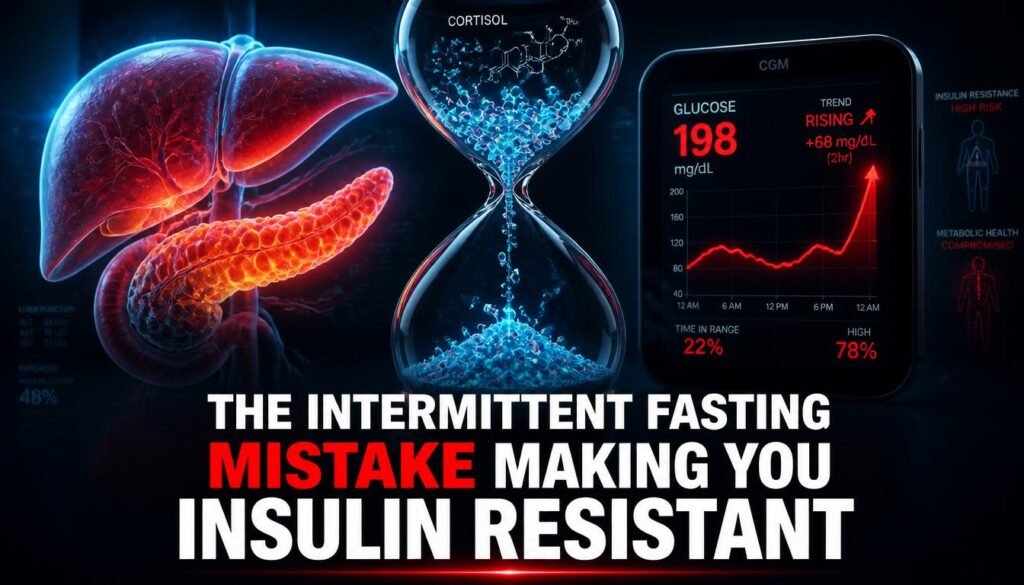
If you have been restricting your eating window to lose weight and improve your metabolic health, only to watch your fasting blood glucose climb and your belly fat refuse to budge, you are likely making a critical intermittent fasting mistake. The most common error in the biohacking community is chronically extending fasting windows (such as daily 20:4 or One Meal A Day) without aligning them to your circadian rhythm, which triggers a chronic cortisol response. This sustained stress hormone elevation leads to “physiological insulin resistance”—a state where your muscles temporarily reject glucose to preserve it for your brain, resulting in massive blood sugar spikes when you finally eat and halting your fat-burning progress.
As a longevity physician, I see patients every week who are fiercely dedicated to time-restricted eating, yet their continuous glucose monitors (CGMs) tell a story of metabolic distress. They believe they are healing their bodies, but they are actually trapping their HPA-axis (hypothalamic-pituitary-adrenal axis) in a state of chronic fight-or-flight. In this comprehensive guide, we will dissect the exact biochemistry of this intermittent fasting mistake, explain the phenomenon of adaptive glucose sparing, and outline the circadian protocols required to restore your insulin sensitivity and reclaim your metabolic flexibility.
The Paradox: How Fasting for Health Can Backfire
To understand why your protocol might be failing, we must first respect the biology of fasting. Time-restricted eating is a powerful hormetic stressor. When applied correctly, it lowers baseline insulin, activates the cellular cleanup pathway of autophagy, and forces your body to oxidize stored fat.
However, fasting is inherently a stressor. To keep your brain fueled when no food is coming in, your adrenal glands release cortisol and adrenaline. These hormones signal your liver to produce new glucose (gluconeogenesis) and your fat cells to release free fatty acids (FFAs) into the bloodstream. This is a brilliant, short-term evolutionary survival mechanism.
The intermittent fasting mistake occurs when this acute, beneficial stressor becomes a chronic, unrelenting daily grind. When you push your fasting window too far, too often—especially in the context of modern life stressors, poor sleep, and high-intensity exercise—your cortisol never gets the signal to drop. This chronic elevation of stress hormones fundamentally alters how your cells interact with insulin, creating a paradoxical state that mimics metabolic disease.
The Core Intermittent Fasting Mistake: Cortisol and Adaptive Glucose Sparing
The biochemical heart of this intermittent fasting mistake lies in a survival mechanism known as adaptive glucose sparing (often referred to as physiological insulin resistance).
When you fast for 18, 20, or 24 hours, your bloodstream becomes saturated with free fatty acids, which your muscles happily burn for energy. To ensure your brain—which relies heavily on glucose—doesn’t starve, your muscle cells temporarily downregulate their insulin receptors. They essentially put up a “Do Not Enter” sign for glucose, sparing it for the brain.
If you wear a continuous glucose monitor (CGM) and break a 20-hour fast with a moderate amount of carbohydrates, you will likely see a massive, alarming spike in your blood sugar. Panicked, many biohackers assume they have become diabetic or “broken” their metabolism. In reality, this is a normal physiological response to prolonged fasting combined with high circulating cortisol. But when you repeat this aggressive fasting cycle every single day, this temporary adaptation becomes your new metabolic baseline. Your muscles remain deaf to insulin, your pancreas pumps out excess insulin to compensate, and you lock yourself into a state of chronic hyperinsulinemia.
3 Signs You Are Making This Intermittent Fasting Mistake
How do you know if your fasting protocol is crossing the line from therapeutic to destructive? Look for these three clinical red flags:
1. The “Dawn Phenomenon” on Steroids
It is normal for blood sugar to rise slightly in the early morning as cortisol naturally peaks to wake you up. But if your fasting morning glucose is consistently creeping above 95 mg/dL (and especially above 100 mg/dL) despite eating no food for 16 hours, your liver is dumping excess glucose due to chronic HPA-axis overactivation. Your fasting window is too long, or placed at the wrong time of day, keeping your stress hormones artificially elevated.
2. Waking Up at 3 AM
If your fasting window extends late into the evening, or if you are doing OMAD (One Meal A Day) and undereating calories, your brain will sense an energy deficit in the middle of the night. To rescue you from nocturnal hypoglycemia, your adrenals will dump a massive spike of cortisol and adrenaline, jolting you awake. If this sounds familiar, read our deep dive into Stop Waking Up at 3 AM: The Cortisol-Melatonin See-Saw Explained.
3. Stubborn Visceral Fat Retention
You are losing weight on the scale, but your midsection remains soft and protruding. Cortisol receptors are highly concentrated in visceral fat tissue. Chronic fasting stress keeps cortisol high, which actively directs fat storage to the abdominal cavity while simultaneously breaking down lean muscle tissue in your arms and legs. For more on this, read Cortisol Belly Fat: Why Stress Hormones Stop You From Losing Weight.
💡 Action Step: You cannot optimize a protocol if your baseline metabolic rate is suppressed by chronic dieting and stress. Use our TDEE Calculator to ensure you are actually eating enough to support your cellular function, and our Intermittent Fasting Calculator to design a circadian-aligned fasting window that respects your hormonal rhythm.
The “Break-Fast” Error: Compounding the Mistake
The intermittent fasting mistake is rarely just about the length of the fast; it is equally about how you break it. This brings us to a biochemical rule called the Randle Cycle (or the glucose-fatty acid cycle).
Discovered in the 1960s, the Randle Cycle dictates that your cells cannot efficiently burn glucose and free fatty acids at the exact same time. After a 20-hour fast, your blood is saturated with free fatty acids. If you break your fast with a meal high in carbohydrates (even “healthy” carbs like sweet potatoes or fruit), the carbohydrates convert to blood glucose.
Your cells are already busy burning the fatty acids, so they reject the glucose. The glucose remains trapped in your bloodstream, forcing your pancreas to release a massive bolus of insulin to shove it into your liver, where it is converted into triglycerides. This is why breaking a long fast with carbohydrates causes extreme lethargy, brain fog, and severe insulin spikes.
How to Fix the Intermittent Fasting Mistake (The Circadian Protocol)
To reverse this metabolic adaptation, we must shift away from the “longer is always better” dogma and adopt Early Time-Restricted Feeding (eTRF). Landmark research published in Cell Metabolism demonstrates that aligning your eating window with your circadian rhythm dramatically improves insulin sensitivity, independent of weight loss.
Here is the clinical protocol to fix the intermittent fasting mistake:
1. Shift to a 14:10 or 16:8 Window (Aligned with Daylight)
Stop doing 20:4 or OMAD daily. These are advanced tools to be used occasionally, not daily lifestyle baselines. More importantly, shift your window to the earlier part of the day. Eating your first meal at 10:00 AM and finishing by 6:00 PM aligns your nutrient intake with peak insulin sensitivity, which naturally occurs in the morning and early afternoon. Insulin sensitivity drops dramatically in the evening as melatonin rises; eating late at night forces your pancreas to work overtime.
2. Break Your Fast with Protein and Fat
To respect the Randle Cycle, your first meal after a fast should contain almost zero carbohydrates. Break your fast with high-quality bioavailable protein and healthy fats (e.g., pasture-raised eggs, avocado, wild-caught salmon, or a clean whey protein isolate). This provides the amino acids necessary to halt muscle catabolism without spiking glucose in an environment already saturated with free fatty acids. Save your complex carbohydrates for your final meal of the day; the subsequent insulin release will actually help drive tryptophan into the brain, aiding in serotonin and melatonin production for deep sleep.
3. Implement “Fasting Holidays”
Your body adapts to any chronic stimulus. If you fast for 16 hours every single day, your body will eventually downregulate its thyroid hormone (T3) to conserve energy, slowing your basal metabolic rate. You must take “fasting holidays.” Two or three days a week, eat a nutrient-dense, high-protein breakfast within an hour of waking. This signals to your hypothalamus that you are not in a famine, keeping your thyroid robust and your cortisol low.
The Fasting Stress Matrix: Dysregulated vs. Optimized
To visualize how to correct the intermittent fasting mistake, compare these two approaches to time-restricted eating:
| Feature | The Dysregulated Protocol (The Mistake) | The Optimized Circadian Protocol |
|---|---|---|
| Fasting Window | 20:4 or OMAD (Daily) | 14:10 or 16:8 (Flexible) |
| Timing | Skips breakfast, eats late into the night. | Early Time-Restricted Feeding (e.g., 9 AM to 5 PM). |
| Cortisol Response | Chronically elevated; disrupts sleep architecture. | Acute morning spike, followed by natural evening decline. |
| Breaking the Fast | High carbohydrate load (spikes glucose via Randle Cycle). | Protein and fat focus (stabilizes blood sugar). |
| Metabolic Outcome | Adaptive glucose sparing, muscle loss, visceral fat retention. | High insulin sensitivity, muscle preservation, fat oxidation. |
Actionable Steps to Rebuild Metabolic Flexibility
If you have fallen victim to the intermittent fasting mistake, your primary goal for the next 30 days is not weight loss; it is metabolic rehabilitation. You must convince your body that it is safe, fed, and out of danger.
- Prioritize Protein: Muscle is your metabolic sink for glucose. If you have lost muscle mass due to aggressive fasting and high cortisol, you must rebuild it. Use our Protein Intake Calculator to ensure you are consuming at least 0.8 to 1 gram of protein per pound of ideal body weight.
- Monitor Fasting Insulin, Not Just Glucose: As we discussed in our guide on High Uric Acid Isn’t Just Gout — It’s a Metabolic Warning Sign, standard blood panels miss the early signs of metabolic dysfunction. Demand a Fasting Insulin test from your doctor. If your fasting insulin is above 8 μIU/mL, your protocol is failing, regardless of what the scale says.
- Manage the Nervous System: Fasting amplifies your baseline stress. If you are sleeping less than 7 hours or dealing with severe psychological stress, do not fast. Eat a nourishing breakfast. Fasting on top of high life stress is a guaranteed recipe for HPA-axis dysfunction and thyroid downregulation.
Final Thoughts
Time-restricted eating is one of the most powerful tools in the longevity arsenal, but it is not a biological free pass. The most dangerous intermittent fasting mistake is treating your body like a machine that can be hacked into submission through chronic caloric deprivation and circadian misalignment. By recognizing the signs of adaptive glucose sparing, respecting the Randle Cycle, and aligning your eating window with the rising and setting of the sun, you can transition from a state of metabolic panic to one of profound cellular efficiency. Stop punishing your physiology, start feeding your circadian rhythm, and watch your insulin sensitivity return to optimal levels.
Frequently Asked Questions (FAQ)
1. What is the biggest intermittent fasting mistake causing insulin resistance?
The most common intermittent fasting mistake is chronically extending fasting windows (like daily 20:4 or OMAD) without aligning them to your circadian rhythm. This triggers chronic cortisol elevation, leading to “adaptive glucose sparing,” where muscles temporarily reject glucose to save it for the brain, mimicking pathological insulin resistance.
2. Why does my blood sugar spike after breaking a fast?
This is often due to the Randle Cycle. After a long fast, your blood is saturated with free fatty acids. If you break your fast with carbohydrates, your cells—which are busy burning fat—reject the glucose, leaving it in the bloodstream and causing a massive spike. Breaking a fast with protein and fat prevents this.
3. Can intermittent fasting cause high morning blood sugar?
Yes. If your fasting window is too long or poorly timed, your adrenal glands will release excess cortisol to mobilize stored energy. This cortisol signals your liver to dump glucose into your bloodstream via gluconeogenesis, resulting in high fasting morning blood sugar despite not eating for many hours.
4. What is Early Time-Restricted Feeding (eTRF)?
Early Time-Restricted Feeding (eTRF) is a fasting protocol where you align your eating window with the earlier, daylight hours of the day (e.g., eating from 8 AM to 4 PM). Research shows this drastically improves insulin sensitivity and blood pressure compared to eating late in the evening, as insulin sensitivity naturally drops as melatonin rises.
5. How do I fix physiological insulin resistance from fasting?
To reverse physiological insulin resistance, shorten your daily fasting window to 14:10 or 16:8, take “fasting holidays” where you eat a healthy breakfast to support thyroid function, and break your fasts with protein and fats rather than carbohydrates to respect the Randle Cycle.
⚕️ Medical Disclaimer
The content provided on RegenStep.com, including this article authored by Dr. Julian Vance, is strictly for educational and informational purposes only. It is not intended to be a substitute for professional medical advice, diagnosis, or treatment.
Fasting protocols, particularly extended fasts or One Meal A Day (OMAD), carry inherent risks and can severely disrupt endocrine function, thyroid health, and blood glucose regulation in susceptible individuals. Never alter your diet or fasting regimen without consulting your physician, especially if you have a history of eating disorders, type 1 or type 2 diabetes, adrenal insufficiency, or if you are taking blood sugar-lowering medications.
What is the biggest intermittent fasting mistake causing insulin resistance?
The most common intermittent fasting mistake is chronically extending fasting windows (like daily 20:4 or OMAD) without aligning them to your circadian rhythm. This triggers chronic cortisol elevation, leading to “adaptive glucose sparing,” where muscles temporarily reject glucose to save it for the brain, mimicking pathological insulin resistance.
Why does my blood sugar spike after breaking a fast?
This is often due to the Randle Cycle. After a long fast, your blood is saturated with free fatty acids. If you break your fast with carbohydrates, your cells—which are busy burning fat—reject the glucose, leaving it in the bloodstream and causing a massive spike. Breaking a fast with protein and fat prevents this.
Can intermittent fasting cause high morning blood sugar?
Yes. If your fasting window is too long or poorly timed, your adrenal glands will release excess cortisol to mobilize stored energy. This cortisol signals your liver to dump glucose into your bloodstream via gluconeogenesis, resulting in high fasting morning blood sugar despite not eating for many hours.
What is Early Time-Restricted Feeding (eTRF)?
Early Time-Restricted Feeding (eTRF) is a fasting protocol where you align your eating window with the earlier, daylight hours of the day (e.g., eating from 8 AM to 4 PM). Research shows this drastically improves insulin sensitivity and blood pressure compared to eating late in the evening, as insulin sensitivity naturally drops as melatonin rises.
How do I fix physiological insulin resistance from fasting?
To reverse physiological insulin resistance, shorten your daily fasting window to 14:10 or 16:8, take “fasting holidays” where you eat a healthy breakfast to support thyroid function, and break your fasts with protein and fats rather than carbohydrates to respect the Randle Cycle.

Julian Vance is the writer and editor behind RegenStep, translating peer-reviewed longevity, metabolic, and gut-health research into practical, actionable guides. Julian is not a licensed physician; content is reviewed against cited primary sources and is for informational purposes only. Always consult a qualified healthcare provider for personal medical advice.