
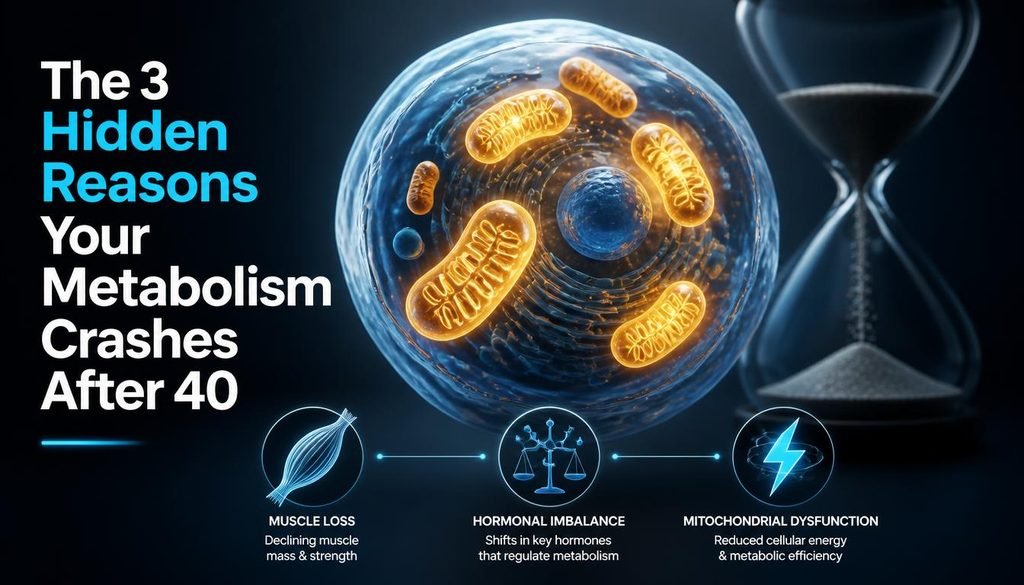
If you have hit your fourth decade and suddenly feel like you are gaining weight while eating the exact same foods, you have likely accepted the mainstream narrative that your metabolism crashes after 40 simply as an unavoidable consequence of aging. You are told that your biological engine naturally slows down, and your only options are to starve yourself or accept the weight gain. As a clinician focused on metabolic optimization and longevity, I am here to tell you that this narrative is a biological myth. The true culprits behind why your metabolism crashes after 40 are not written in your DNA; they are secondary, modifiable factors driven by muscle loss, cellular exhaustion, and shifting hormonal crosstalk.
In 2021, a landmark study published in the journal Science completely shattered the medical community’s understanding of aging and energy expenditure. Researchers analyzed the metabolic rates of 6,400 people across 29 countries and discovered that resting metabolic rate actually remains remarkably stable from age 20 all the way to age 60. The “slowdown” you are experiencing is not an inevitable decline in your basal metabolic rate. In this comprehensive guide, we will expose the three hidden physiological drivers that create the illusion of a slowing metabolism, and outline the exact clinical protocols required to restore your metabolic flexibility and reclaim your vitality.
The Great Metabolic Myth: What the Science Actually Proves
To understand why your metabolism crashes after 40, we must first look at the data from the Pontzer et al. study referenced by the National Institutes of Health (NIH). The data proved that a 45-year-old has the same baseline cellular energy expenditure as a 25-year-old, assuming their body composition and activity levels remain identical.
So, why does it feel like your metabolism crashes after 40? Because your body composition and daily movement patterns do not remain identical. The biological environment of a 45-year-old is vastly different from that of a 25-year-old. You are dealing with accumulated oxidative stress, shifting sex hormones, and a subconscious reduction in daily movement. The metabolic “crash” is actually a cascade of three specific, hidden dysfunctions that compound over time. Let us break down the exact biochemistry of these three drivers.
Reason 1: Silent Sarcopenia and the Collapse of NEAT
The first and most significant reason your metabolism crashes after 40 is the silent loss of metabolically active tissue, combined with a subconscious drop in daily movement.
The Sarcopenia Epidemic
Sarcopenia is the age-related loss of skeletal muscle mass and function. Beginning in your 30s, but accelerating rapidly after 40, you naturally lose 3% to 8% of your muscle mass per decade if you are not actively engaging in heavy resistance training. Skeletal muscle is not just for aesthetics; it is the largest metabolic sink in the human body. Muscle tissue is highly insulin-sensitive and acts as a primary disposal site for blood glucose.
When you lose muscle, you lose your metabolic armor. Even if your resting metabolic rate (the energy required to keep your organs functioning) remains stable, your active metabolic rate plummets because you have less tissue demanding energy. Furthermore, the loss of muscle directly drives insulin resistance, forcing your pancreas to pump out more insulin, which locks your fat cells in a state of storage. To ensure you are eating enough amino acids to preserve this vital tissue, use our Protein Intake Calculator.
The Collapse of NEAT
Non-Exercise Activity Thermogenesis (NEAT) accounts for all the calories you burn outside of intentional exercise—fidgeting, pacing, maintaining posture, and doing household chores. According to research from Harvard Health, NEAT can account for up to 15-30% of your daily caloric expenditure. As we enter our 40s, career demands peak, joint stiffness begins, and energy levels dip. Without realizing it, we sit more, stand less, and fidget less. This subconscious drop in NEAT creates a massive caloric surplus that mimics a “slowing metabolism.”
Reason 2: Mitochondrial Senescence and Cellular Exhaustion
The second hidden driver of why your metabolism crashes after 40 occurs at the microscopic level, inside your cellular engines.
The ATP Crisis
Your mitochondria are the power plants of your cells, responsible for converting the food you eat and the oxygen you breathe into ATP (adenosine triphosphate), the biological currency of energy. As you age, your mitochondria are subjected to decades of oxidative stress from environmental toxins, poor sleep, and processed diets. This cumulative damage mutates mitochondrial DNA and reduces their efficiency.
When your mitochondria become dysfunctional (a state known as mitochondrial senescence), they produce less ATP and generate more Reactive Oxygen Species (ROS)—free radicals that cause further cellular damage. This is why you feel physically exhausted even after a full night’s sleep. Your cells are literally failing to extract energy from your food efficiently. Instead of burning dietary fat for fuel, your metabolically crippled mitochondria force your body to store it.
Triggering Mitochondrial Biogenesis
To reverse this cellular exhaustion, you must force your body to build new, highly efficient mitochondria—a process called mitochondrial biogenesis. This is triggered primarily through Zone 2 cardiovascular training (steady-state cardio where you can barely hold a conversation) and targeted fasting. Fasting activates the AMPK pathway, which signals your cells to clear out dead mitochondria (mitophagy) and build new ones. Learn how to structure this in our guide: Autophagy: The Free Anti-Aging Switch Inside Your Cells.
Reason 3: Hormonal Crosstalk (Cortisol, Insulin, and Sex Hormones)
The final piece of the puzzle when your metabolism crashes after 40 is a profound shift in your endocrine system. Your hormones do not operate in isolation; they exist in a complex web of crosstalk.
The Sex Hormone Decline
For women, the 40s mark the onset of perimenopause. Progesterone drops first, leading to estrogen dominance, water retention, and severe sleep disruption. For men, testosterone levels begin a steady decline of about 1% per year. Both of these sex hormones are highly anabolic; they protect muscle mass and keep fat storage in check. As they decline, your body becomes primed for fat accumulation.
The Cortisol-Insulin Vicious Cycle
Simultaneously, the 40s are often the most stressful decade of life—balancing aging parents, growing children, and peak career responsibilities. Chronic psychological stress keeps cortisol elevated. Cortisol actively breaks down muscle tissue to convert amino acids into glucose (gluconeogenesis) to fuel your “fight or flight” response.
This constant drip of cortisol drives visceral fat accumulation—the hard, inflammatory fat that wraps around your liver and pancreas. Visceral fat acts as an active endocrine organ, pumping out inflammatory cytokines that block insulin receptors. You become insulin resistant, meaning your body must produce massive amounts of insulin just to keep your blood sugar normal. Because insulin is a fat-storage hormone, high circulating levels make it biochemically impossible to burn stored body fat. For a deeper dive into this mechanism, read Cortisol Belly Fat: Why Stress Hormones Stop You From Losing Weight.
💡 Action Step: You cannot fix a metabolic crash by guessing your caloric needs. Use our TDEE Calculator to establish your true baseline energy expenditure, and our Body Fat Calculator to track your visceral fat risk using the U.S. Navy circumference method.
The 3 Hidden Drivers: Summary Table
To visualize how these three factors compound to create the illusion of an aging metabolism, refer to this clinical breakdown:
| The Hidden Driver | The Biological Mechanism | The Metabolic Consequence |
|---|---|---|
| 1. Sarcopenia & NEAT Drop | Loss of glucose-disposing muscle mass; subconscious reduction in daily movement. | Lower active metabolic rate; creeping insulin resistance; unexplained weight gain. |
| 2. Mitochondrial Senescence | Cumulative oxidative damage reduces ATP production and increases cellular waste. | Chronic fatigue; inability to oxidize (burn) dietary fat; reliance on sugar for energy. |
| 3. Hormonal Crosstalk | Declining sex hormones + chronic cortisol elevation drives visceral fat storage. | High fasting insulin; locked fat cells; severe abdominal weight retention. |
The Longevity Protocol: How to Reverse the Slowdown
If you want to reverse the reality of how your metabolism crashes after 40, you must abandon the standard mainstream advice of “eat less, do more cardio.” Chronic caloric restriction in your 40s will only accelerate muscle loss and crash your thyroid. Instead, adopt this evidence-based longevity protocol.
1. Prioritize Heavy Resistance Training
You must send a biological signal to your body that muscle is required for survival. Lift heavy weights 3 to 4 times a week, focusing on compound movements (squats, deadlifts, presses, and rows). This halts sarcopenia, rebuilds your metabolic sink, and improves insulin sensitivity.
2. Implement Strategic Fasting
To clear out senescent mitochondria and lower baseline insulin, you must give your digestive system a rest. Use our Intermittent Fasting Calculator to design a 14:10 or 16:8 eating window. Ensure you break your fast with protein and healthy fats to respect the Randle Cycle and prevent blood sugar spikes.
3. Optimize Sleep Architecture
Deep sleep is when your brain clears neurotoxins and your body releases human growth hormone (HGH), which is vital for tissue repair and fat mobilization. If you are sleeping less than 7 hours, or if your sleep is fragmented by alcohol or late-night eating, your cortisol will remain high, and your metabolism will stall. Read our guide on Why Your Sleep Architecture Matters More Than Hours in Bed.
Standard Advice vs. The Longevity Protocol
| Metric | The Standard “Diet” Advice (Fails After 40) | The Longevity Protocol (Reverses the Crash) |
|---|---|---|
| Exercise | Chronic, steady-state cardio (running, elliptical). | Heavy resistance training + Zone 2 cardio. |
| Nutrition | Severe caloric restriction and low fat. | High protein (0.8-1g per lb of ideal body weight) + healthy fats. |
| Fasting | Skipping meals randomly, causing stress. | Structured Time-Restricted Eating (e.g., 16:8) aligned with circadian rhythm. |
| Focus | Obsessing over the scale weight. | Tracking waist-to-height ratio, grip strength, and fasting insulin. |
Final Thoughts
The belief that your metabolism crashes after 40 as an unavoidable law of nature is a disempowering myth. Your resting metabolic rate is likely just as robust today as it was a decade ago. The slowdown you are experiencing is the cumulative result of silent muscle loss, exhausted mitochondria, and a stressful hormonal environment.
By shifting your focus from starving your body to building it—through heavy resistance training, targeted fasting, and circadian-aligned sleep—you can reverse these hidden drivers. Stop blaming your age, start optimizing your cellular biology, and reclaim the metabolic flexibility of your youth.
Frequently Asked Questions (FAQ)
1. What actually causes it when your metabolism crashes after 40?
Your metabolism does not naturally slow down due to age; resting metabolic rate remains stable until age 60. The actual causes are secondary factors: sarcopenia (age-related muscle loss), mitochondrial dysfunction (cellular energy decline), and hormonal shifts (declining sex hormones combined with elevated cortisol and insulin resistance).
2. Is it true that your metabolism crashes after 40 naturally?
No. A landmark 2021 study published in the journal Science analyzed 6,400 people and proved that human resting metabolic rate is remarkably stable from age 20 to 60. The perceived “crash” is actually the result of lifestyle-induced muscle loss, reduced daily movement (NEAT), and accumulated cellular stress.
3. How can I speed up my metabolism after 40?
To optimize your metabolism after 40, you must prioritize heavy resistance training to rebuild metabolically active muscle mass, implement time-restricted eating to lower baseline insulin and trigger mitochondrial cleanup (autophagy), and optimize sleep architecture to regulate cortisol and growth hormone production.
4. Does menopause or andropause cause weight gain?
Yes. The decline in estrogen (in women) and testosterone (in men) removes the anabolic protection these hormones provide, making it easier to lose muscle and store visceral fat. Furthermore, these hormonal shifts often increase insulin resistance, making fat loss significantly harder without targeted dietary interventions.
5. Why am I gaining weight in my 40s even though I eat the same?
If your diet remains the same but you gain weight in your 40s, it is likely due to a subconscious drop in NEAT (Non-Exercise Activity Thermogenesis) and the loss of skeletal muscle mass. With less muscle to burn glucose and less daily movement, your previous caloric intake now creates a surplus, which is stored as visceral fat due to age-related insulin resistance.
⚕️ Medical Disclaimer
The content provided on RegenStep.com, including this article authored by Dr. Julian Vance, is strictly for educational and informational purposes only. It is not intended to be a substitute for professional medical advice, diagnosis, or treatment.
Metabolic optimization protocols, including heavy resistance training and intermittent fasting, carry inherent risks and may not be suitable for individuals with uncontrolled hypertension, severe cardiovascular disease, or a history of eating disorders. Always consult with your physician or a qualified healthcare provider before beginning any new exercise, fasting, or dietary regimen, particularly if you are taking prescription medications for blood sugar or blood pressure.
What actually causes it when your metabolism crashes after 40?
Your metabolism does not naturally slow down due to age; resting metabolic rate remains stable until age 60. The actual causes are secondary factors: sarcopenia (age-related muscle loss), mitochondrial dysfunction (cellular energy decline), and hormonal shifts (declining sex hormones combined with elevated cortisol and insulin resistance).
Is it true that your metabolism crashes after 40 naturally?
No. A landmark 2021 study published in the journal Science analyzed 6,400 people and proved that human resting metabolic rate is remarkably stable from age 20 to 60. The perceived “crash” is actually the result of lifestyle-induced muscle loss, reduced daily movement (NEAT), and accumulated cellular stress.
How can I speed up my metabolism after 40?
To optimize your metabolism after 40, you must prioritize heavy resistance training to rebuild metabolically active muscle mass, implement time-restricted eating to lower baseline insulin and trigger mitochondrial cleanup (autophagy), and optimize sleep architecture to regulate cortisol and growth hormone production.
Does menopause or andropause cause weight gain?
Yes. The decline in estrogen (in women) and testosterone (in men) removes the anabolic protection these hormones provide, making it easier to lose muscle and store visceral fat. Furthermore, these hormonal shifts often increase insulin resistance, making fat loss significantly harder without targeted dietary interventions.
Why am I gaining weight in my 40s even though I eat the same?
If your diet remains the same but you gain weight in your 40s, it is likely due to a subconscious drop in NEAT (Non-Exercise Activity Thermogenesis) and the loss of skeletal muscle mass. With less muscle to burn glucose and less daily movement, your previous caloric intake now creates a surplus, which is stored as visceral fat due to age-related insulin resistance.

Julian Vance is the writer and editor behind RegenStep, translating peer-reviewed longevity, metabolic, and gut-health research into practical, actionable guides. Julian is not a licensed physician; content is reviewed against cited primary sources and is for informational purposes only. Always consult a qualified healthcare provider for personal medical advice.