
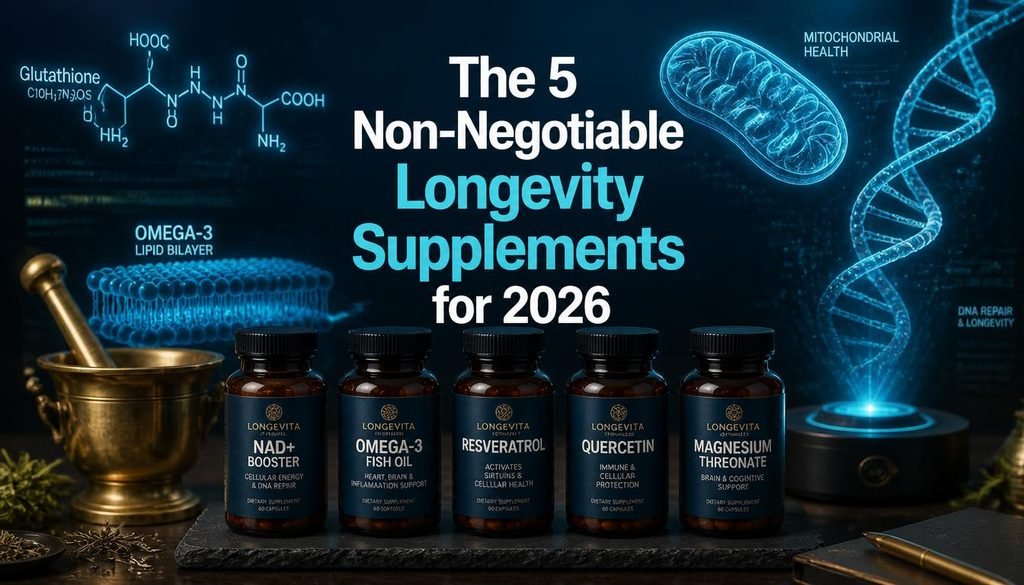
When evaluating longevity supplements in 2026, the line between rigorous clinical science and aggressive marketing has never been more blurred. The global market for longevity supplements is a multi-billion-dollar ecosystem flooded with exotic peptides, rare adaptogens, and unproven NAD+ boosters that promise to reverse your biological age. But as a clinician focused on metabolic optimization and cellular aging, I do not base my protocols on marketing budgets or mouse models. I base them on human clinical trials, bioavailability, and multi-system efficacy.
The truth is that you do not need a $2,000 monthly stack to extend your healthspan. You need to apply the 80/20 rule to your biohacking protocol: focus on the few compounds that deliver the vast majority of cellular, neurological, and metabolic benefits. In this guide, I will break down the exact biochemistry behind the five non-negotiable longevity supplements you should be taking this year, the precise dosages required for clinical efficacy, and how to stack them for maximum absorption.
The Criteria: What Makes a Supplement “Non-Negotiable”?
Before we dissect the specific compounds, we must establish the clinical criteria for separating effective longevity supplements from expensive placebos. To make this list, a compound must meet three strict requirements:
- Human Clinical Validation: It must have robust, peer-reviewed human data demonstrating a measurable impact on the hallmarks of aging (e.g., mitochondrial dysfunction, epigenetic alterations, or loss of proteostasis).
- Bioavailability: The compound must actually reach the target tissue in active form. Many famous anti-aging molecules are destroyed by stomach acid or possess terrible cellular uptake rates.
- Pleiotropy: It must exert positive effects across multiple biological systems simultaneously. We are looking for high-yield interventions, not narrow-spectrum fixes.
1. Creatine Monohydrate (The Cellular Energy & Brain Armor)
Creatine monohydrate is arguably the most misunderstood of all longevity supplements. Culturally, it is pigeonholed as a bodybuilding aid. In modern longevity medicine, it is recognized as one of the most powerful, safe, and heavily researched neuroprotective and mitochondrial compounds on the planet.
The Biochemical Mechanism
Your cells rely on ATP (adenosine triphosphate) for energy. When ATP is utilized, it loses a phosphate molecule and becomes ADP (adenosine diphosphate), which is essentially cellular exhaust. Creatine acts as a rapid-recycling reservoir, donating its phosphate group to ADP to instantly regenerate ATP.
While this is vital for muscle contraction, it is equally critical for the brain. The brain consumes 20% of your body’s total energy despite being only 2% of its mass. Research demonstrates that creatine supplementation significantly reduces mental fatigue, improves short-term memory, and protects against age-related cognitive decline. Furthermore, it directly combats sarcopenia (age-related muscle loss), which is a primary predictor of all-cause mortality and frailty.
- The Protocol: 5 grams of pure Creatine Monohydrate daily. Avoid expensive “buffered” or “liquid” versions; standard monohydrate is the most bioavailable and heavily validated form.
- Action Step: To maximize muscle retention as you age, ensure you are eating enough amino acids to pair with your creatine. Use our Protein Intake Calculator to find your exact daily target.
2. High-EPA Omega-3 Fatty Acids (The Inflammation Resolver)
When discussing longevity supplements, omega-3 fatty acids are universally recommended, but the devil is in the details. Most cheap drugstore fish oils are rancid, heavily oxidized, and contain mostly DHA or filler fats. For neurological and cardiovascular protection, you must prioritize high-EPA formulations.
The Biochemical Mechanism
EPA (Eicosapentaenoic acid) is the primary driver of resolving systemic inflammation. It competes with arachidonic acid (an omega-6 found in seed oils and grain-fed meats) for the COX and LOX enzymes, effectively shutting down the production of pro-inflammatory prostaglandins. Furthermore, high doses of EPA increase cell membrane fluidity, which improves insulin receptor sensitivity and neurotransmitter receptor function.
A landmark meta-analysis confirmed that omega-3 interventions are only effective for mood regulation and neuroprotection if the EPA content is greater than 60% of the total profile, and the daily EPA dose exceeds 1,000 mg.
- The Protocol: 2,000 mg to 3,000 mg of combined EPA/DHA daily, with a strict focus on achieving at least 1,500 mg of EPA. Look for brands certified by IFOS (International Fish Oil Standards) to guarantee the absence of heavy metals and rancidity.
3. Magnesium Glycinate or L-Threonate (The Nervous System Reset)
Over 50% of the Western population is deficient in magnesium, a mineral required for over 300 enzymatic reactions, including ATP synthesis and DNA repair. However, the form of magnesium you buy dictates its efficacy. Magnesium oxide has an absorption rate of less than 5% and acts primarily as a laxative. When evaluating longevity supplements, magnesium remains one of the most critical, yet frequently misused, compounds.
The Biochemical Mechanism
Every molecule of ATP your mitochondria produce must bind to a magnesium ion to become biologically active (Mg-ATP). Without adequate intracellular magnesium, your cellular engines literally stall.
For neurological and sleep benefits, Magnesium Glycinate or Magnesium L-Threonate are the gold standards. Glycinate easily crosses the blood-brain barrier and provides glycine, an inhibitory neurotransmitter that lowers core body temperature and promotes deep, slow-wave sleep. L-Threonate was specifically developed to elevate magnesium levels in the cerebrospinal fluid, enhancing synaptic density and neuroplasticity.
- The Protocol: 200 mg to 400 mg of elemental Magnesium Glycinate taken 60 minutes before bed to optimize sleep architecture. For targeted cognitive enhancement, Magnesium L-Threonate can be taken in the morning. Learn more about optimizing your sleep cycles in our guide: Why Your Sleep Architecture Matters More Than Hours in Bed.
4. GlyNAC (The Glutathione Precursor & Mitochondrial Defender)
In the last two years, GlyNAC has rapidly emerged as one of the most powerful longevity supplements in the functional medicine arsenal. GlyNAC is a combination of two amino acids: Glycine and N-Acetyl Cysteine (NAC).
The Biochemical Mechanism
Glutathione is the master antioxidant of the human body, responsible for neutralizing reactive oxygen species (ROS) and detoxifying the liver. As we age, our natural production of glutathione plummets due to a deficiency in its rate-limiting precursors: glycine and cysteine. This intracellular depletion leads to massive oxidative stress, mitochondrial dysfunction, and accelerated cellular senescence.
Clinical trials at Baylor College of Medicine demonstrated that supplementing with GlyNAC in older adults completely restored intracellular glutathione levels to those of young adults. This reversal of oxidative stress resulted in measurable improvements in muscle strength, cognitive function, and insulin resistance.
- The Protocol: A combined dose providing roughly 1.5g to 3g of Glycine and 600mg to 1,200mg of NAC daily. Take it on an empty stomach or between meals to maximize amino acid absorption without competition from dietary proteins.
5. Vitamin D3 + K2 (The Calcium Director & Immune Modulator)
Vitamin D3 and K2 are foundational longevity supplements that must be taken together. Taking high-dose Vitamin D3 without Vitamin K2 is a clinical error that can lead to vascular calcification.
The Biochemical Mechanism
Vitamin D3 acts more like a pro-hormone than a vitamin, regulating over 2,000 genes involved in immune function, cellular apoptosis, and bone metabolism. However, Vitamin D3 increases the absorption of calcium from your diet. Without Vitamin K2, that calcium has no directional signal and can deposit into your arterial walls and kidneys, driving atherosclerosis and kidney stones.
Vitamin K2 activates osteocalcin (which directs calcium into the bone matrix) and Matrix Gla Protein (MGP), which actively sweeps calcium out of your soft tissues and blood vessels. This synergy prevents the “calcium paradox” and protects your endothelial lining.
- The Protocol: 4,000 to 5,000 IU of Vitamin D3 combined with 100 mcg to 200 mcg of Vitamin K2 (specifically in the MK-7 form for a longer half-life). Always take this stack with a fat-containing meal, as both are strictly fat-soluble.
💡 Action Step: You cannot optimize your cellular health if your baseline metabolic rate is suppressed. Use our TDEE Calculator to dial in your exact daily energy expenditure, and our Intermittent Fasting Calculator to trigger the autophagy that expensive compounds try to mimic.
What I Left Off the List (And Why)
You might be wondering why certain famous longevity supplements are missing from this protocol. Here is the clinical reality:
- NMN / NR (NAD+ Boosters): While boosting NAD+ is vital for aging cells, high-quality, stabilized precursors are incredibly expensive, and human longevity data is still maturing compared to the robust evidence for GlyNAC and Creatine.
- Resveratrol: The human bioavailability of standard resveratrol is notoriously poor, and recent meta-analyses have cast significant doubt on its ability to extend lifespan or improve metabolic markers in healthy humans.
- Collagen Peptides: Excellent for joints and skin, but a high-quality daily dose is costly. You can achieve similar amino acid profiles (glycine and proline) by incorporating bone broth or slow-cooked tough cuts of meat into your diet.
How to Stack Them for Maximum Absorption
Timing and synergy are critical when stacking your longevity supplements. Taking them all at once can lead to competition for absorption transporters or gastrointestinal distress. Refer to this clinical schedule:
| Time of Day | Supplement | Dosage | Purpose & Mechanism |
|---|---|---|---|
| Morning (With Fat) | Vitamin D3 + K2 (MK-7) | 5,000 IU / 100 mcg | Fat-soluble absorption; sets circadian immune tone. |
| Morning (Fasted) | GlyNAC | 1.5g Glycine / 600mg NAC | Empty stomach absorption; fuels daytime glutathione synthesis. |
| Breakfast / Lunch | High-EPA Omega-3 | 2,000mg+ (min 1.5g EPA) | Fat-soluble absorption; blunts post-meal inflammatory cascades. |
| Anytime (With Water) | Creatine Monohydrate | 5 grams | Saturates muscle and brain phosphocreatine stores. |
| Before Bed (Fasted) | Magnesium Glycinate | 300mg – 400mg | Down-regulates NMDA receptors; promotes deep slow-wave sleep. |
Final Thoughts
Ultimately, the most effective longevity supplements do not rely on exotic marketing; they rely on biochemical synergy and consistency of use. By allocating your resources toward Creatine, high-EPA Omega-3s, Magnesium, GlyNAC, and the D3/K2 complex, you are covering the vast majority of the hallmarks of aging. You are protecting your brain’s energy supply, resolving systemic inflammation, restoring master antioxidant levels, and directing calcium away from your arteries.
Do not fall for the trap that extending your healthspan requires a pharmacy cabinet full of unproven molecules. Biology respects consistency, foundational biochemistry, and targeted stressors like heavy resistance training. Secure your baseline, take these compounds daily, and watch your biological age reflect the investment.
Frequently Asked Questions (FAQ)
1. What are the best longevity supplements for 2026?
The most evidence-based longevity supplements for 2026 include Creatine Monohydrate for cellular energy and neuroprotection, high-EPA Omega-3s for resolving neuro-inflammation, Magnesium Glycinate for sleep architecture, GlyNAC for restoring intracellular glutathione, and a Vitamin D3/K2 complex for immune and vascular health.
2. Why is Creatine considered a top longevity supplement?
Creatine is heavily researched for its ability to recycle ATP, the primary energy currency of cells. Beyond preserving muscle mass against age-related sarcopenia, it is highly neuroprotective, reducing mental fatigue and supporting cognitive function and memory in older adults.
3. What is GlyNAC and why is it important for aging?
GlyNAC is a combination of the amino acids Glycine and N-Acetyl Cysteine. It provides the rate-limiting precursors required to synthesize glutathione, the body’s master antioxidant. Clinical trials show that GlyNAC supplementation restores depleted glutathione levels in older adults, reversing oxidative stress and mitochondrial dysfunction.
4. Should I take Vitamin D3 and K2 together?
Yes, they must be taken together. Vitamin D3 increases calcium absorption from the diet, while Vitamin K2 activates proteins (like osteocalcin and MGP) that direct that calcium into the bones and teeth, preventing it from calcifying your arteries and soft tissues.
5. Are NMN and Resveratrol necessary for anti-aging?
No. While NAD+ boosters like NMN and compounds like Resveratrol are popular, they are highly expensive and lack the robust, long-term human clinical validation seen with foundational compounds like Creatine, Omega-3s, and Magnesium. You can naturally boost NAD+ through Zone 2 cardio and intermittent fasting.
⚕️ Medical Disclaimer
The content provided on RegenStep.com, including this guide authored by Dr. Julian Vance, is strictly for educational and informational purposes only. It is not intended to be a substitute for professional medical advice, diagnosis, or treatment.
Supplements can interact with prescription medications and underlying health conditions. For example, high-dose Omega-3s and Vitamin K2 can interact with blood thinners like Warfarin, and NAC may interact with nitroglycerin. Always consult with your physician or a qualified healthcare provider before beginning any new supplementation protocol, particularly if you are taking prescription medications, have a history of liver or kidney disease, or are pregnant or nursing.
The Criteria: What Makes a Supplement “Non-Negotiable”?
Before we dissect the specific compounds, we must establish the clinical criteria for separating effective longevity supplements from expensive placebos. To make this list, a compound must meet three strict requirements:
What are the best longevity supplements for 2026?
The most evidence-based longevity supplements for 2026 include Creatine Monohydrate for cellular energy and neuroprotection, high-EPA Omega-3s for resolving neuro-inflammation, Magnesium Glycinate for sleep architecture, GlyNAC for restoring intracellular glutathione, and a Vitamin D3/K2 complex for immune and vascular health.
Why is Creatine considered a top longevity supplement?
Creatine is heavily researched for its ability to recycle ATP, the primary energy currency of cells. Beyond preserving muscle mass against age-related sarcopenia, it is highly neuroprotective, reducing mental fatigue and supporting cognitive function and memory in older adults.
What is GlyNAC and why is it important for aging?
GlyNAC is a combination of the amino acids Glycine and N-Acetyl Cysteine. It provides the rate-limiting precursors required to synthesize glutathione, the body’s master antioxidant. Clinical trials show that GlyNAC supplementation restores depleted glutathione levels in older adults, reversing oxidative stress and mitochondrial dysfunction.
Should I take Vitamin D3 and K2 together?
Yes, they must be taken together. Vitamin D3 increases calcium absorption from the diet, while Vitamin K2 activates proteins (like osteocalcin and MGP) that direct that calcium into the bones and teeth, preventing it from calcifying your arteries and soft tissues.
Are NMN and Resveratrol necessary for anti-aging?
No. While NAD+ boosters like NMN and compounds like Resveratrol are popular, they are highly expensive and lack the robust, long-term human clinical validation seen with foundational compounds like Creatine, Omega-3s, and Magnesium. You can naturally boost NAD+ through Zone 2 cardio and intermittent fasting.

Julian Vance is the writer and editor behind RegenStep, translating peer-reviewed longevity, metabolic, and gut-health research into practical, actionable guides. Julian is not a licensed physician; content is reviewed against cited primary sources and is for informational purposes only. Always consult a qualified healthcare provider for personal medical advice.