
If you have creaky knees, a torn rotator cuff, or osteoarthritis, you have undoubtedly been told to consume more collagen.
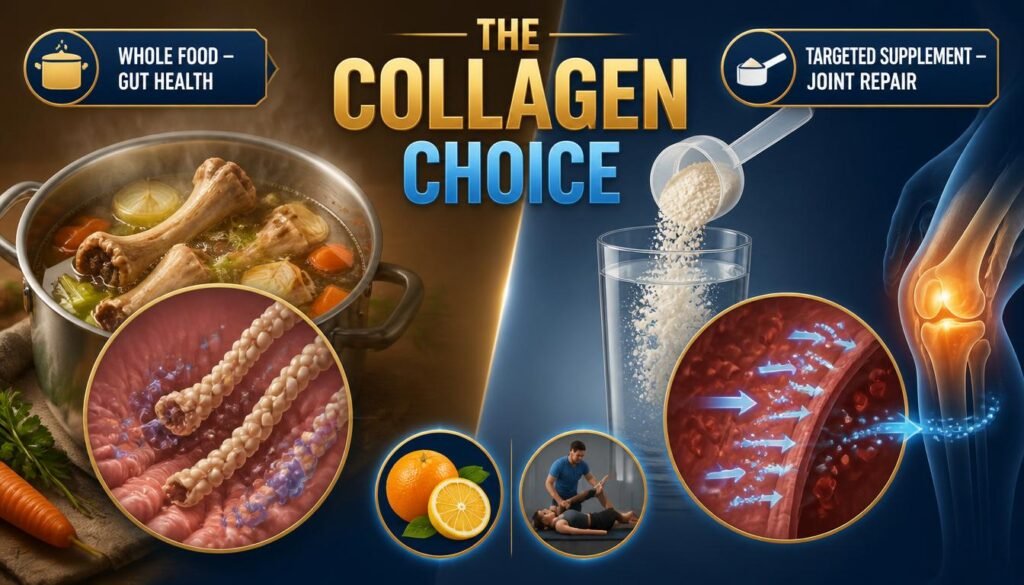
In the functional medicine and biohacking communities, two massive trends dominate this space: the ancient tradition of simmering Bone Broth, and the modern, engineered convenience of Collagen Peptide powders.
Both contain the raw materials your body needs to rebuild connective tissue. But biologically speaking, they are processed by your gastrointestinal tract in completely different ways. Here is the exact cellular science of how your body utilizes collagen, the difference between a whole food and a hydrolyzed supplement, and which one actually rebuilds your joints faster.
Let me introduce you to Margaret, a 63‑year‑old former marathon runner who was told she needed a knee replacement. “I tried bone broth for months,” she told me. “I drank it every day, but my knees didn’t improve. I thought collagen was a scam.”
Margaret wasn’t wrong about bone broth—it just wasn’t the right tool for her goal. She switched to hydrolyzed collagen peptides at a clinical dose of 15 grams per day, combined with vitamin C and timed around her physical therapy sessions. Within 12 weeks, her knee pain dropped significantly, and she avoided surgery. “I didn’t realize there was a difference,” she says. “Now I know—bone broth is food, but collagen peptides are medicine.”
Here is the exact cellular science of how your body utilizes collagen, the difference between a whole food and a hydrolyzed supplement, and which one actually rebuilds your joints faster.
External Link: A 2025 randomized controlled trial found that hydrolyzed collagen peptides significantly improved joint pain, stiffness, and physical function in patients with osteoarthritis.here
Both options are cheap compared with clinic-based repair. See what the expensive end actually delivers in our regenerative therapy guide.
The Cellular Science: What Your Joints Actually Need
Cartilage, tendons, and ligaments are avascular—meaning they have very little direct blood flow. Because they lack a robust blood supply, they heal incredibly slowly compared to muscle tissue.
To repair them, your body relies on specialized cells called fibroblasts (in tendons) and chondrocytes (in cartilage). These cells act like microscopic construction workers. But to build new joint tissue, they require a massive, continuous supply of three specific amino acids: Glycine, Proline, and Hydroxyproline.
This specific triad of amino acids is what makes up collagen.
The Case for Bone Broth: The Whole‑Food Matrix
Bone broth is created by simmering animal bones, marrow, and connective tissue for 12 to 48 hours. The heat and acid (usually apple cider vinegar) slowly extract the nutrients from the bones into the liquid.
The Pros
- The Synergistic Matrix: Bone broth doesn’t just contain collagen (in the form of gelatin); it contains the entire biological matrix of a joint. It is rich in Glycosaminoglycans (GAGs) like Hyaluronic Acid, Chondroitin, and Glucosamine, which lubricate the synovial fluid inside your joints.
- Gut Healing: The gelatin in bone broth is a large, sticky protein. It is phenomenal for coating and soothing an inflamed gastrointestinal tract and sealing the tight junctions of a Leaky Gut.
The Fatal Flaw for Joint Repair
Bone broth has a major biological bottleneck: Molecular Weight. The collagen in bone broth is largely intact (unhydrolyzed). Gelatin molecules can have molecular weights between 33,000 and 120,000. Because the protein molecules are massive, your digestive system has to work incredibly hard to break them down into individual amino acids before they can enter your bloodstream.
Furthermore, the amount of actual collagen in a cup of bone broth is highly unpredictable. Depending on the bones used and the cook time, a cup might contain 10 grams of protein, or it might contain 2 grams. You cannot dose it accurately.
Internal Link: Gut health is foundational for overall healing. Read Leaky Gut Syndrome 2026: Science‑Backed Realities.
The Case for Collagen Peptides: The Engineered Biohack
Collagen peptides are created by taking animal hides or scales and putting them through a rigorous enzymatic process called hydrolysis.
The Pros
- Pre‑Digested for Instant Absorption: Hydrolysis breaks the massive collagen protein down into microscopic chains of amino acids (peptides) with molecular weights as low as 2,000 to 5,000. Because they have a very low molecular weight, they bypass heavy digestion. They cross the intestinal wall intact and flood your bloodstream within 30 to 60 minutes of ingestion.
- The “Signaling” Effect: This is the ultimate biohack. When your body detects a massive, sudden flood of these specific peptides in the blood, it acts as a biological alarm system. Your fibroblasts think, “Wait, there is broken collagen in the blood—tissue must be damaged!” This tricks your cells into hyper‑drive, violently stimulating them to build new collagen in your joints.
- Standardized Dosing: Clinical trials for joint pain and tendon repair consistently use high doses (15 to 20 grams per day). You can guarantee this exact clinical dose with one scoop of powder, whereas you would have to drink gallons of bone broth to hit the same metric.
External Link: A double‑blind, placebo‑controlled trial demonstrated that hydrolyzed collagen peptides are a safe and effective option for symptomatic management of osteoarthritis.here
The Verdict: Which Rebuilds Joints Faster?
For rapid, targeted structural repair of joints, tendons, and ligaments, Hydrolyzed Collagen Peptides win flawlessly. The bioavailability, signaling effect, and standardized dosing make it the superior clinical tool for physical recovery.
However, Bone Broth is the superior tool for gut health, immune support, and holistic nutrition. They are not competitors—they are complementary. Bone broth is whole‑food nutrition; collagen peptides are targeted supplementation.
The Biohacker’s Joint Repair Protocol
If you are actively trying to heal a joint or tendon injury, you must combine the collagen peptides with two specific biological triggers.
1. The Vitamin C Co‑Factor
Your body physically cannot synthesize new collagen without Vitamin C. Vitamin C is an essential cofactor for the hydroxylation reactions that stabilize collagen’s triple‑helix structure. Without adequate vitamin C, collagen synthesis cannot proceed properly.
The Hack: Always take your collagen peptides with 500mg of whole‑food Vitamin C, or mix it into a glass of water with a heavy squeeze of fresh lemon juice.
2. The Mechanical Load (Timing is Everything)
Because tendons have poor blood flow, they act like sponges. When you exercise, you squeeze the fluid out of the tendon. When you stop, the tendon sucks fluid back in.
The Hack: To force the collagen peptides directly into the damaged joint, consume your 15g of collagen + Vitamin C exactly 45 to 60 minutes before a rehabilitation workout. The peptides will peak in your bloodstream just as you are exercising the joint, forcing the raw materials directly into the avascular tissue.
The Collagen Protocol Matrix
| Component | Bone Broth | Hydrolyzed Collagen Peptides |
|---|---|---|
| Primary Benefit | Gut healing, holistic nutrition | Joint, tendon, and cartilage repair |
| Absorption | Slow; requires heavy digestion | Rapid; absorbed as small peptides |
| Dosing | Unpredictable; varies by batch | Standardized; 15‑20g clinical dose |
| Molecular Weight | High (33,000‑120,000) | Low (2,000‑5,000) |
| Best Used | As a daily food, not a therapeutic tool | As a targeted supplement for joint repair |
The Bottom Line: Choose the Right Tool for the Job
Margaret now follows a daily protocol: a scoop of hydrolyzed collagen peptides before her physical therapy sessions, with a squeeze of lemon for vitamin C. “I still drink bone broth for my gut,” she says. “But for my knees, I use the peptides. I can actually feel the difference.”
Bone broth and collagen peptides are not interchangeable. Bone broth is a nutrient‑dense whole food that supports gut health and provides a broad spectrum of minerals and amino acids. Hydrolyzed collagen peptides are a precisely engineered supplement designed to flood your bloodstream with the specific building blocks your joints need to repair themselves.
If your goal is rapid joint repair, choose the peptides. If your goal is gut health and overall nutrition, choose the broth. And if you want both—use both, but for different purposes.
Frequently Asked Questions (FAQ)
Q: Which is better for joints, collagen or bone broth?
A: For rapid joint repair, hydrolyzed collagen peptides are superior. They are pre‑digested, highly bioavailable, and deliver a standardized clinical dose. Bone broth is better for gut health and holistic nutrition but lacks the concentrated, predictable collagen dose needed for joint regeneration.
Q: How long does it take for collagen peptides to work for joints?
A: Clinical trials typically show measurable improvements in joint pain and function after 8 to 12 weeks of consistent daily use. Some patients notice improvements sooner, but structural repair takes time.
Q: Should people with Ehlers‑Danlos Syndrome take collagen?
A: EDS is a genetic condition affecting collagen synthesis, not a nutritional deficiency. While collagen supplements are generally safe, they do not correct the underlying genetic defect. Always consult a specialist before starting any supplement regimen for EDS.
Q: What type of collagen is best for joint repair?
A: For direct structural repair, hydrolyzed collagen (types I and III) provides the amino acid building blocks at high doses. For immune‑mediated joint inflammation, undenatured type II collagen works through a different mechanism at much lower doses (10‑40 mg daily). Many protocols combine both.
Q: Can I just eat more meat instead of taking collagen?
A: Muscle meat (steak, chicken breast) is rich in the amino acid Methionine but very poor in Glycine. Connective tissue requires Glycine. If you eat a modern diet consisting only of lean muscle meats without consuming the bones, skin, and tendons of the animal, you are inherently deficient in the amino acids required for joint repair.
Q: Does heat destroy collagen peptides?
A: No. Unlike some delicate proteins (like whey), collagen peptides are highly heat‑stable. You can mix a scoop of unflavored hydrolyzed collagen powder directly into boiling hot coffee or tea without denaturing the amino acids or losing the biological benefits.
Q: Is “vegan collagen” effective for joint repair?
A: No. There is no such thing as vegan collagen. Collagen is an exclusively animal‑based protein. “Vegan collagen” supplements do not contain collagen; they contain the vitamins and minerals (like Vitamin C and Zinc) that your body uses to produce its own collagen. While healthy, they do not provide the direct, raw amino acid peptides required for rapid tissue repair.

Julian Vance is the writer and editor behind RegenStep, translating peer-reviewed longevity, metabolic, and gut-health research into practical, actionable guides. Julian is not a licensed physician; content is reviewed against cited primary sources and is for informational purposes only. Always consult a qualified healthcare provider for personal medical advice.