
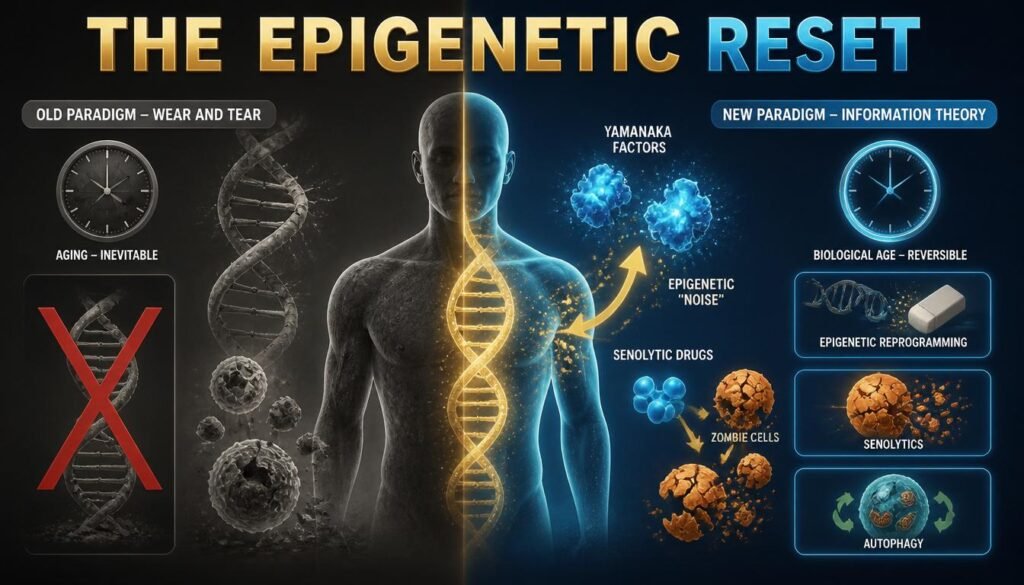
For generations, humanity accepted a single, depressing biological premise: aging is inevitable. We were taught that the human body is like a car—over time, the parts wear out, the engine rusts, and eventually, it breaks down completely.
But as we navigate the scientific breakthroughs of 2026, the medical community has completely abandoned the “wear and tear” model.
Aging is no longer viewed as a natural, unavoidable decline. It is now classified by leading geroscience researchers as a programmable disease—an accumulation of epigenetic noise that can be slowed, stopped, and in some cases, biologically reversed.
Let me introduce you to Dr. James, a 68-year-old retired research scientist who spent his career studying cellular biology. “I was trained to believe that aging was inevitable,” he told me. “But in the last five years, the data has completely flipped. We’re not just slowing aging anymore—we’re reversing it in clinical trials. I never thought I’d see this in my lifetime.”
Dr. James now follows a personalized longevity protocol: intermittent fasting, targeted senolytic supplementation, and NAD+ precursors. “I feel sharper than I did a decade ago,” he says. “The science is real, and it’s moving faster than most people realize.”
Here is the groundbreaking 2026 science that is rewriting the rules of human lifespan, and the protocols moving from billionaire biohacking labs into mainstream medicine.
If the framework is shifting, this is what still holds up: the evidence-based guide to healthspan.
The New Paradigm: The Information Theory of Aging
To understand the cure, you must understand the disease. The current consensus in longevity science is based on the Information Theory of Aging.
Your DNA is the hardware (the piano keys), and your epigenome is the software (the sheet music that tells the cell which keys to play). When you are young, the sheet music is perfectly clear; a liver cell knows exactly how to be a liver cell.
However, as you encounter stress, radiation, processed foods, and time, the epigenome accumulates “scratch marks” or “noise.” The sheet music becomes blurry. The liver cell forgets how to function optimally and starts acting like a generic, aged cell. This loss of cellular identity is what we call aging.
As Dr. David Sinclair and his co-authors have outlined, cells accumulate epigenetic noise, gradually becoming worse at what they do. What should have remained inactive starts getting translated and vice versa. The Information Theory of Aging proposes that aging results from the progressive loss of epigenetic information.
The breakthrough of 2026 is the realization that the original, youthful DNA is still perfectly intact underneath the noise. We just have to clean off the scratches.
The 3 Pillars of Reversing Biological Age
Modern longevity protocols focus on clearing this cellular noise and rebooting the biological operating system.
1. Epigenetic Reprogramming (The Yamanaka Factors)
In 2012, scientist Shinya Yamanaka won the Nobel Prize for discovering four specific proteins (the Yamanaka Factors) that could take any adult cell and reverse its age all the way back to a stem cell.
By 2026, researchers have learned how to pulse these factors just enough to reverse the age of the cell without making it lose its identity.
The 2026 Breakthrough: In January 2026, the FDA granted clearance for the first-ever cellular rejuvenation therapy using epigenetic reprogramming. The Phase 1 clinical trial (NCT07290244) is evaluating the safety and efficacy of this approach in targeting age-related optic nerve conditions, such as open-angle glaucoma.
External Link: Life Biosciences Receives FDA Clearance for First-Ever Cellular Rejuvenation Therapy Using Epigenetic Reprogramming — Read more
First Human Dosed: In June 2026, the first human was dosed with a cellular reprogramming drug in a longevity trial. The trial does not yet establish that humans can live longer or that cellular aging can be reversed in tissues outside the eye, but it represents the first opportunity to test whether restoring epigenetic information can ameliorate human disease.
According to researchers, the approach works by resetting the epigenetic programming of cells, potentially reversing aspects of cellular aging. While full systemic human reprogramming is still in clinical trials, this technology has proven that biological age is entirely flexible.
2. Senolytics: Killing the “Zombie” Cells
As cells accumulate damage, they are supposed to die (apoptosis). However, some refuse to die. They become Senescent Cells (zombie cells) . They sit in your tissues, secreting toxic, inflammatory chemicals (SASP) that rapidly age the healthy cells around them.
The most accessible longevity breakthrough today is the use of Senolytics—compounds designed to hunt down and kill these zombie cells.
2026 Clinical Evidence: Clinical trials show that senolytics have potential for improving mobility, reducing inflammation, and supporting healthy aging. Researchers at Cedars-Sinai are pioneering work developing novel therapies and refining the first generation of senolytics, including fisetin, dasatinib, and quercetin.
Fisetin & Quercetin: These powerful plant polyphenols are now in human trials. Recent 2025 studies show that intermittent fisetin matches or equals genetic senescent cell clearance and synthetic senolytics in preserving grip strength, muscle function, and reducing skeletal muscle senescence—often comparable or superior to D+Q (dasatinib + quercetin) in frailty models.
The “Hit-and-Run” Protocol: Senolytic compounds are often used in a “hit-and-run” strike—a short, high-dose pulse to clear zombie cells, followed by a long break to allow healthy cells to thrive. Preclinical studies have demonstrated benefit in multiple models, including decreased neuroinflammation and improvement in neuronal function and cognitive performance.
Internal Link: Clearing senescent cells is a key regenerative strategy. Read Senolytics: How to Flush Zombie Cells Out of Your Body.
3. mTOR Inhibition and Autophagy
We now know that constant growth is the enemy of longevity. The mTOR pathway is the body’s master growth switch. When it is constantly turned on (by eating high-protein meals six times a day), the body never repairs itself.
By actively suppressing mTOR through prolonged fasting or specific pharmacological agents (like Rapamycin), the body triggers autophagy—a deep cellular cleaning process that recycles misfolded proteins and damaged mitochondria, essentially remodeling the cell from the inside out.
2026 Research: Pharmacological inhibition of mTORC1 using rapamycin or its analogs (rapalogs) has demonstrated significant neuroprotective potential. By restoring autophagic flux, rebalancing metabolic axes (AMPK/SIRT1), and suppressing chronic inflammation, these compounds can rescue synaptic function and reactivate neurogenesis.
In human T cells exposed to acute stress, rapamycin and other mTOR inhibitors suppressed senescence not by slowing protein synthesis, but by directly reducing DNA lesional burden and improving cell survival.
Internal Link: Autophagy is the body’s cellular recycling program. Read Autophagy Activation: How Fasting Triggers Cellular Cleanup.
The Biological Age Reversal Evidence
A comprehensive review published in 2026 presents evidence that biological age reversal of 4-11 years has been achieved in human subjects through non-pharmacological interventions, while cellular reprogramming has extended median remaining lifespan by 109% in aged murine models.
This is not science fiction. It is peer-reviewed data.
The 2026 Biohacker’s Protocol
You don’t need a billion-dollar lab to start reversing your biological age today. The most effective protocols are largely behavioral and nutritional:
1. Aggressive Fasting Windows
Implement a 16-to-18 hour fasting window daily, or a 3-day water fast quarterly, to suppress mTOR and trigger deep autophagy.
Time-restricted feeding has been shown to extend healthspan in both sexes, with benefits more prolonged in female mice. Research has shown that decreasing daily calorie consumption can extend life in numerous model organisms while also delaying the onset of age-associated diseases.
2. Temperature Hormesis
Use deliberate cold exposure (ice baths) and extreme heat (saunas) to trigger shock proteins that repair damaged DNA.
3. Targeted NAD+ Restoration
As we age, our NAD+ levels (the fuel for our cellular repair enzymes, called Sirtuins) plummet. Supplementing with precursors like NMN or NR restores the fuel these enzymes need to fix the epigenetic scratches.
2026 Research: A Nestlé-led clinical study found that NR and NMN supplementation can similarly increase NAD+ levels in healthy adults and may also support gut health. This suggests that NR and NMN may deliver dual health benefits: enhancing cellular energy metabolism and healthy aging via NAD+ elevation, while also supporting overall health through improved gut microbiota balance.
Internal Link: NAD+ boosters are a cornerstone of longevity. Read NAD+ Boosters 2026: NMN vs NR.
The Longevity Protocol Matrix
| Intervention | Mechanism | 2026 Evidence | Protocol |
|---|---|---|---|
| Epigenetic Reprogramming | Resets epigenetic “noise” via Yamanaka factors | First human trial dosed June 2026; FDA-approved Phase 1 trial | Experimental; clinical trials only |
| Senolytics (Fisetin/Quercetin) | Clears senescent “zombie” cells | Human trials show improved mobility; matches genetic clearance | Intermittent “hit-and-run” pulses |
| mTOR Inhibition (Rapamycin/Fasting) | Triggers autophagy; reduces DNA damage | Neuroprotective; preserves cell survival under stress | 16-18hr daily fast; quarterly 3-day fasts |
| NAD+ Precursors (NMN/NR) | Restores sirtuin function; repairs epigenetic damage | First comparative clinical study shows NAD+ elevation and gut health benefits | Daily supplementation |
The Bottom Line: Aging Is Not Inevitable
Dr. James now follows a daily longevity protocol: a 16-hour fasting window, targeted senolytic pulses, and NAD+ precursors. “I spent my career studying cells,” he says. “Now I’m watching my own cells get younger. It’s the most exciting time in biology since the discovery of DNA.”
Aging is no longer viewed as a natural, unavoidable decline. It is now classified by leading geroscience researchers as a programmable disease—an accumulation of epigenetic noise that can be slowed, stopped, and in some cases, biologically reversed.
The goal is healthspan extension—ensuring that your biological age remains youthful and disease-free until the very end of your chronological lifespan, effectively eliminating the decades of frailty and nursing home care previously thought inevitable.
FAQ: The 2026 Science of Aging
Q: Is aging officially classified as a disease?
A: While the WHO has introduced codes relating to age-related decline, the longevity community treats aging as the “mother of all diseases.” By treating the root cause (aging itself), the goal is to simultaneously prevent the downstream symptoms: cancer, Alzheimer’s, and heart disease. Leading researchers argue that aging meets the definition of a disease—a progressive loss of function that leads to pathology and death.
Q: Can we actually live forever?
A: “Immortality” is not the goal of current 2026 science. The goal is healthspan extension—ensuring that your biological age remains youthful and disease-free until the very end of your chronological lifespan, effectively eliminating the decades of frailty and nursing home care previously thought inevitable.
Q: What is the most effective anti-aging intervention available right now?
A: Despite the hype around new drugs and supplements, rigorous clinical data still points to exercise (specifically a combination of VO2 max training and heavy resistance training) as the single most potent longevity drug in existence, profoundly affecting mitochondrial health and epigenetic expression.
Q: What is the #1 mistake that will make you age faster?
A: Chronic stress and poor sleep are among the fastest drivers of epigenetic aging. When you are stressed, your body produces cortisol, which accelerates epigenetic “noise” accumulation. Chronic sleep deprivation impairs the glymphatic system, allowing neurotoxic waste to accumulate in the brain.
Q: What should a 70-year-old be doing every day at home?
A: A daily longevity routine should include: movement (30-45 minutes of Zone 2 cardio), resistance training (2-3 times per week), cognitive stimulation (learning new skills, reading), social connection, and 7-8 hours of quality sleep. Nutrition should focus on protein adequacy (30-40g per meal), fiber diversity, and polyphenols.
Q: What is the Japanese secret to anti-aging?
A: Okinawan longevity is attributed to a combination of factors: hara hachi bu (eating until 80% full), a plant-dominant diet rich in sweet potatoes and vegetables, strong social connections (moai), natural daily movement, and a sense of purpose (ikigai). These lifestyle factors reduce chronic inflammation and support healthy epigenetic aging.
Q: How close is science to reversing aging?
A: As of 2026, we are closer than ever. First-in-human epigenetic reprogramming trials are underway, biological age reversal of 4-11 years has been achieved in human subjects through non-pharmacological interventions, and senolytics are in human trials showing improved mobility and reduced inflammation. While we cannot yet “reverse aging” completely, we can slow, halt, and in some cases partially reverse biological age.
Q: Are there any FDA-approved anti-aging drugs?
A: Currently, there are no FDA-approved drugs specifically for “anti-aging.” However, drugs like Metformin (for diabetes) and Rapamycin (for organ transplant rejection) are being studied off-label for longevity. The FDA has approved the first-ever clinical trial for epigenetic reprogramming, marking a significant regulatory shift toward treating aging as a medical condition.

Julian Vance is the writer and editor behind RegenStep, translating peer-reviewed longevity, metabolic, and gut-health research into practical, actionable guides. Julian is not a licensed physician; content is reviewed against cited primary sources and is for informational purposes only. Always consult a qualified healthcare provider for personal medical advice.