
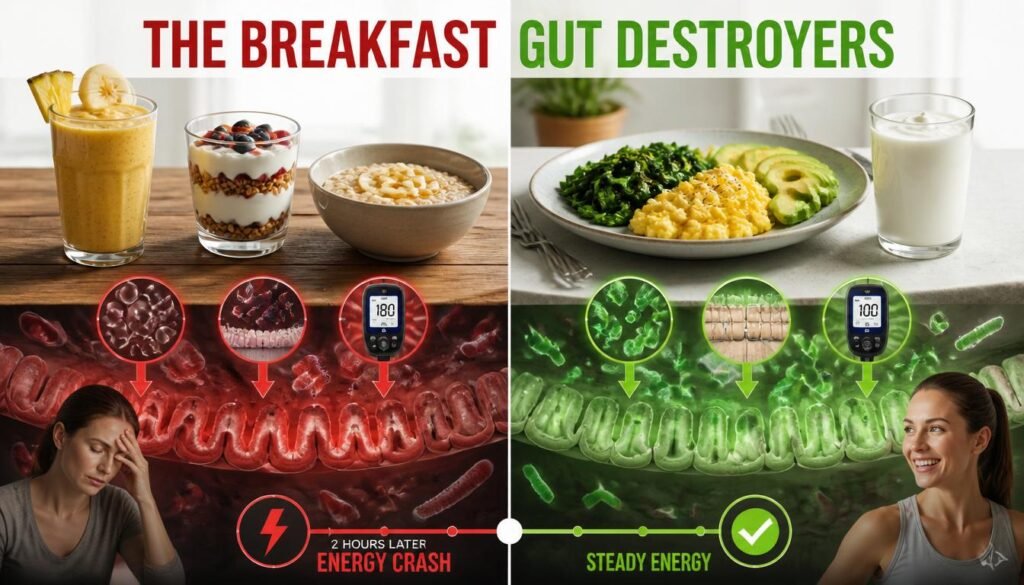
You wake up determined to have a perfect day of eating. Instead of reaching for a donut or a bagel, you make a “healthy” choice: a large bowl of instant oatmeal with oat milk, a massive tropical fruit smoothie, or a fat-free yogurt parfait topped with granola and honey.
Two hours later, your stomach is aggressively bloated, your energy has completely crashed, and you are hunting the pantry for a mid-morning snack.
You blame your willpower or assume you have a slow metabolism. In reality, you have fallen victim to one of the greatest marketing illusions in modern nutrition.
Let me introduce you to Sarah, a 42-year-old marketing executive who thought she was doing everything right. “I started every day with a green smoothie—banana, mango, spinach, and apple juice,” she told me. “I felt so virtuous. But by 10 AM, I was bloated, foggy, and desperate for sugar.”
Sarah’s “healthy” breakfast was actually a biological disaster for her gut. She had undiagnosed SIBO, and the high-fructose smoothie was feeding the bacteria in her small intestine, causing fermentation, gas, and that crushing mid-morning energy crash. We shifted her to a savory, protein-first breakfast: scrambled eggs with sautéed greens and half an avocado. Within a week, her bloating subsided, her energy stabilized, and she stopped craving sugar by mid-morning. “I thought I was being healthy,” she says. “I was actually making myself sick.”
The standard “healthy” western breakfast is a biological disaster for your gastrointestinal tract and your metabolic hormones. Here is the exact cellular science behind why your morning routine is driving chronic bloating, leaky gut, and mid-morning fatigue, along with the functional medicine protocols you should be eating instead.
External Link: A 2025 PubMed review found that emulsifier supplementation lowered short-chain fatty acid concentration compared with placebo, indicating disrupted gut fermentation.Read more here.
What you eat at breakfast ripples outward through the gut-brain-skin axis.
The 3 “Healthy” Gut Destroyers
If your gut is already compromised by stress, antibiotics, or hidden infections like SIBO (Small Intestinal Bacterial Overgrowth) , starting your day with these three staples is the equivalent of throwing gasoline on a metabolic fire.
1. The Tropical Fruit Smoothie Bomb
Blending bananas, mangoes, pineapple, and apple juice into a massive morning smoothie creates a high-fructose liquid bomb.
The Gut Impact: Fructose is highly fermentable. If you have any bacterial overgrowth in your small intestine, this liquid sugar acts as an instant buffet for the bad bacteria. Studies show that SIBO may represent an important reversible cause of carbohydrate intolerance, with fructose malabsorption contributing to bloating, gas, and abdominal discomfort. The bacteria ferment the fructose within minutes, releasing massive amounts of hydrogen gas and causing severe, painful bloating.
The Metabolic Impact: By pulverizing the fruit, you destroy the protective matrix of the fiber. The sugar hits your bloodstream almost instantly, spiking your insulin, which inevitably leads to a massive blood sugar crash—and severe brain fog—by 10:30 AM.
2. Commercial Yogurt Parfaits
Most commercial yogurts marketed for gut health are actually metabolic traps.
The Gut Impact: Unless you are eating plain, unsweetened, full-fat Greek or Icelandic yogurt, you are consuming a dessert. Many commercial yogurts contain up to 20 grams of added sugar per serving. Worse, they are packed with industrial emulsifiers (like carrageenan, xanthan gum, and polysorbate-80).
Clinical studies show these specific emulsifiers actively degrade the protective mucosal barrier of your intestines. Research has found that emulsifiers like carboxymethylcellulose and polysorbate 80 have been linked to changes in the gut microbiome, including a reduction in beneficial bacteria. Early studies suggest emulsifiers may increase gut permeability (“leaky gut”), allowing unwanted compounds to pass into the bloodstream and trigger low-grade inflammation. A 2025 placebo-controlled trial found that emulsifier supplementation lowered short-chain fatty acid concentration compared with placebo, indicating disrupted gut fermentation.
3. Instant Oatmeal and Agave Nectar
Oats are heavily marketed as a heart-healthy superfood. But instant oatmeal has been so heavily processed and milled that the body digests it almost exactly like a bowl of pure table sugar.
The Gut Impact: The glycemic index of instant oats ranges from 79 to 83—firmly in the high-GI category. Quick-cooking oats and instant oatmeal produce significantly higher glycemic responses (GI of 71 and 75, respectively) than less processed oats. Research shows that eating minimally processed oats, like steel-cut oats, leads to a much smaller increase in blood sugar and insulin compared with more processed oats like rolled or instant.
When you top it with “natural” sweeteners like agave nectar—which is up to 90% pure fructose, higher than high-fructose corn syrup—it feeds opportunistic gut fungi like Candida albicans. Agave nectar can contain between 56% and 90% fructose, compared to about 50% in refined sugar and 55% in HFCS. This drives fungal overgrowth, severe sugar cravings, and systemic lethargy.
Internal Link: SIBO is a common hidden cause of bloating. Read SIBO: The Hidden Gut Infection Behind 78% of IBS Cases.
The Reversal Protocol: How to Build a Gut-Healing Breakfast
To heal your gut and stabilize your energy, you must fundamentally change your morning nutritional paradigm. You must shift from Sweet to Savory.
A gut-healing breakfast prioritizes proteins, healthy fats, and cellular structural support, keeping your insulin flat and starving the bad bacteria in your microbiome.
1. The “Protein First” Mandate
Start your day with at least 30 grams of high-quality protein. Protein requires significant energy to digest, keeps you full for hours by suppressing the hunger hormone ghrelin, and does not feed the fermenting bacteria in your small intestine.
What to Eat: 3 to 4 pasture-raised eggs cooked in grass-fed butter, a high-quality smoked salmon plate, or leftover steak or chicken from last night’s dinner. (Yes, eating dinner for breakfast is one of the ultimate biohacks for gut health).
External Link: Gastroenterologists recommend starting the day with a high-protein, high-fiber breakfast for a healthy gut and sustained energy. Eggs offer high-quality protein that promotes gut repair and are easy to digest.Read more here.
2. The SIBO-Safe Smoothie
If you absolutely must have a smoothie, rebuild it to support your intestinal wall rather than spiking your blood sugar.
The Formula: Use an unsweetened, gum-free base (like pure coconut milk or macadamia nut milk). Add a handful of low-fructose berries (blueberries or raspberries).
The Biohack: Add 15 to 20 grams of Hydrolyzed Collagen Peptides and 5 grams of L-Glutamine powder. These two amino acid profiles act as structural spackle, actively repairing the tight junctions of a leaky gut wall while keeping your blood sugar perfectly flat.
3. Emulsifier-Free Fermentation
If you tolerate dairy, swap the sugary, gummy commercial yogurts for traditional, raw, or unsweetened fermented foods.
What to Eat: Plain, full-fat kefir or unsweetened coconut-milk yogurt. These provide the beneficial Saccharomyces boulardii and transient Lactobacilli strains to help reset the microbiome without the toxic, gut-degrading thickeners.
Internal Link: Plain, full-fat fermented dairy is a much better choice than low-fat processed yogurts. Read The Yogurt Lie: How Low-Fat Dairy Emulsifiers Damage Your Gut.
The Gut-Healing Breakfast Matrix
| Breakfast Type | What It Does to Your Gut | What to Eat Instead |
|---|---|---|
| Tropical Fruit Smoothie | Feeds SIBO; causes fructose fermentation and bloating | Low-fructose berry smoothie with collagen and L-glutamine |
| Commercial Yogurt Parfait | Emulsifiers degrade mucus barrier; high sugar feeds pathogens | Plain full-fat Greek yogurt or kefir with nuts and seeds |
| Instant Oatmeal | High GI spikes blood sugar; agave fuels fungal overgrowth | Steel-cut oats (if tolerated) or savory protein breakfast |
| Protein-First Breakfast | Stabilizes insulin; starves bad bacteria; repairs gut lining | Eggs, smoked salmon, or leftover protein from dinner |
The Bottom Line: Sweet is Not Always Healthy
Sarah now follows a daily savory breakfast protocol: three scrambled eggs with spinach and avocado, or smoked salmon with a side of fermented vegetables. “I used to dread mornings because I knew I’d crash by 10 AM,” she says. “Now I have steady energy all day. My gut finally feels calm.”
The standard “healthy” western breakfast is a marketing illusion. The food industry has convinced us that sweet, processed, fiber-stripped morning meals are good for us—when in reality, they are driving gut dysbiosis, blood sugar chaos, and chronic inflammation.
Your gut doesn’t want sugar and emulsifiers first thing in the morning. It wants protein, healthy fats, and structural support. Shift to savory, and your gut will thank you.
Frequently Asked Questions (FAQ)
Q: Are oats inherently bad for my gut?
A: Not necessarily, but the type of oat matters immensely. Instant oats have a GI of 79-83 and spike blood sugar rapidly. If your gut is healthy, traditional steel-cut oats (GI: 53) which retain their fibrous structure, are a great prebiotic. However, if you are actively suffering from IBS or SIBO, the high fermentable fiber content in any oat will likely trigger severe bloating and should be temporarily avoided.
Q: What does Dr. Gundry say to eat for breakfast?
A: Dr. Gundry recommends savory, gut-friendly breakfasts focused on protein and healthy fats, such as eggs cooked in avocado or olive oil, plain coconut or goat yogurt, and fermented foods. He emphasizes avoiding lectin-rich foods and prioritizing polyphenols that feed beneficial gut bacteria.
Q: I don’t have time to cook eggs in the morning. What is a fast alternative?
A: Preparation is key for gut health. Hard-boil a dozen eggs on Sunday night to grab on the go, or rely on a high-quality, filler-free protein powder (like an organic beef isolate or pure whey isolate, if tolerated) mixed simply with water and a scoop of collagen.
Q: Why do I feel nauseous when I eat protein in the morning?
A: If you have spent years eating high-sugar breakfasts, your stomach acid (hydrochloric acid) production may be very low. High-protein meals require strong stomach acid to digest. As you transition to a savory breakfast, your body may need a few weeks to upregulate its acid production. Sipping a little apple cider vinegar diluted in water before eating can help jumpstart this process.
Q: Is fasting better for my gut than eating breakfast?
A: For many people, yes. Giving your digestive tract a 14 to 16-hour break overnight allows the Migrating Motor Complex (MMC) —your gut’s internal street sweeper—to activate and clear out leftover bacteria and food debris. If you aren’t hungry in the morning, delaying your first savory meal until 11:00 AM or noon is a phenomenal way to let your gut heal naturally.
Q: What is the #1 healthiest breakfast?
A: According to gastroenterologists and functional medicine experts, the healthiest breakfast is protein-first and savory: eggs (or smoked salmon) with vegetables, healthy fats (avocado or olive oil), and fermented foods if tolerated. This combination stabilizes blood sugar, provides gut-repairing amino acids, and supports a healthy microbiome without spiking insulin or feeding pathogenic bacteria.

Julian Vance is the writer and editor behind RegenStep, translating peer-reviewed longevity, metabolic, and gut-health research into practical, actionable guides. Julian is not a licensed physician; content is reviewed against cited primary sources and is for informational purposes only. Always consult a qualified healthcare provider for personal medical advice.