
If you could only track one number to estimate how many years of healthy life you have left, cardiologists increasingly argue it shouldn’t be cholesterol, blood pressure, or even resting heart rate — it should be VO2 max. It’s the most literal measure of how efficiently your body can take in oxygen and deliver it to working muscle, and across decades of cardiorespiratory fitness research, it has consistently out-predicted almost every other standard risk factor for early death.
What VO2 max actually measures
VO2 max is the maximum rate at which your body can consume oxygen during intense exercise, expressed in milliliters of oxygen per kilogram of body weight per minute (mL/kg/min). It’s a composite score: it reflects how much blood your heart can pump per beat, how many capillaries are feeding your muscles, and how efficiently your mitochondria can use the oxygen once it arrives. That’s precisely why it’s such a strong predictor — a poor score usually means multiple systems, not just one, are underperforming.
The evidence: a graded, dose-dependent relationship with mortality
The study most frequently cited in this space is Mandsager et al. (2018), published in JAMA Network Open, which followed a large cohort of adults undergoing exercise treadmill testing (PubMed). The finding that keeps getting requoted across the fitness and longevity literature: people in the lowest cardiorespiratory fitness bracket had somewhere between 2 and 5 times the risk of early death compared with those in the highest fitness bracket — a gap wider than the risk difference seen for smoking, diabetes, or hypertension in the same population. Subsequent work, including a 2022 scoping review by Myers et al. in Sports Medicine and a 2014 prognostic meta-analysis by Kodama et al. in PLOS ONE, has reinforced the same pattern: the relationship isn’t a cliff-edge effect at the extremes, it’s a graded gradient across the entire fitness spectrum.
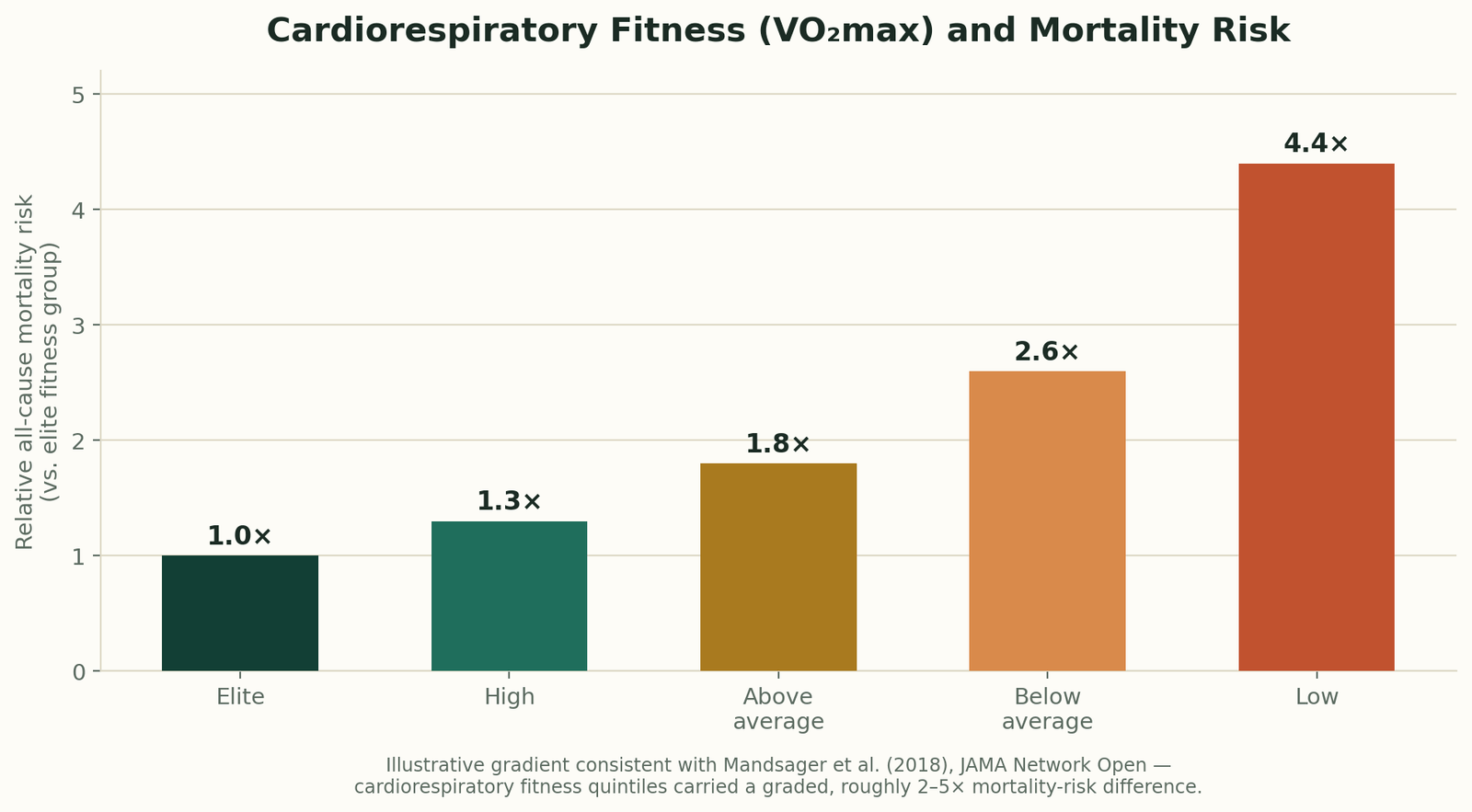
What makes this notable from a longevity-habits standpoint is that fitness, unlike genetics or age, is modifiable at almost any stage of life. We touched on VO2 max as one input among many in our evidence-based guide to longevity habits — this article goes deeper specifically on why this one metric carries so much independent predictive weight.
How VO2 max is actually measured
- Lab-grade test: a graded treadmill or cycle ergometer test with a mask measuring inhaled and exhaled gas concentrations directly — the gold standard, typically done in a sports-science lab or cardiology clinic.
- Field estimates: the Cooper 12-minute run test or the Rockport walk test use distance covered and heart rate to estimate VO2 max without lab equipment.
- Wearable estimates: modern smartwatches estimate VO2 max from heart-rate response during runs; they’re directionally useful for tracking your own trend over time but are consistently less accurate than a lab test for absolute values.
What actually moves the number
VO2 max responds to training, and it responds fastest to a mix of two distinct training zones rather than either alone:
- Zone 2 (aerobic base) training — long, conversational-pace sessions that build mitochondrial density and capillary networks over months. We cover exactly how to dial this in in our Zone 2 cardio guide, which also explains why this same training zone is one of the most effective tools for visceral fat loss.
- High-intensity intervals — short bursts at or near maximal effort force the cardiovascular system to adapt to a higher ceiling, and are generally the fastest way to move VO2 max specifically, as opposed to general aerobic endurance.
Muscle mass matters here too, and not just for strength. Skeletal muscle is the tissue actually consuming the oxygen VO2 max measures — losing muscle through sarcopenia doesn’t just weaken you, it shrinks your ceiling for oxygen utilization. That’s part of why the biology of muscle preservation, including the telomere-protection mechanisms we detailed in our piece on TRF2 and muscle stem cells, is directly relevant to cardiorespiratory fitness and not just a separate “strength” conversation.
Where VO2 max fits alongside other metabolic levers
Cardiorespiratory fitness doesn’t operate in isolation from the rest of your metabolic health. Mitochondrial efficiency — the same machinery that determines your VO2 max ceiling — is also central to metabolic processes like thermogenesis; we explored the exercise-adjacent side of that in how coffee and green tea activate brown fat. Improving fitness and improving metabolic flexibility tend to move together, which is one reason cardiorespiratory training shows up as a common thread across nearly every longevity intervention with strong evidence behind it.
Frequently asked questions
What’s considered a “good” VO2 max?
It’s highly age- and sex-dependent. Rather than chasing an absolute number, most exercise physiologists recommend tracking your own percentile trend over time using a consistent test method.
Can you meaningfully improve VO2 max after age 50?
Yes. Cardiorespiratory fitness remains trainable throughout life; the relative percentage improvement from a structured program is often comparable across age groups, even if absolute values are naturally lower than in younger adults.
Is VO2 max more important than strength training for longevity?
The evidence doesn’t support treating them as competing priorities — grip strength and muscle mass are independently associated with longevity, and muscle tissue itself is what drives oxygen consumption during a VO2 max test. The two are complementary, not substitutes for each other.
This article is for educational purposes and is not medical advice. Consult a physician before beginning a new high-intensity exercise program, particularly if you have known cardiovascular risk factors.