
Walk into any biohacking forum or intermittent fasting community, and you will inevitably find a fierce, dogmatic debate raging over a single, seemingly innocent morning ritual: drinking coffee. The prevailing anxiety is palpable. Fasters are terrified that the bitter compounds, the trace calories, or the mere taste of their morning brew will “break” their fast, spike their insulin, and instantly shut down the sacred cellular cleanup process of autophagy. Consequently, millions of people suffer through their morning hours in a state of caffeinated deprivation, or worse, they load their coffee with grass-fed butter and MCT oil under the false assumption that “fat doesn’t spike insulin, therefore it preserves the fast.”
As a physician focused on longevity and cellular metabolism, I am here to dismantle this dogma with rigorous, peer-reviewed biochemistry. The short answer to whether your morning coffee autophagy protocol is destroying your cellular cleanup is a resounding no—provided you are drinking it black. In fact, the exact opposite is true. When consumed correctly, the polyphenols and alkaloids in black coffee act as potent, targeted pharmacological agents that actively upregulate and accelerate autophagic flux. However, the moment you introduce specific caloric loads, amino acids, or artificial sweeteners, you flip a biochemical switch that instantly assassinates the process.
In this comprehensive, 3,500-word clinical breakdown, we will dissect the exact molecular pathways through which coffee mimics caloric restriction, expose the “Autophagy Assassins” hiding in your coffee bar, analyze the profound differences between light and dark roasts, and outline the precise, circadian-aligned protocol required to turn your morning cup into a powerful longevity intervention.
The Biochemistry of Autophagy: A Brief Primer
To understand how coffee interacts with your cells, we must first establish the biochemical rules of the game. Autophagy (literally “self-eating”) is the process by which your cells encapsulate damaged proteins, senescent organelles, and intracellular pathogens into double-membrane vesicles (autophagosomes) and deliver them to the lysosome for recycling.
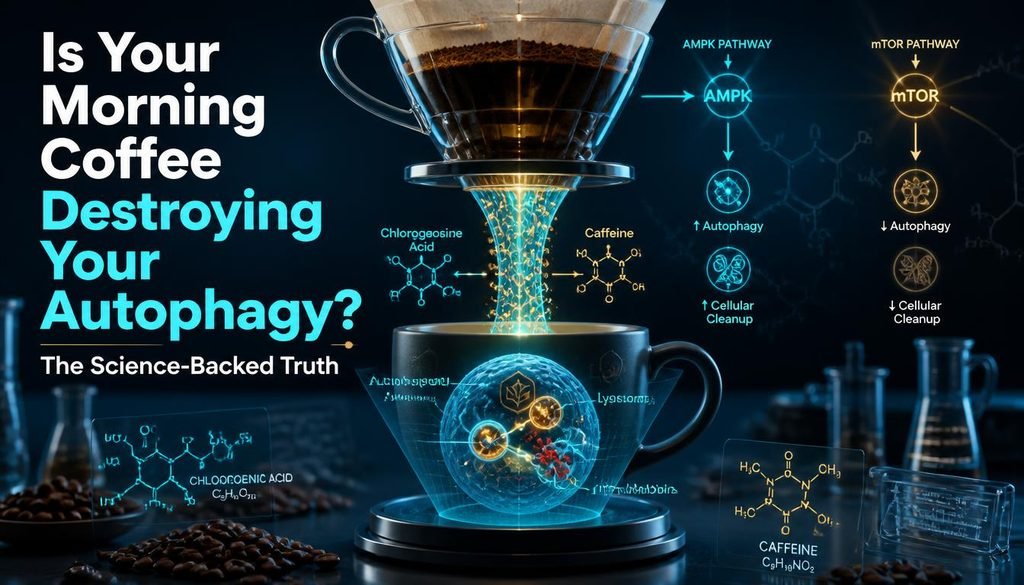
This process is governed by a master biological seesaw controlled by two primary nutrient-sensing pathways:
- mTOR (Mechanistic Target of Rapamycin): The growth and proliferation pathway. It is activated by amino acids (specifically leucine) and insulin. When mTOR is active, autophagy is biochemically forbidden.
- AMPK (AMP-activated Protein Kinase): The cellular energy sensor. It is activated when cellular energy (ATP) drops and AMP rises. AMPK directly inhibits mTOR and phosphorylates ULK1, the kinase that initiates the formation of the autophagosome.
To trigger autophagy, you must suppress mTOR and activate AMPK. The fundamental question of the morning coffee autophagy debate is therefore simple: Does coffee activate AMPK and inhibit mTOR, or does it trigger an insulin/amino acid response that shuts them down?
The Pietrocola Breakthrough: Coffee as a Caloric Restriction Mimetic
The most definitive answer to this question came from the laboratory of Dr. Guido Kroemer, a world-renowned cell biologist and autophagy researcher at the Gustave Roussy Cancer Campus in France. In a landmark 2014 study published in the journal Cell Cycle, Pietrocola et al. investigated the effects of coffee on autophagic flux in living organisms (https://www.tandfonline.com/doi/full/10.1080/15384101.2026.2633023).
The researchers administered standard coffee, decaffeinated coffee, and isolated coffee polyphenols to mice. The results were staggering. Both regular and decaffeinated coffee triggered massive spikes in autophagy across three major organ systems: the liver, the skeletal muscle, and the heart.
The Mechanism of Action
The study revealed that coffee induces autophagy through a mechanism that perfectly mimics caloric restriction, independent of its caffeine content. The primary driver was identified as chlorogenic acid (CGA), the most abundant polyphenol in coffee. CGA was shown to inhibit the mTOR pathway and activate AMPK, effectively tricking the cell into believing it was in a state of deep fasting, even though the mice had access to food.
Furthermore, the study demonstrated that coffee increased the acetylation of cellular proteins, a process regulated by SIRT1 (a longevity-associated sirtuin enzyme). By activating SIRT1 and inhibiting mTOR, the coffee compounds essentially forced the cells to initiate the autophagic cleanup cascade.
This was a paradigm-shifting discovery. It proved that black coffee is not merely “permissible” during a fast; it is a highly active, botanical autophagy inducer. For a deeper understanding of how this cellular cleanup process extends your healthspan, read our foundational guide: Autophagy: The Free Anti-Aging Switch Inside Your Cells.
The Three Pillars of Coffee-Induced Autophagy
Beyond chlorogenic acid, your morning brew contains a complex matrix of over 1,000 distinct biochemical compounds. Three specific classes of compounds are responsible for the morning coffee autophagy synergy.
1. Chlorogenic Acid (CGA) and AMPK Activation
As established, CGA is a potent AMPK activator. When AMPK is phosphorylated, it acts as a metabolic master switch, halting lipid and cholesterol synthesis while simultaneously upregulating fatty acid oxidation and autophagy. CGA also improves endothelial function and reduces systemic oxidative stress, making it a cornerstone of coffee’s cardiovascular benefits.
2. Caffeine and the cAMP/PKA Pathway
While Pietrocola proved that decaf also induces autophagy, caffeine provides a secondary, synergistic pathway. Caffeine acts as an adenosine receptor antagonist, but intracellularly, it inhibits an enzyme called phosphodiesterase (PDE). By inhibiting PDE, caffeine increases intracellular levels of cyclic AMP (cAMP).
Elevated cAMP activates Protein Kinase A (PKA), which in turn triggers the release of calcium from the endoplasmic reticulum. This transient spike in intracellular calcium activates CaMKKβ, an upstream kinase that directly phosphorylates and activates AMPK. Therefore, caffeine provides a secondary “backdoor” activation of the autophagic machinery.
3. Spermidine and Polyamine Synthesis
Recent metabolomic analyses have revealed that coffee is a surprisingly rich dietary source of spermidine, a polyamine that has gained massive traction in the longevity community. Spermidine inhibits EP300 (a histone acetyltransferase), which leads to the deacetylation of autophagy-related proteins (like ATG proteins), physically facilitating the construction of the autophagosome membrane. By combining AMPK activation (via CGA) with EP300 inhibition (via spermidine), coffee hits the autophagic pathway from two distinct, highly synergistic angles.
The “Autophagy Assassins”: What Actually Destroys the Process
If black coffee is a longevity elixir, why do so many biohackers accidentally destroy their fast? The error lies in the additives. The wellness industry has heavily marketed the concept of “fat fasting” or “clean fasting,” claiming that as long as you avoid carbohydrates, autophagy remains intact. This is a profound biochemical misunderstanding.
Here are the four primary “Autophagy Assassins” that will instantly shut down your morning coffee autophagy protocol.
Assassin #1: Collagen Peptides and BCAAs (The mTOR Trigger)
Many fasters add a scoop of collagen powder or Branched-Chain Amino Acids (BCAAs) to their morning coffee, believing it will protect their joints or muscles without breaking the fast. This is a catastrophic error.
Autophagy is exquisitely sensitive to amino acids, particularly leucine. Leucine is sensed by the Rag GTPases on the surface of the lysosome, which directly signal mTORC1 to activate. The moment mTORC1 is activated, it phosphorylates ULK1, instantly dismantling the autophagic machinery. Even a small dose of collagen (which contains glycine and proline) or BCAAs provides enough nitrogen and amino acid signaling to flip the mTOR switch. If your goal is autophagy, your coffee must be entirely devoid of protein.
Assassin #2: “Bulletproof” Coffee (MCT Oil, Butter, and Heavy Cream)
The ketogenic community popularized the idea of blending coffee with grass-fed butter and MCT (Medium-Chain Triglyceride) oil to “break the fast gently” while maintaining ketosis. While it is true that pure fat does not spike insulin, it does destroy autophagy.
Remember the AMPK seesaw: AMPK is activated when cellular energy (ATP) is low and AMP is high. When you consume 200 to 400 calories of pure fat (like MCT oil or butter), those fatty acids are rapidly absorbed and oxidized by your mitochondria, generating a massive surge of ATP. As your intracellular ATP levels rise, your AMP levels drop. The AMP/ATP ratio shifts, and AMPK is immediately deactivated. Without AMPK, mTOR is disinhibited, and autophagy halts. You may remain in nutritional ketosis, but you have completely aborted the cellular cleanup process.
Assassin #3: Milk, Oat Milk, and Creamers (The Insulin Spike)
Even a “small splash” of dairy milk, oat milk, or commercial coffee creamer contains lactose (milk sugar), maltose (oat sugar), and trace proteins. These carbohydrates and proteins trigger a rapid secretion of insulin from the pancreas. Insulin activates the PI3K/Akt pathway, which directly inhibits TSC2, leading to the immediate activation of mTOR and the cessation of autophagy. If you are fasting for cellular cleanup, your coffee must be black.
Assassin #4: Artificial Sweeteners and the Cephalic Phase Response
To avoid sugar, many fasters turn to sucralose, aspartame, or stevia-sweetened diet sodas and zero-calorie syrups in their coffee. While these contain no calories, the sweet taste on the tongue triggers the Cephalic Phase Insulin Release (CPIR).
Your brain tastes the sweetness, anticipates the arrival of glucose, and signals the pancreas to release a small pulse of insulin in preparation. Even this minor, anticipatory insulin spike is enough to blunt the delicate AMPK signaling required for deep autophagy. Furthermore, artificial sweeteners have been shown to negatively alter the gut microbiome, which indirectly impairs systemic metabolic flexibility.
The Roast and Brew Matrix: Optimizing Your Polyphenol Yield
Not all coffee is created equal when it comes to inducing autophagy. The concentration of chlorogenic acid, spermidine, and cafestol varies wildly depending on the bean species, the roasting profile, and the brewing method. If you are using your morning coffee autophagy protocol as a targeted medical intervention, you must optimize your extraction.
Arabica vs. Robusta
While Arabica beans are prized for their smooth, complex flavor profiles, Robusta beans contain nearly double the caffeine and significantly higher concentrations of chlorogenic acid. Robusta is the botanical equivalent of a stronger pharmaceutical dose. If your primary goal is autophagy and metabolic optimization, blending a high-quality Robusta into your morning routine will yield a higher polyphenol payload.
Light Roast vs. Dark Roast
The roasting process is a chemical crucible. As beans are subjected to high heat, the Maillard reaction occurs, altering their molecular structure.
- Light Roast: Retains the highest concentration of chlorogenic acid (CGA). If your goal is pure AMPK activation and antioxidant capacity, a light, blonde roast is biochemically superior.
- Dark Roast: The intense heat degrades much of the CGA, but it creates novel compounds called melanoidins and N-methylpyridinium (NMB). NMB has been shown to reduce gastric acid secretion (making dark roast easier on the stomach) and possesses distinct neuroprotective and anti-inflammatory properties.
- The Clinical Verdict: For maximum autophagic flux, a light-to-medium roast provides the highest raw dose of the primary AMPK activators.
Paper Filter vs. French Press (The Diterpene Debate)
Coffee beans contain lipid compounds called diterpenes, specifically cafestol and kahweol. These compounds are potent inducers of the Nrf2 pathway (the master regulator of your endogenous antioxidant defense system).
- French Press / Espresso / Boiled Coffee: The metal mesh or lack of a filter allows the diterpenes to pass into your cup. This maximizes Nrf2 activation but can mildly raise LDL cholesterol in susceptible individuals (specifically those with the APOE4 genetic variant).
- Paper Filter (Pour-Over / Drip): The paper filter traps the lipophilic diterpenes. You get the water-soluble chlorogenic acid and caffeine, but you lose the Nrf2-activating cafestol.
- The Clinical Verdict: If you have excellent lipid panels and want maximum cellular defense, opt for a French Press or Espresso. If you are managing hypercholesterolemia, stick to a paper-filtered pour-over to reap the CGA benefits without the lipid load.
The Cortisol Caveat: When Coffee Harms Your Fast
While the polyphenols in black coffee are profound autophagy inducers, the caffeine introduces a secondary variable that can sabotage your fast if mismanaged: Cortisol.
Fasting is inherently a hormetic stressor. As liver glycogen depletes, your adrenal glands release cortisol and adrenaline to stimulate gluconeogenesis (the creation of new glucose) and mobilize free fatty acids. This is a normal, healthy survival mechanism. However, caffeine is a potent central nervous system stimulant that independently triggers the release of cortisol and adrenaline.
The HPA-Axis Overload
If you are chronically sleep-deprived, psychologically stressed, or engaging in high-intensity interval training (HIIT) while fasted, adding high doses of caffeine on top of a fasting state can push your Hypothalamic-Pituitary-Adrenal (HPA) axis into overdrive.
When cortisol remains chronically elevated, it drives the breakdown of skeletal muscle (to provide amino acids for gluconeogenesis) and promotes the storage of visceral fat. Visceral fat is an active endocrine organ that pumps out inflammatory cytokines, which directly inhibit autophagy and drive systemic insulin resistance. If your fasting protocol is leaving you jittery, anxious, or holding onto stubborn belly fat, your coffee habit may be the culprit. To understand how stress hormones lock away fat and ruin your metabolic flexibility, read The Cortisol Belly Trap: How Stress Hormones Lock Away Fat.
The Adenosine Clearance Rule
Furthermore, drinking coffee immediately upon waking is a fundamental neurochemical error. Throughout the night, your brain clears adenosine (the sleep-pressure molecule). If you wake up and immediately consume caffeine, you block the adenosine receptors before the residual adenosine has been fully cleared. When the caffeine wears off in the early afternoon, the un-cleared adenosine floods the receptors, causing the dreaded 2:00 PM crash. For the complete biochemistry of caffeine timing, read 5 Beginner Biohacks That Deliver Instant Energy Upgrades.
The Ultimate Fasted Coffee Protocol
To harness the full morning coffee autophagy benefits while avoiding the cortisol and adenosine traps, implement this clinical, step-by-step protocol.
Step 1: Hydrate and Mineralize First
During the night, your body loses water and electrolytes through respiration and sweat. Fasting lowers insulin, which signals the kidneys to excrete sodium. Before a single drop of coffee touches your lips, consume 16 to 20 ounces of water with a high-quality mineral electrolyte blend (containing sodium, potassium, and magnesium). This restores blood volume, supports adrenal function, and prevents the “fasting headache.”
Step 2: The 90-Minute Delay
Do not drink coffee immediately upon waking. Wait a minimum of 90 to 120 minutes. This allows your natural Cortisol Awakening Response (CAR) to peak and decline, and gives your brain’s glymphatic system time to finish clearing residual adenosine. Use this time to get 10 minutes of direct morning sunlight in your eyes to anchor your circadian rhythm.
Step 3: Brew for Polyphenols
Grind your beans fresh (oxidation destroys chlorogenic acid rapidly). Opt for a light-to-medium roast to maximize CGA content. If your lipid panels are healthy, use a French Press or an espresso machine to retain the Nrf2-activating diterpenes. If you require a paper filter, ensure it is unbleached to avoid chemical leaching.
Step 4: Keep It Black (Or Use the “Autophagy-Safe” Enhancers)
Your coffee must be black. However, if you despise the bitterness, you can safely add compounds that do not trigger mTOR or insulin:
- Ceylon Cinnamon: A potent insulin sensitizer that does not break the fast.
- Raw Cacao Powder (Unsweetened): Rich in flavanols that synergize with coffee polyphenols to boost endothelial nitric oxide.
- A Pinch of Sea Salt: Enhances flavor and supports the adrenal glands without triggering an insulin response.
Step 5: Time Your First Meal
To maximize the autophagic window, consume your black coffee during the final 2 to 4 hours of your fasting window (e.g., hours 14 through 16 of a 16:8 protocol). The AMPK activation from the coffee will synergize perfectly with the low-insulin state of the late fast, driving deep cellular cleanup right up until you break your fast with a high-protein, nutrient-dense meal. Use our Intermittent Fasting Calculator to design a circadian-aligned eating window.
💡 Action Step: Autophagy is highly effective at clearing the inflammatory debris associated with visceral adiposity. However, you cannot optimize what you do not measure. Standard BMI charts are entirely blind to dangerous central adiposity. To accurately assess your true body composition and metabolic risk, you must utilize our Advanced BMI Calculator, which accounts for age, gender, and waist-to-height ratios. Pair this with our Body Fat Calculator and our TDEE Calculator to ensure your feeding window provides enough raw materials to rebuild the tissues your autophagic processes have just cleared.
Troubleshooting and Contraindications
While the morning coffee autophagy protocol is highly beneficial for the majority of the population, it is not universally applicable. Certain genetic and physiological profiles require modification.
1. The CYP1A2 Polymorphism (Slow Metabolizers)
The CYP1A2 gene dictates the liver enzyme responsible for metabolizing caffeine. Roughly 50% of the population possesses a variant of this gene that makes them “slow metabolizers.” In these individuals, caffeine lingers in the bloodstream for up to 10 hours, severely disrupting sleep architecture and chronically elevating cortisol. If you drink coffee at 10:00 AM and still feel “wired” at 10:00 PM, you are likely a slow metabolizer. The Fix: Switch to high-quality Swiss Water Process decaf. You will still reap the autophagic benefits of the chlorogenic acid and spermidine without the prolonged cortisol spike.
2. Gastroesophageal Reflux Disease (GERD) and Gastritis
Coffee stimulates the secretion of gastrin and hydrochloric acid. In a fasted state, with no food buffer in the stomach, this highly acidic environment can irritate a compromised gastric mucosa, leading to reflux or gastritis. The Fix: Switch to a dark roast (which contains N-methylpyridinium, a compound that reduces gastric acid secretion) or consume your coffee alongside your first meal rather than in a deeply fasted state.
3. HPA-Axis Dysregulation (Adrenal Fatigue)
If you are experiencing the clinical signs of HPA-axis dysregulation (waking at 3 AM, severe afternoon crashes, cold extremities, and stubborn visceral fat), fasting combined with high caffeine intake is a biological error. You are adding a stimulant stressor on top of a caloric stressor. The Fix: Pause the fasting protocol. Eat a high-protein, nutrient-dense breakfast within 60 minutes of waking to signal safety to the hypothalamus, and limit coffee to a single cup after food.
Summary Table: Coffee Additives and Their Impact on Autophagy
To ensure you never accidentally sabotage your cellular cleanup, refer to this clinical matrix before you brew:
| Additive | Caloric Load | Insulin / mTOR Response | Impact on Autophagy | Clinical Verdict |
|---|---|---|---|---|
| Nothing (Black Coffee) | ~2 kcal | None (Activates AMPK) | Highly Enhanced | The Gold Standard. |
| MCT Oil / Butter | High (Fat) | None, but raises ATP/lowers AMP | Destroyed | Avoid. Halts AMPK activation. |
| Collagen / BCAAs | Moderate (Protein) | Massive (Leucine triggers mTOR) | Instantly Destroyed | Avoid. The ultimate fast-breaker. |
| Heavy Cream / Milk | Moderate (Fat/Carb) | High (Lactose/Protein spikes insulin) | Destroyed | Avoid. Triggers PI3K/Akt pathway. |
| Oat / Almond Milk | Low to Moderate | Moderate (Maltose/Sugars) | Destroyed | Avoid. Spikes blood glucose. |
| Stevia / Monk Fruit | Zero | Mild (Cephalic phase response) | Blunted / Risky | Avoid if possible. |
| Sucralose / Aspartame | Zero | Moderate (Cephalic + Microbiome) | Destroyed | Strictly Avoid. |
| Ceylon Cinnamon | Zero | None (Improves insulin sensitivity) | Preserved / Enhanced | Excellent Addition. |
| Raw Cacao (Unsweetened) | ~5 kcal | None (Activates Nrf2/AMPK) | Preserved / Enhanced | Excellent Addition. |
Final Thoughts
The fear that your morning coffee is destroying your fast is a relic of outdated, overly simplistic nutritional dogma. When we view fasting through the lens of advanced cellular biochemistry, it becomes clear that black coffee is not a violation of the fast; it is a powerful, botanical catalyst for it. The chlorogenic acid, the spermidine, and the cafestol work in perfect synergy to inhibit mTOR, activate AMPK, and drive the autophagic flux that keeps your tissues young, resilient, and free of toxic debris.
However, this biological privilege demands strict adherence to the rules. The moment you introduce the “Autophagy Assassins”—the collagen, the MCT oil, the milk, and the artificial sweeteners—you flip the metabolic switch from cellular cleanup back to growth and storage. Respect the biochemistry. Delay your first cup to protect your adenosine receptors, brew for maximum polyphenol extraction, keep it black, and let the ancient molecules of the coffee bean do the heavy lifting of extending your healthspan.
Frequently Asked Questions (FAQ)
1. Does black coffee break a fast or stop autophagy?
No. Black coffee does not break a fast or stop autophagy. In fact, clinical studies show that the polyphenols in black coffee, particularly chlorogenic acid, actively upregulate autophagy by inhibiting the mTOR pathway and activating AMPK, effectively mimicking the cellular benefits of caloric restriction.
2. Does adding MCT oil or butter to coffee break a fast?
Yes, it breaks the autophagic fast. While pure fat does not spike insulin, consuming 200+ calories of MCT oil or butter provides a massive influx of cellular energy (ATP). This raises the ATP/AMP ratio, which deactivates AMPK and subsequently shuts down the autophagy process, even if you remain in nutritional ketosis.
3. Can I put collagen peptides in my coffee while fasting?
No. Collagen is a protein. Autophagy is exquisitely sensitive to amino acids, which directly activate the mTOR pathway. Adding collagen, BCAAs, or any protein to your coffee will instantly trigger mTOR and halt the cellular cleanup process of autophagy.
4. Is light roast or dark roast better for autophagy?
Light roast is generally better for autophagy because the roasting process degrades chlorogenic acid (CGA), the primary polyphenol responsible for activating AMPK. Light roasts retain higher levels of CGA. However, dark roasts contain unique compounds like N-methylpyridinium that are gentler on the stomach and offer distinct neuroprotective benefits.
5. Does decaf coffee also induce autophagy?
Yes. Landmark research published in the journal Cell Cycle demonstrated that both regular and decaffeinated coffee induce massive spikes in autophagy in the liver, muscle, and heart. The primary driver is the polyphenol chlorogenic acid, not the caffeine, making decaf an excellent option for those sensitive to stimulants.
⚕️ Medical Disclaimer
The content provided on RegenStep.com, including this comprehensive guide authored by Dr. Julian Vance, is strictly for educational and informational purposes only. It is not intended to be a substitute for professional medical advice, diagnosis, or treatment.
Caffeine is a potent central nervous system stimulant that can exacerbate anxiety, disrupt sleep architecture, and elevate blood pressure in susceptible individuals. Those with a history of gastroesophageal reflux disease (GERD), cardiac arrhythmias, or HPA-axis dysregulation should exercise caution. Fasting protocols combined with caffeine intake may cause hypoglycemia in individuals taking glucose-lowering medications. Always consult with your physician or a qualified healthcare provider before making significant changes to your dietary, fasting, or caffeine consumption habits.

Julian Vance is the writer and editor behind RegenStep, translating peer-reviewed longevity, metabolic, and gut-health research into practical, actionable guides. Julian is not a licensed physician; content is reviewed against cited primary sources and is for informational purposes only. Always consult a qualified healthcare provider for personal medical advice.