
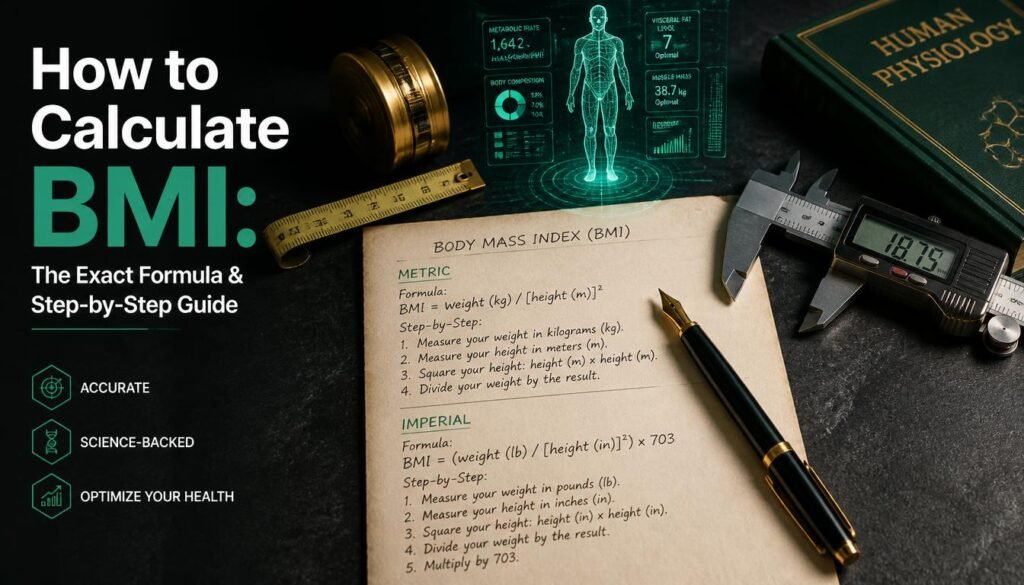
If you have ever visited a doctor’s office or stepped into a gym, you have likely encountered the Body Mass Index (BMI). It is the most widely used screening tool in global medicine to categorize weight status. But despite its ubiquity, a surprising number of people do not actually know how to calculate BMI on their own, relying instead on automated apps or clinic scales.
To answer the question directly for those looking for a quick featured snippet: To calculate BMI, you divide your body weight in kilograms by your height in meters squared (kg/m²). If you are using the imperial system (pounds and inches), you divide your weight in pounds by your height in inches squared, and then multiply that result by 703.
While knowing how to calculate BMI is a foundational health literacy skill, as a clinician focused on longevity and metabolic optimization, I must also give you a critical warning: the number you get at the end of this equation is merely a starting point. It is a blunt mathematical instrument that completely ignores muscle mass, bone density, and fat distribution. In this comprehensive guide, I will walk you through the exact manual calculations, explain the history behind the formula, and show you how to interpret your results through the lens of modern metabolic science.
The BMI Formula: How to Calculate BMI Manually
The Body Mass Index is calculated using one of two standard formulas, depending on whether you use the metric system (kilograms and meters) or the imperial system (pounds and inches). Both formulas yield the exact same final index number.
Method 1: The Metric Formula (Kilograms and Meters)
The metric formula is the original and most straightforward version of the equation used by the World Health Organization (WHO).
The Formula:
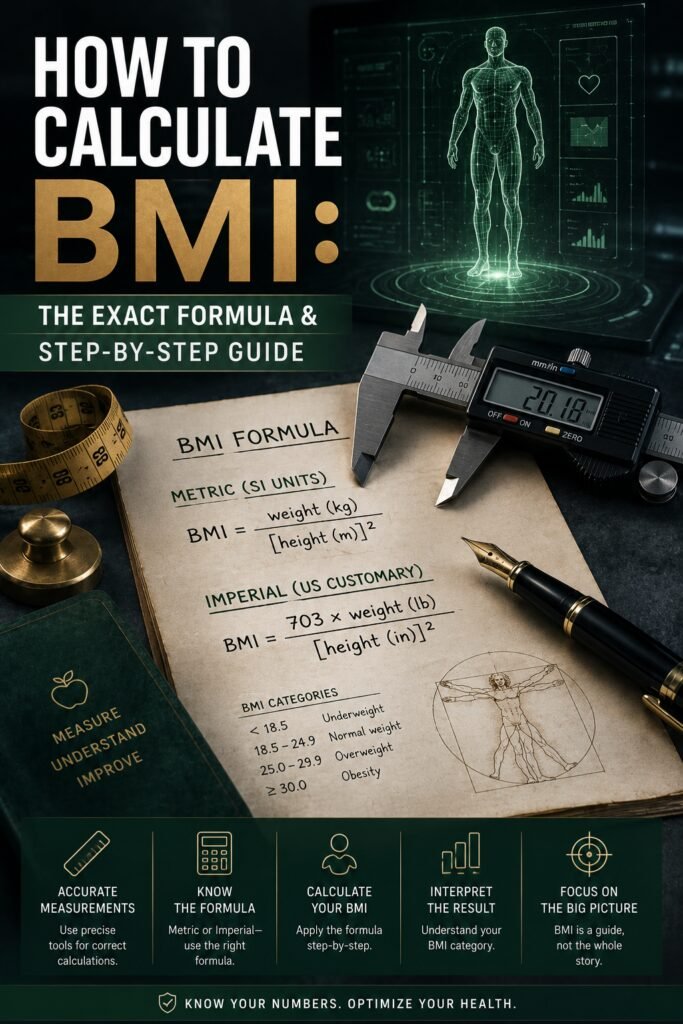
BMI = Weight (kg) / [Height (m)]²
Step-by-Step Instructions:
- Measure your weight in kilograms (kg).
- Measure your height in meters (m). (Note: If you know your height in centimeters, simply divide by 100 to get meters. For example, 175 cm = 1.75 m).
- Square your height (multiply your height in meters by itself).
- Divide your weight by the squared height number.
Example Calculation: Let’s take a man who weighs 80 kg and is 1.80 meters tall.
- Step 1: Weight = 80 kg
- Step 2: Height = 1.80 m
- Step 3: Square the height = 1.80 × 1.80 = 3.24
- Step 4: Divide weight by squared height = 80 / 3.24 = 24.69
- Result: His BMI is 24.7.
Method 2: The Imperial Formula (Pounds and Inches)
If you live in the United States, you likely track your weight in pounds and your height in feet and inches. To use the imperial system, you must use a conversion factor (703) to make the math align with the metric standard. Knowing how to calculate BMI in imperial units requires one extra step.
The Formula:
BMI = (Weight (lbs) / [Height (in)]²) × 703
Step-by-Step Instructions:
- Measure your weight in pounds (lbs).
- Measure your height in total inches. (Note: If you are 5 feet 9 inches tall, multiply 5 × 12 = 60, then add 9. Your total height is 69 inches).
- Square your height (multiply your total inches by itself).
- Divide your weight by the squared height number.
- Multiply that result by 703.
Example Calculation: Let’s take a woman who weighs 145 lbs and is 5 feet 5 inches tall (65 inches).
- Step 1: Weight = 145 lbs
- Step 2: Height = 65 inches
- Step 3: Square the height = 65 × 65 = 4,225
- Step 4: Divide weight by squared height = 145 / 4,225 = 0.0343
- Step 5: Multiply by 703 = 0.0343 × 703 = 24.11
- Result: Her BMI is 24.1.
💡 Action Step: Manual calculations are excellent for understanding the mechanics of your body metrics, but for daily tracking and dietary planning, you need actionable data. Once you have your baseline, use our TDEE Calculator to find out exactly how many calories your body burns daily, and our Protein Intake Calculator to ensure you are eating enough to preserve lean muscle mass.
The Standard BMI Categories
Once you know how to calculate BMI and have arrived at your final number, the next step is to categorize it. The World Health Organization (WHO) and the Centers for Disease Control and Prevention (CDC) use the following standard classifications for adults over the age of 20:
| BMI Range | Weight Status | Clinical Implication |
|---|---|---|
| Below 18.5 | Underweight | Increased risk of nutrient deficiencies, osteoporosis, and immune dysfunction. |
| 18.5 – 24.9 | Normal Weight | Statistically lowest risk for weight-related chronic diseases in the general population. |
| 25.0 – 29.9 | Overweight | Increased risk for metabolic syndrome, hypertension, and insulin resistance. |
| 30.0 – 34.9 | Obesity (Class I) | High risk for type 2 diabetes, cardiovascular disease, and sleep apnea. |
| 35.0 – 39.9 | Obesity (Class II) | Severe risk for systemic inflammation and joint degradation. |
| 40.0 and Above | Obesity (Class III) | Extreme risk for premature mortality and severe metabolic dysregulation. |
While these categories are highly effective for tracking population-level health trends, applying them rigidly to an individual without context is where the medical community frequently makes mistakes.
The History of the Formula: Why It Was Never Meant for You
To truly understand the limitations of this tool, you must understand its origins. When you learn how to calculate BMI, you are actually learning the “Quetelet Index.” It was invented in the 1830s by Lambert Adolphe Jacques Quetelet, a Belgian mathematician, astronomer, and sociologist.
Quetelet was not a physician. He was obsessed with statistics and the concept of “l’homme moyen” (the average man). He developed this formula to study the physical characteristics of the average population, not to assess the health, body fat percentage, or metabolic viability of an individual.
For over a century, the medical community ignored it. It wasn’t until the 1970s and 1980s, when life insurance companies needed a quick, cheap way to correlate weight with mortality risk, that the Quetelet Index was rebranded as the “Body Mass Index” and adopted as a universal medical standard. Knowing how to calculate BMI is useful, but understanding that it was designed for 19th-century population averages—not 21st-century biohackers—is critical for your mental health and fitness strategy.
The 3 Massive Blind Spots of the BMI Formula
As a longevity specialist, I do not ignore BMI entirely; it is a useful red flag. If someone has a BMI of 38, they almost certainly carry excess adipose tissue that will drive systemic inflammation. However, in the “normal” and “overweight” categories, the formula breaks down completely. Here is why:
1. The Athlete’s Paradox (Muscle vs. Fat)
Muscle tissue is roughly 18% denser than adipose (fat) tissue. If you engage in heavy resistance training, you will accumulate dense, metabolically active muscle mass. Because the formula only measures total mass against gravity, it cannot distinguish between a pound of muscle and a pound of fat.
Many elite athletes, bodybuilders, and heavy lifters calculate their BMI and fall into the “Overweight” or “Obese” categories, despite having single-digit body fat percentages and pristine cardiovascular health. If you lift weights, knowing how to calculate BMI will likely just give you a number that triggers unnecessary anxiety.
2. Normal Weight Obesity (“Skinny Fat”)
This is the most dangerous blind spot. You can easily fall into the “Normal” BMI category (18.5 – 24.9) while carrying a dangerously high amount of visceral fat—the hard, inflammatory fat that wraps around your liver and pancreas. This phenotype, known as “normal weight obesity,” carries the exact same metabolic risks (heart disease, fatty liver, insulin resistance) as clinical obesity, but because the BMI formula says you are “healthy,” doctors often miss the warning signs until a cardiac event occurs. Read our deep dive into Visceral Fat vs Subcutaneous Fat: Which One Is Actually Killing You? to understand this hidden epidemic.
3. Sarcopenic Aging
As we age, particularly past 50, we naturally lose skeletal muscle mass (sarcopenia) and gain fat. An older adult might maintain the exact same body weight (and therefore the exact same BMI) from age 30 to age 70. However, their body composition has radically shifted from muscle to fat. The BMI formula remains completely blind to this dangerous loss of functional tissue, which is a primary predictor of frailty and falls in longevity medicine.
Beyond the Math: 3 Better Ways to Measure Metabolic Health
Once you know how to calculate BMI, I want you to use it once, write it down, and then immediately pivot to metrics that actually reflect your biological age and metabolic reality.
1. Waist-to-Height Ratio (WHtR)
This is vastly superior to BMI for predicting cardiovascular mortality.
- How to do it: Measure your waist circumference at the level of your navel. Divide that number by your total height.
- The Goal: Keep your waist circumference to less than half of your height (a ratio of < 0.5). This directly measures dangerous central adiposity, regardless of how heavy your bones or muscles are.
2. Body Fat Percentage
Instead of asking “how heavy am I?”, you should be asking “what percentage of my mass is adipose tissue?” You can estimate this using skinfold calipers, DEXA scans, or bioelectrical impedance scales.
- Optimal Ranges for Longevity: Generally, 10-20% for men and 20-30% for women.
- Action Step: Use our advanced Body Fat Calculator to get a highly accurate baseline estimate using the U.S. Navy circumference method.
3. Fasting Insulin and Triglycerides
Your bloodwork tells the truth that the scale hides. A “normal” BMI means nothing if your fasting insulin is 15 μIU/mL (indicating severe insulin resistance) and your triglycerides are 250 mg/dL. Optimal fasting insulin is between 2-5 μIU/mL. If your metabolic blood markers are poor, your BMI category is irrelevant. For more on the blood tests you need, read Silent Inflammation Markers: The Blood Tests Your Doctor Isn’t Ordering.
How BMI Shifts with Age and Sex
It is also important to note that the “ideal” BMI shifts as you age. While the WHO standard categories apply to all adults, longevity researchers have noted a phenomenon called the “obesity paradox” in older populations.
Studies consistently show that for adults over the age of 65, a slightly higher BMI (between 25.0 and 27.0) is actually associated with lower all-cause mortality than a “normal” BMI of 22.0. Why? Because older adults with a slightly higher BMI have more metabolic reserves to survive acute illnesses (like pneumonia or surgery) and are less likely to suffer from fatal sarcopenia and bone fractures.
Furthermore, sex hormones dictate fat storage. Women naturally require higher essential fat stores for hormonal regulation. If a woman uses the standard formula and attempts to force her BMI down to 18.5 through extreme caloric restriction, she risks triggering hypothalamic amenorrhea, crashing her thyroid, and accelerating bone loss. For women struggling with stress-induced weight retention, understanding Cortisol Belly Fat: Why Stress Hormones Stop You From Losing Weight is far more valuable than the BMI formula.
Final Thoughts: Use the Tool, Don’t Let It Use You
Learning how to calculate BMI is a basic requirement of health literacy, but it should not be the cornerstone of your health strategy. The formula is a relic of 19th-century statistics that fails to account for the complexities of human tissue, hormonal health, and metabolic flexibility.
Calculate your number to establish a baseline. If you are severely outside the normal ranges, it is a signal to investigate your dietary and lifestyle habits. But once you have that number, put the calculator away. Pick up a tape measure to check your waist-to-height ratio, pick up heavy weights to build metabolic armor, and focus on the daily longevity habits that actually dictate your healthspan. Your biology is far too complex to be summarized by a simple division problem.
The Full BMI Series
One formula, many different realities. These guides break the number down by sex, by age, by body type, and against the metrics that measure you more honestly.
Reading the Number by Age and Sex
- BMI Chart for Women by Age
- BMI Chart for Men by Age
- Is BMI Accurate at Every Age?
- Why the BMI Calculator Fails Female Biology
- Why the BMI Calculator Fails Male Biology
Where the Formula Breaks Down
What the Number Cannot Tell You
- Visceral vs Subcutaneous Fat
- 7 Warning Signs of Insulin Resistance
- The Complete Insulin Resistance Diet Guide
Frequently Asked Questions (FAQ)
1. What is the exact formula for how to calculate BMI?
The standard metric formula for BMI is weight in kilograms divided by height in meters squared (kg/m²). For the imperial system, the formula is (weight in pounds divided by height in inches squared) multiplied by 703.
2. How do I calculate BMI if I only know my weight in pounds and height in feet?
First, convert your height entirely into inches (multiply your feet by 12 and add the remaining inches). Then, square that total inch number. Divide your weight in pounds by that squared number, and finally, multiply the result by 703 to get your BMI.
3. Is the BMI formula accurate for athletes and bodybuilders?
No. The BMI formula is highly inaccurate for athletes and bodybuilders because it cannot distinguish between dense muscle mass and fat mass. Muscular individuals frequently register as “overweight” or “obese” on the BMI scale despite having very low body fat percentages and excellent metabolic health.
4. What is a healthy BMI for a 50-year-old man or woman?
While the WHO defines a “normal” BMI as 18.5 to 24.9 for all adults, longevity research suggests that for adults over 50, a slightly higher BMI (between 25.0 and 27.0) may be protective. Extra weight in older age provides metabolic reserves against acute illness and protects against dangerous muscle loss (sarcopenia).
5. How to calculate BMI for children and teens?
The math formula to calculate BMI is the same for children as it is for adults. However, the resulting number is not interpreted using standard adult categories. Instead, it is plotted on a CDC growth chart against children of the same age and sex to determine a BMI percentile, which accounts for normal growth and developmental changes.
⚕️ Medical Disclaimer
The content provided on RegenStep.com, including this mathematical guide authored by Dr. Julian Vance, is strictly for educational and informational purposes only. It is not intended to be a substitute for professional medical advice, diagnosis, or treatment.
The Body Mass Index (BMI) is a generalized population screening tool and does not diagnose body fatness, metabolic health, or the presence of disease. Always consult with your physician or a qualified healthcare provider to interpret your health metrics in the context of your individual medical history, bloodwork, and physical examinations.
How do I calculate BMI if I only know my weight in pounds and height in feet?
First, convert your height entirely into inches (multiply your feet by 12 and add the remaining inches). Then, square that total inch number. Divide your weight in pounds by that squared number, and finally, multiply the result by 703 to get your BMI.
Is the BMI formula accurate for athletes and bodybuilders?
No. The BMI formula is highly inaccurate for athletes and bodybuilders because it cannot distinguish between dense muscle mass and fat mass. Muscular individuals frequently register as “overweight” or “obese” on the BMI scale despite having very low body fat percentages and excellent metabolic health.
What is a healthy BMI for a 50-year-old man or woman?
While the WHO defines a “normal” BMI as 18.5 to 24.9 for all adults, longevity research suggests that for adults over 50, a slightly higher BMI (between 25.0 and 27.0) may be protective. Extra weight in older age provides metabolic reserves against acute illness and protects against dangerous muscle loss (sarcopenia).
How to calculate BMI for children and teens?
The math formula to calculate BMI is the same for children as it is for adults. However, the resulting number is not interpreted using standard adult categories. Instead, it is plotted on a CDC growth chart against children of the same age and sex to determine a BMI percentile, which accounts for normal growth and developmental changes.

Julian Vance is the writer and editor behind RegenStep, translating peer-reviewed longevity, metabolic, and gut-health research into practical, actionable guides. Julian is not a licensed physician; content is reviewed against cited primary sources and is for informational purposes only. Always consult a qualified healthcare provider for personal medical advice.